
Streaming and retail platforms personalize what each user sees next by ranking items they are likely to value. What is the main purpose of a recommender system?
Select an answer to reveal the explanation.
Short Explanation and Infographic
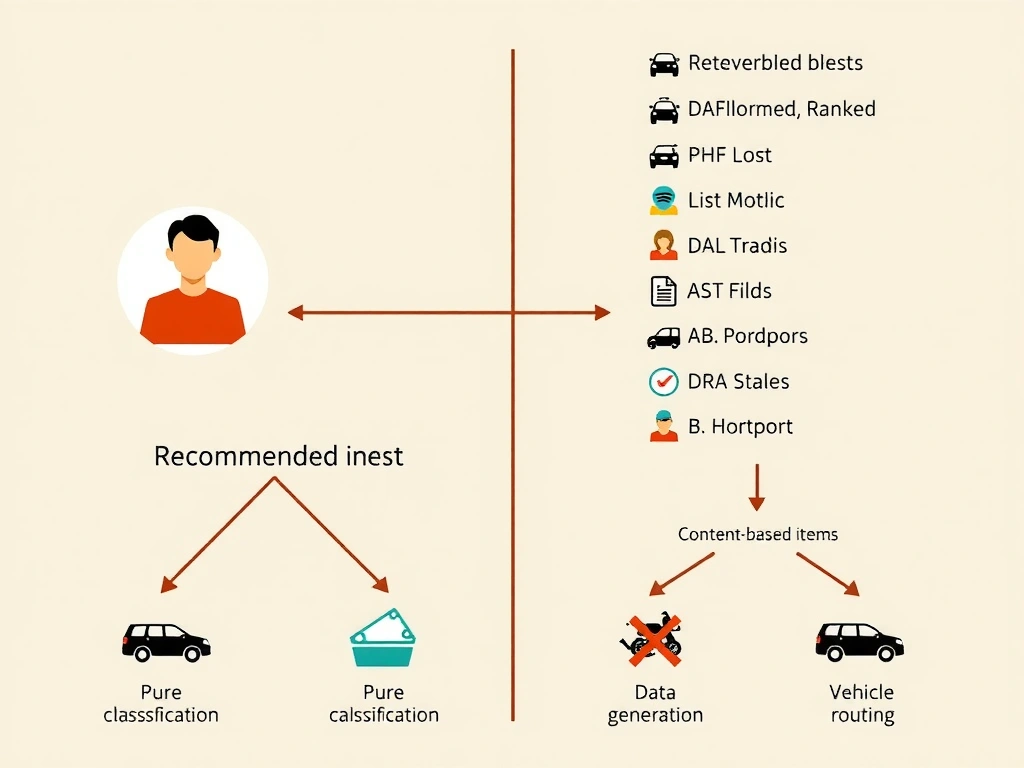
Check this out. You finish a show, and the app lines up three more you'll probably love—that's a recommender system doing its job. Main purpose: suggest items—movies, products, articles—matched to your preferences (and sometimes context like time or device). Think of a sharp store clerk who knows what you bought last time, not a filing clerk stamping category labels on boxes, not a GAN inventing fake rows, and definitely not a GPS plotting highways for cars. Exam trap: classification sounds “smart with documents,” generation sounds “AI-ish,” pathfinding sounds mathy—none are the recommender's mission. When the question is personalization and suggestions, pick recommenders. Land it: user + catalog → ranked suggestions.
Full explanation below image
Full Explanation
Recommender systems help users discover relevant items from large catalogs by predicting preferences or ranking candidates. Classic families include collaborative filtering (user–item interaction patterns), content-based methods (item and user attributes), and hybrid models that combine both, increasingly with deep learning, sequential models, and multi-objective ranking (accuracy, diversity, fairness, freshness).
The primary purpose is personalization: map a user (and context) to a shortlist of products, songs, videos, news, or similar items they are likely to engage with. Success metrics range from offline ranking measures (NDCG, MAP, recall@k) to online business KPIs (CTR, conversion, watch time) often validated via A/B tests. Practical systems also handle cold start, popularity bias, feedback loops, and real-time serving constraints.
Distractors name different AI goals. Document classification assigns labels from a taxonomy without centering individualized suggestions. Generative modeling may create new samples, but that is not what defines recommenders, which usually score items already in inventory. Autonomous vehicle pathfinding optimizes trajectories under dynamics and maps—an unrelated control problem. Underlying principle: recommendation ranks a catalog for a person and context, not a universal taxonomy label. Best practice balances relevance with diversity and fairness, monitors feedback loops that over-promote popular items, and validates online as well as offline. Memory aid: recommender means what should this user see next; classifier means what class is this item; generator means create new data; planner means how do I get from A to B. Exam stems about suggesting content or products based on preferences point to recommender systems. In practice, document the decision criteria you used so teammates can reproduce the evaluation. Prefer metrics and checks that match the business risk, not vanity scores. When reviewing distractors on an exam item, name the misconception each option encodes: wrong learning paradigm, wrong evaluation stage, or a metric that optimizes the wrong objective. A reliable memory aid is to restate the concept in one sentence, then ask which option alone matches that definition without adding unrelated goals. Finally, connect the idea to a production workflow step—data prep, training, validation, or monitoring—so the correct answer stays grounded in how systems are actually built and governed.