
An information-extraction system must tag mentions such as people, companies, and geographic locations inside free-form text. Which NLP task performs that identification and classification?
Select an answer to reveal the explanation.
Short Explanation and Infographic
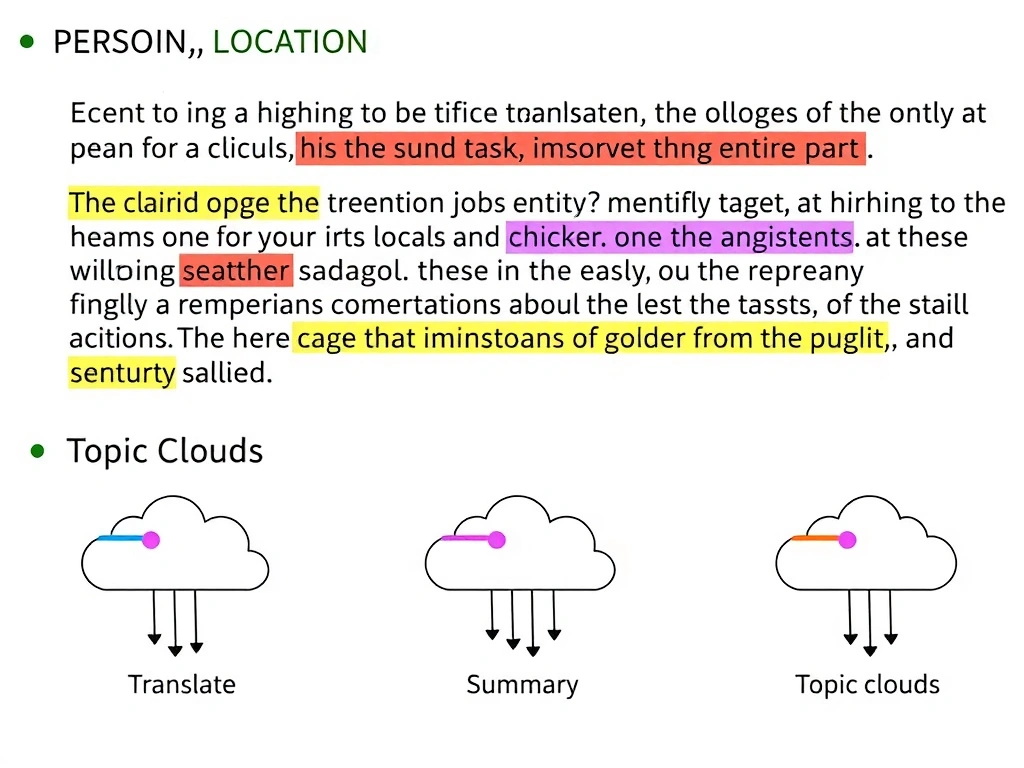
Here's where it gets interesting for you. You've got news text: “Ada joined Acme in Austin.” NER draws boxes around Ada (person), Acme (org), Austin (location). That's the job—find the spans, slap on the right type. Think of it like a highlighter pack for proper nouns and similar entities, not a translator, not a cliff-notes writer, not a “what themes float around the corpus” tool. Exam trap: picking summarization or topics because they also “understand documents.” Different verbs. Translation is another rabbit hole. If the stem says identify and classify people, places, organizations in text, you're looking at NER. Stick with me—entity spans + labels = NER. Got it? Sweet.
Full explanation below image
Full Explanation
Named entity recognition (NER) is a sequence labeling / span classification task in NLP. Given raw text, a NER system detects contiguous mentions of entities and assigns each mention a type from a schema—commonly person, organization, location, dates, monetary amounts, and domain-specific types (genes, product SKUs, legal parties). Approaches range from rule-based gazetteers to CRF sequence models to contextual encoder architectures (BiLSTM-CRF, transformers with token or span classification heads).
NER underpins search, knowledge-base population, compliance redaction, customer support routing, and retrieval-augmented generation when entities must be grounded. Quality depends on annotation guidelines, nested or discontinuous entities, domain shift, and ambiguous surface forms. Evaluation typically uses precision, recall, and F1 on exact or relaxed span matches.
The distractors are major NLP tasks with different outputs. Machine translation maps text to another language without requiring entity type labels as its primary product. Summarization produces shorter text capturing main content, not typed entity inventories. Topic modeling infers document-level theme distributions, not token-level entity tags. Underlying principle: NER is span detection plus type labeling on free text, not document-level themes or full-document rewrite. Best practice invests in clear annotation guidelines, measures span-level F1, and re-trains or adapts when domain vocabulary shifts. Memory aid: NER answers which spans are entities and what kind; translation answers how do I say this in language Y; summarization answers what is the short version; topics answer what is this document about thematically. Choose NER whenever identification and classification of named entities is the stated goal. In practice, document the decision criteria you used so teammates can reproduce the evaluation. Prefer metrics and checks that match the business risk, not vanity scores. When reviewing distractors on an exam item, name the misconception each option encodes: wrong learning paradigm, wrong evaluation stage, or a metric that optimizes the wrong objective. A reliable memory aid is to restate the concept in one sentence, then ask which option alone matches that definition without adding unrelated goals. Finally, connect the idea to a production workflow step—data prep, training, validation, or monitoring—so the correct answer stays grounded in how systems are actually built and governed.