
Organizations increasingly require AI systems that people can trust in high-impact settings. What does “ethical AI” primarily refer to?
Select an answer to reveal the explanation.
Short Explanation and Infographic
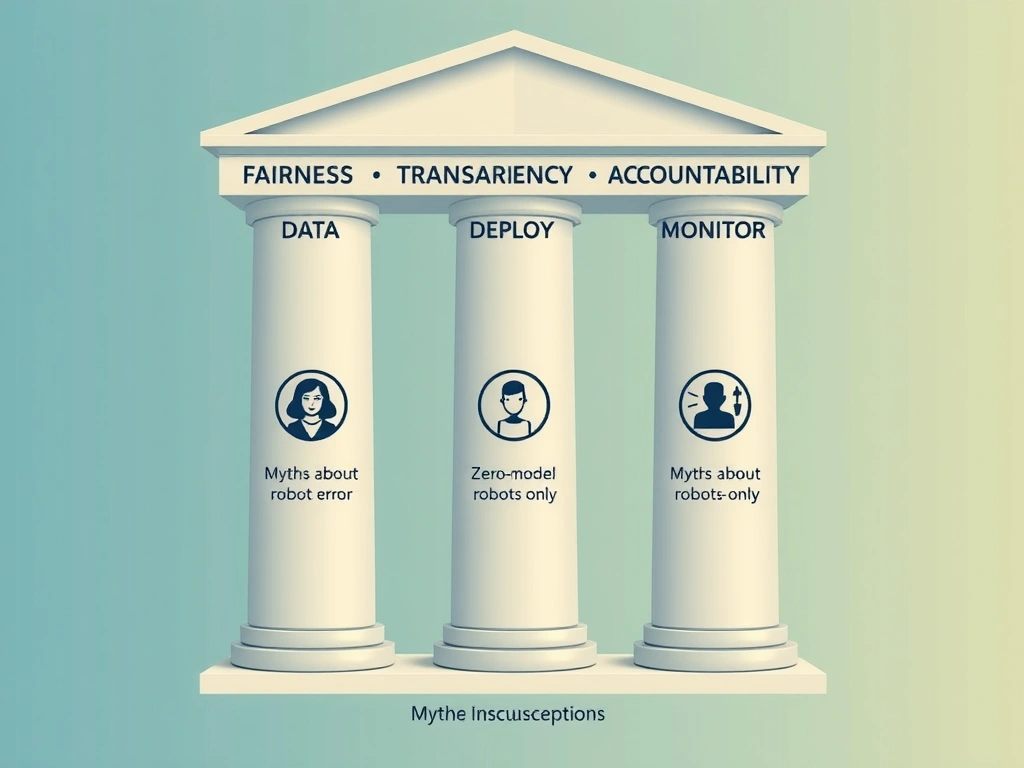
Here's the deal. Ethical AI isn't a magic shield that makes models never wrong—and it's not “AI that writes philosophy papers” or “only robot bodies.” It's how you build and run systems people can trust: fair outcomes, clear explanations where it matters, real accountability when things go sideways, privacy respected. Imagine your boss ships a lending model and regulators ask who owns the decision trail—that's ethical AI in the wild. Exam trap: zero-error fantasies, or narrowing ethics to robots. Pay close attention: look for transparent, fair, accountable. That's the trio that shows up again and again. You've got this—build models that work and that you'd defend in a review meeting.
Full explanation below image
Full Explanation
Ethical AI (often discussed alongside responsible AI and AI governance) is the practice of aligning the design, development, deployment, and monitoring of AI systems with human values and societal norms. Core themes typically include fairness and non-discrimination, transparency and explainability appropriate to the context, accountability and governance (who is responsible for outcomes), privacy and data protection, safety and robustness, and human oversight. These principles are implemented through impact assessments, documentation (model cards, datasheets), bias testing, stakeholder engagement, audit trails, and operational controls—not slogans alone.
The focus is socio-technical: models, data pipelines, incentives, and organizational processes all shape harm or benefit. Ethical AI therefore applies to ranking systems, medical decision support, hiring tools, generative models, and many other applications—not only embodied robots. It also accepts that errors will occur; the goal is proportional risk management, redress mechanisms, and continuous monitoring rather than an impossible guarantee of perfection.
Incorrect options distort the concept. Using AI to analyze moral dilemmas is an application domain, not the definition of ethical system-building. Equating ethical AI with autonomous robot construction confuses embodiment with governance. Claiming ethical AI is a rule set that prevents all mistakes misunderstands both ML uncertainty and organizational responsibility. Underlying principle: ethical AI is a lifecycle practice of fairness, transparency, and accountability—not a promise of zero error or a robotics specialty. Best practice embeds impact assessments, bias testing, documentation, and human ownership into delivery gates rather than treating ethics as a late checklist. Memory aid: ethical AI asks whether the system is fair, understandable enough, and owned by accountable humans—not whether a robot body shipped or whether error rate is exactly zero. Exam answers that emphasize transparency, fairness, and accountability match the standard framing.