
Bayesian approaches in machine learning emphasize representing uncertainty over unknowns rather than returning only a single fitted value. What is their primary goal when estimating model parameters?
Select an answer to reveal the explanation.
Short Explanation and Infographic
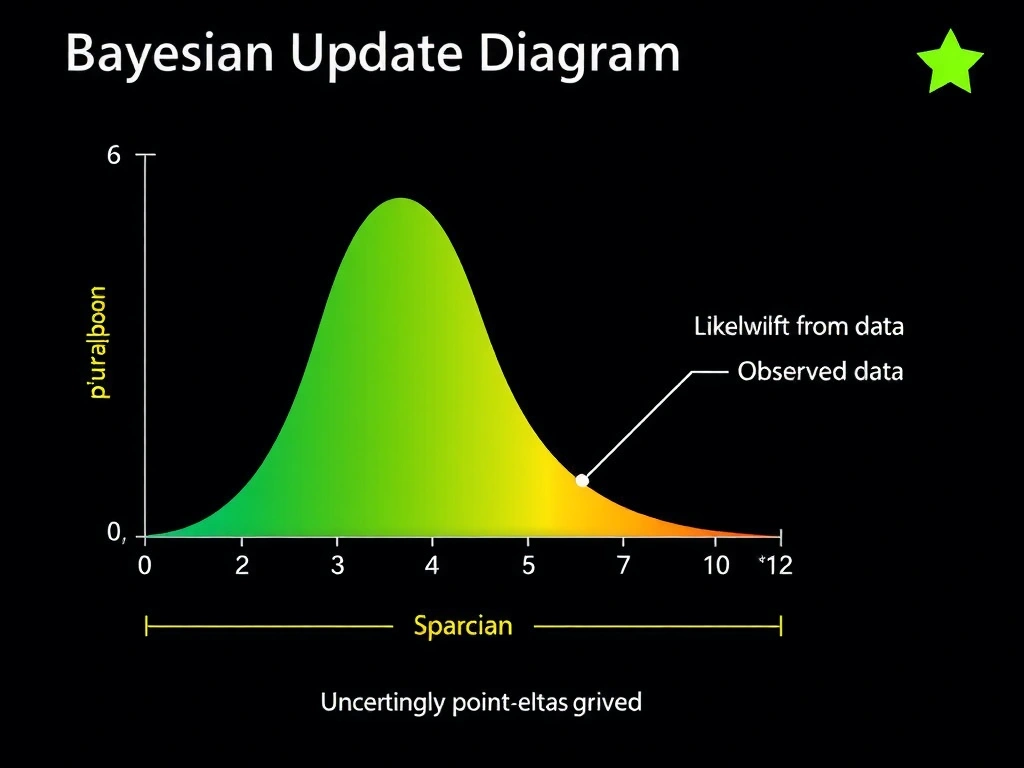
Check this out. Imagine your boss walks in with a half-baked prior: “I already believe churn is low for enterprise accounts.” Bayesian methods don't throw that belief away—and they don't pretend one number is the whole story either. You start with a prior over parameters, see the data, and get a posterior distribution: not just “the weight is 0.3,” but a spread of plausible values. That's the main goal—fold prior knowledge into a probability distribution over unknowns. Exam trap: people pick “faster training” or “only for huge datasets.” Trust me, Bayesian inference can be slower. Another trap is “single point estimate”—that's more classical ML flavor. If the choice talks priors and posteriors over parameters, you're in the right neighborhood. Land this: prior + data → posterior distribution.
Full explanation below image
Full Explanation
Bayesian methods treat unknown parameters (and often predictions) as random variables. The workflow starts with a prior distribution that encodes beliefs or regularization before seeing the current dataset. The likelihood describes how data would arise under different parameter values. Bayes’ rule yields the posterior: a distribution over parameters conditioned on the observed data. From that posterior you can compute means, credible intervals, posterior predictive distributions, and decision-theoretic actions under uncertainty.
This is fundamentally different from procedures that return only a point estimate (for example, a single maximum-likelihood or MAP value without a full uncertainty story). While MAP uses a prior, the hallmark of the Bayesian goal highlighted on many exams is obtaining and using a probability distribution over parameters, not merely minimizing a loss for one vector of weights. Uncertainty quantification supports safer decision-making, active learning, and calibrated predictions, especially when data are scarce or decisions are high-stakes.
Distractors miss the mark for clear reasons. Reducing compute is not the purpose—Markov chain Monte Carlo, variational inference, and related tools can be expensive. Claiming Bayesian methods exist only for enormous datasets confuses a possible application setting with the statistical objective. Emphasizing a lone point estimate describes frequentist or pure optimization mindsets more than Bayesian inference. Underlying principle: Bayesian inference updates beliefs into a full posterior rather than stopping at one point estimate. Best practice reports uncertainty when decisions are high-stakes and chooses approximate inference methods appropriate to compute budgets. Memory aid: classical fit means best single parameter vector; Bayesian fit means distribution over parameters given data and prior. When a question mentions prior beliefs and distributions over parameters, Bayesian methods are the intended answer.