
Before a model starts learning from examples, some settings must already be chosen by the practitioner—values that training will not update on its own. What term describes those pre-chosen settings?
Select an answer to reveal the explanation.
Short Explanation and Infographic
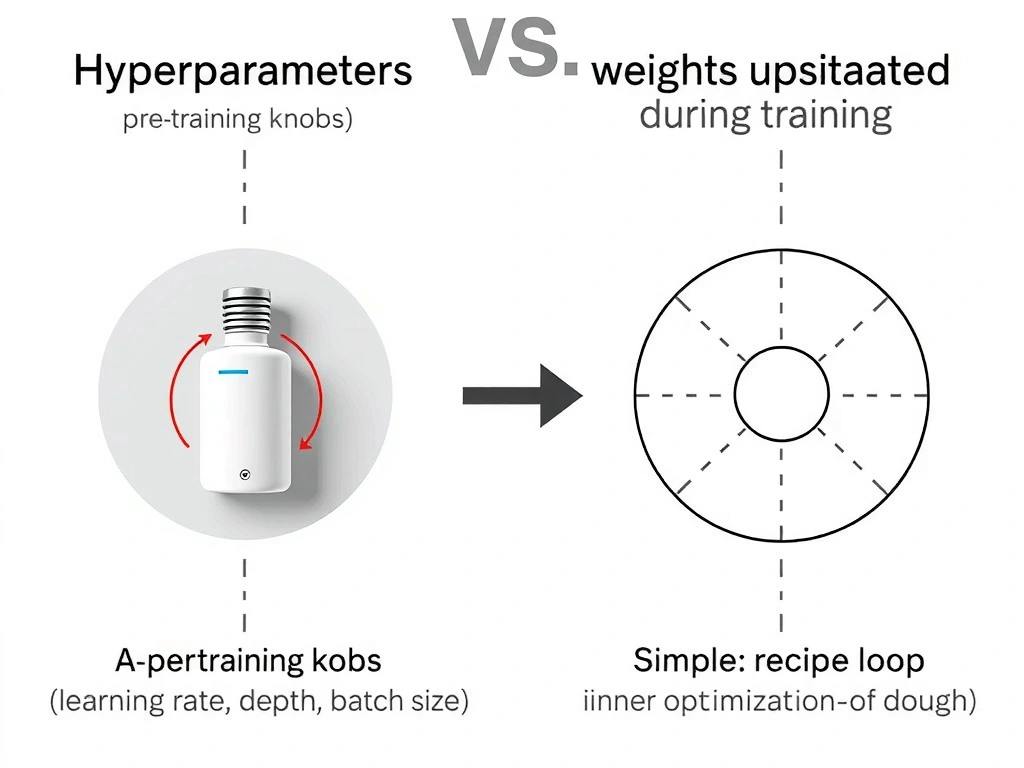
Okay, let's dive in. Think of training a model like baking bread: the flour and water ratios you measure before the oven is the recipe—you don't re-invent those mid-bake. In ML, those recipe knobs are hyperparameters: learning rate, number of layers, regularization strength, batch size. The dough itself—the weights—changes as you train. Here's the deal: the exam loves to trick you into calling weights “hyperparameters” or saying a hyperparameter is just “dataset size” or “accuracy.” Nope. If the optimizer learns it from data, it's a parameter; if you set it and training doesn't freely rewrite it, it's a hyperparameter. Boss walks in and asks why the model is unstable? First thing you check is often the learning rate—classic hyperparameter. Got it? Sweet. Remember: set before learning, not learned as weights.
Full explanation below image
Full Explanation
In supervised and many unsupervised workflows, a model contains two different kinds of quantities. Model parameters (for example, neural network weights and biases, or the coefficients in a linear model) are estimated from data by an optimization procedure such as gradient descent. Hyperparameters, by contrast, are choices the practitioner makes that structure the learning problem or the algorithm itself: learning rate, number of hidden units, tree maximum depth, k in k-nearest neighbors, regularization coefficients, dropout rates, and similar controls. They are defined before training begins or tuned in an outer loop (grid search, random search, Bayesian optimization) that is separate from the inner weight-update process.
This distinction matters in practice and on exams. If every knob were learned the same way, you would not need validation sets for tuning, early stopping schedules, or nested cross-validation. Because hyperparameters control capacity and optimization dynamics, poor choices produce underfit or overfit models even when the architecture is sound. Best practice is to hold out validation data (or use cross-validation), search a sensible hyperparameter space, and only then report test-set performance once.
The distractors capture common misconceptions. Treating learned weights as hyperparameters reverses the definition. Confusing hyperparameters with evaluation metrics mixes configuration with measurement. Equating hyperparameters with “how big the training set is” oversimplifies: data volume is an important design factor, but it is not what the term denotes. Underlying principle: separate quantities the optimizer learns from knobs the practitioner configures around that learning loop. Best practice tunes hyperparameters on validation data and freezes them before the final test evaluation. A useful memory aid: parameters are fit; hyperparameters are set or tuned outside the main fit. On certification items, pick the option that emphasizes pre-training or outer-loop configuration rather than values discovered solely by the training optimizer.