
Which statement best describes how a reinforcement learning agent typically improves its policy?
Select an answer to reveal the explanation.
Short Explanation and Infographic
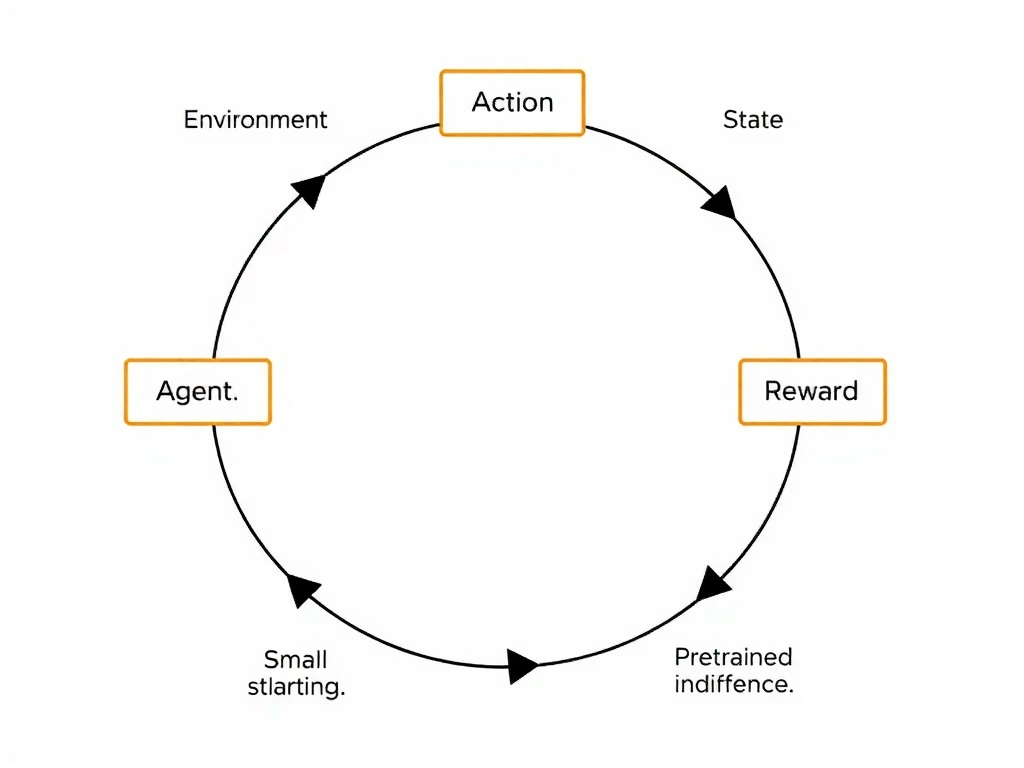
Let's dive in. Reinforcement learning is video-game learning for algorithms: try something, get points or lose points, get better at the game. The agent pokes the environment, sees what happens, and updates its policy. Think of teaching a dog with treats — not with a spreadsheet of every correct sit. Exam trap: people slap supervised learning answers on RL questions ("needs labeled data") or say it's just a frozen pretrained model. Nope. Trial and error, reward signal, environment loop — that's the RL agent story. If your boss says we don't have action labels, only success metrics after actions, you're in RL land.
Full explanation below image
Full Explanation
Reinforcement learning (RL) frames learning as an agent that observes states, selects actions according to a policy, and receives rewards from an environment over time. The objective is typically to maximize expected cumulative reward (return). Learning proceeds through interaction—exploration of actions and exploitation of what currently works—using algorithms such as value-based methods (for example Q-learning), policy gradients, or actor-critic hybrids. Delayed and sparse rewards make credit assignment a central difficulty.
The correct statement captures this trial-and-error interaction loop driven by reward feedback. Unlike supervised learning, the agent usually does not receive the correct action for each state; it receives evaluative signals that may arrive only after long sequences. Unlike pure use of a frozen pretrained model, policy improvement implies updating behavior from experience (online) or from logged interaction data in offline RL variants—yet the conceptual core remains learning from consequences of actions in an environment model or real environment.
Distractors map to other paradigms: frozen inference is deployment without the RL learning loop; full action labels describe supervised imitation when abundant expert demos exist (related but not the main RL characteristic); insisting on a single static corpus without environment contact misstates the classic agent definition, even though offline RL uses fixed datasets as a special case. The exam still anchors on interaction, reward, and policy improvement as the defining story.
Underlying principle: RL optimizes sequential decisions under evaluative feedback, not static input-label pairs. Best practice includes careful reward design to avoid specification gaming, sufficient exploration, and evaluation in held-out environments or offline policy evaluation when live experiments are costly. Memory aid: supervised means learn from labels; unsupervised means structure without labels; RL means learn from rewards via interaction. Keywords such as agent, environment, reward, policy, and trial-and-error point to reinforcement learning.