
In neural network training, what is the primary purpose of the backpropagation algorithm?
Select an answer to reveal the explanation.
Short Explanation and Infographic
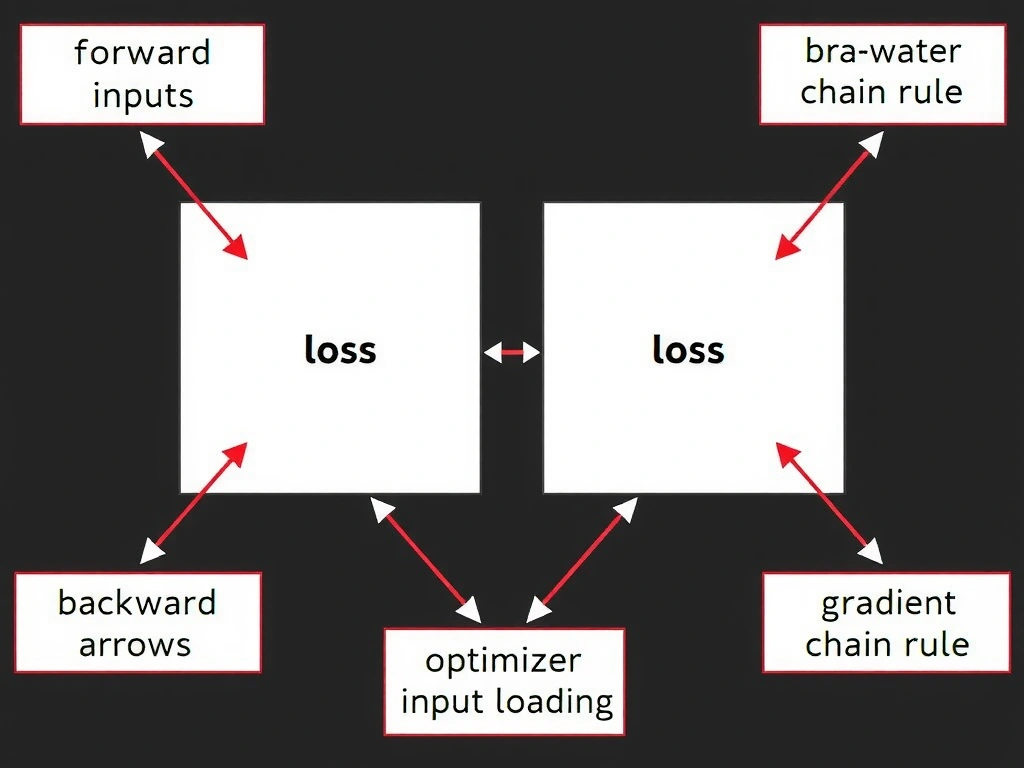
Hopefully you answered gradients — here's why. Forward pass: data goes in, prediction comes out, loss says how wrong you were. Backprop is the return trip: "which weights made us wrong, and by how much?" It uses the chain rule so every parameter gets a gradient. Think of it like blaming the right hop in a multi-hop network path when something breaks. Exam trap: confusing backprop with "just load the inputs," drawing the architecture, or some magic one-shot formula. Nope. Backprop = efficient gradient calculation for learning. Without it, training deep nets the usual way falls apart. Got it? Keep rolling.
Full explanation below image
Full Explanation
Backpropagation is the standard algorithm for computing gradients of a scalar loss with respect to neural network parameters. After a forward pass produces predictions and a loss value, backpropagation traverses the computational graph in reverse, applying the chain rule to accumulate partial derivatives for each weight and bias. Those gradients then drive an optimizer (SGD, Adam, and similar methods) that updates parameters to reduce loss. Without efficient gradient computation, deep networks would not be practical to train at scale.
The correct option states this purpose: efficient gradient calculation for weight updates. Automatic differentiation frameworks implement backpropagation under the hood; understanding the concept remains essential for diagnosing training issues (vanishing or exploding gradients, incorrect loss wiring) and for exam fluency. Backprop is not a replacement for the optimizer; it supplies the derivatives the optimizer consumes.
Visualizing architecture is unrelated to the math of learning—diagrams may help humans design networks but do not compute gradients. Supplying inputs to the network is the beginning of the forward pass, not backpropagation. Closed-form solutions exist for some linear models but not as a general replacement for iterative gradient-based training of deep nonlinear nets; backprop is precisely what enables those iterative updates at scale.
Underlying principle: supervised deep learning separates forward inference, loss evaluation, reverse-mode differentiation, and parameter steps. Best practice is to verify loss definitions, watch gradient norms, and remember that bugs in the computational graph often surface as dead or exploding gradients. Memory aid: forward pass predicts; loss measures error; backprop assigns credit via gradients; optimizer steps weights. If a question asks how the network obtains weight adjustments from error, the algorithmic answer is backpropagation used with an optimizer.