
Compared with a basic scripted chatbot, what primarily distinguishes conversational AI systems in production dialogue use cases?
Select an answer to reveal the explanation.
Short Explanation and Infographic
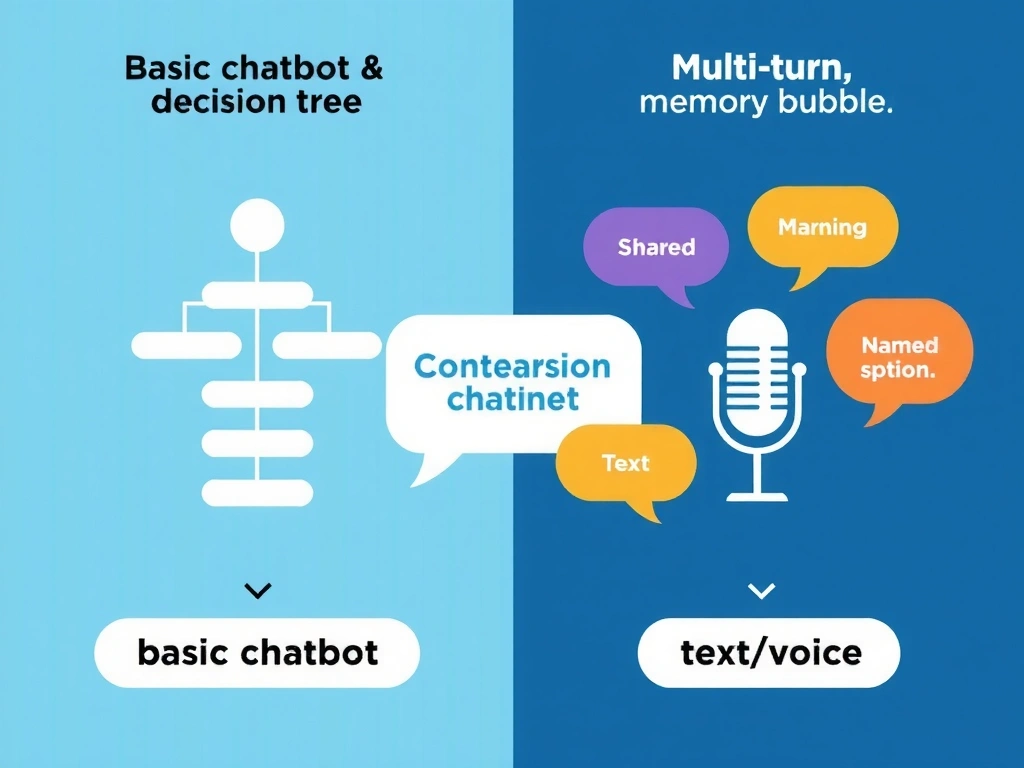
Okay, real talk: not every bot that answers "What's your order number?" is conversational AI. A basic chatbot can be a decision tree that panics if you rephrase. Conversational AI is the upgrade — it tracks context across turns, handles messier language, and feels closer to talking to a person. Imagine your boss says, "Customers keep changing topics mid-chat — the old script dies." That's why you need the more flexible stack. Exam trap: voice-only vs text-only, or "chatbot = work / conversational AI = home." Nope. It's about depth of dialogue and context, not the channel or the building. Remember: multi-turn, context-aware, human-like = conversational AI.
Full explanation below image
Full Explanation
In industry terminology, “chatbot” often denotes a narrower dialogue system—frequently rule-based, intent-and-slot templates, or limited FAQ retrieval—while “conversational AI” refers to broader systems that combine NLU, dialogue management, memory or context, and generation or response selection to support more natural multi-turn interaction. The primary distinguishing characteristic on many certification outlines is this richer contextual understanding and more human-like conversational capability.
The correct option states that conversational AI can engage with greater complexity and context than a basic chatbot. That may include tracking entities across turns, clarifying ambiguity, handling topic shifts, and integrating backend tools, often powered by machine learning or large language models. Evaluation emphasizes task success, containment rate, conversation length quality, and safety—not only single-turn FAQ hit rate.
It is inaccurate to claim all chatbots are forever pure if-then systems; the market uses “chatbot” loosely for simple ML bots too. The reliable exam contrast is capability and context, not an absolute ban on learning. Voice versus text is a channel choice (IVR, smart speakers, web widgets) orthogonal to the chatbot versus conversational-AI labels—both can be text, voice, or multimodal. Likewise, enterprise support versus personal assistants is a product category, not the technical differentiator; either technology class appears in either market.
Underlying principle: classify dialogue systems by dialogue depth and context handling, not by channel or industry slogan. Best practice is to specify required multi-turn behaviors, evaluation metrics, escalation paths, and safety controls regardless of marketing names. Memory aid: scripted or shallow turns approximate a basic chatbot; context-rich multi-turn dialogue approximates conversational AI. When designing systems, write requirements for context windows, tool use, and failure recovery instead of relying on the vendor label alone.