
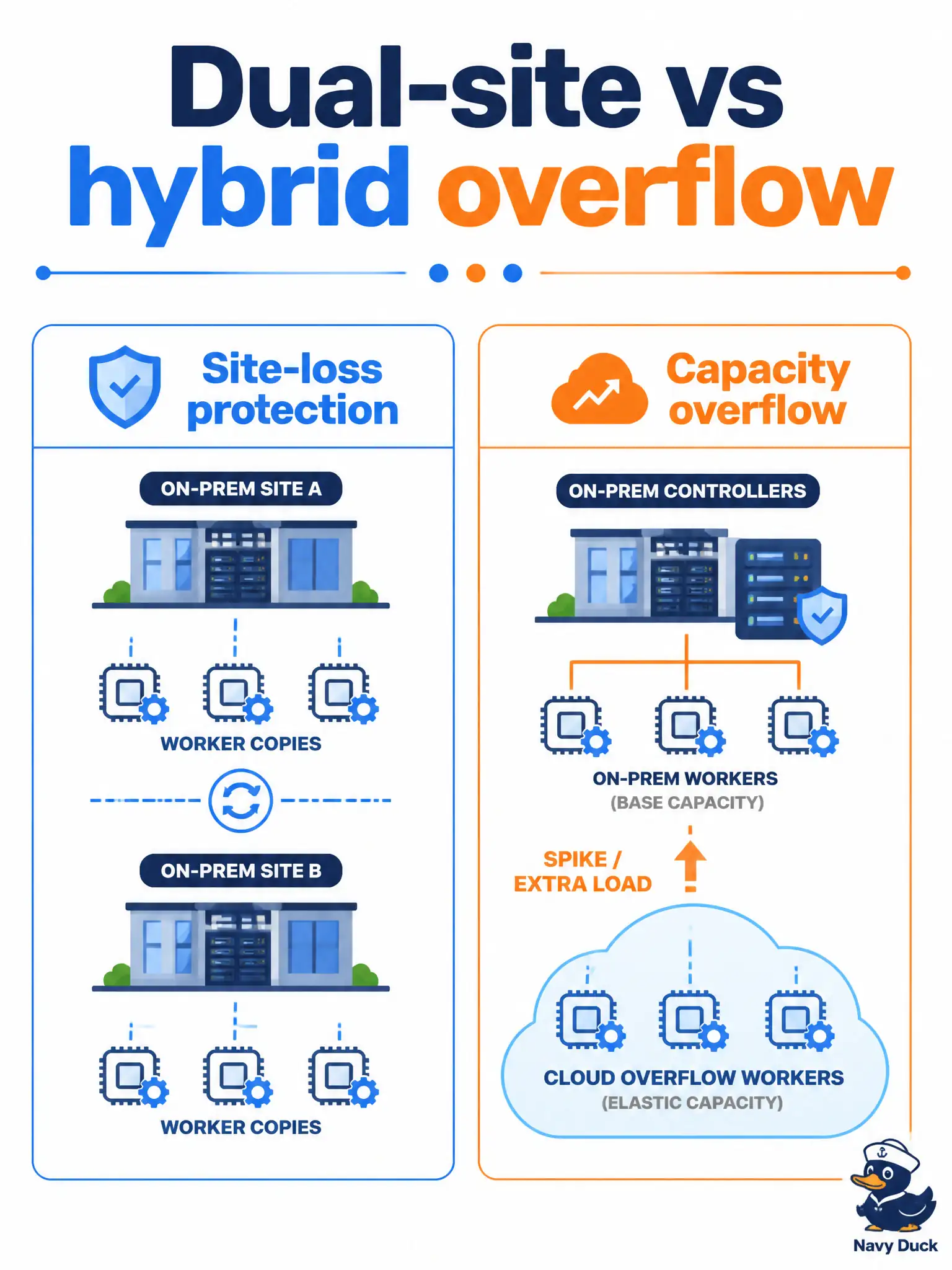
A metro IT team must survive loss of an entire data center for its Cisco-API workers, while controllers stay on-premises. Which pattern matches protecting against site loss versus only overflowing stateless workers to cloud?
Select an answer to reveal the explanation.
Short Explanation
Two firehouses cover a district fire; sending only overflow trucks to a rental lot covers a crowd spike—different problems. Dual-site on-prem workers buy site-loss protection. Hybrid overflow of stateless workers is another pattern—match the failure you fear.
Full Explanation
Protecting Cisco-API workers against loss of an entire data center while controllers remain on-premises calls for dual-site on-prem copies of those workers, or equivalent site-diverse pools that can still reach the controllers. That pattern addresses site loss. Hybrid overflow of only stateless workers to cloud is a different pattern aimed at capacity spikes, not a substitute for surviving a dark municipal DC if controller reachability and policy still assume on-prem adjacency.
Overflowing only UI static assets to a CDN fails because the workers—the privileged integration tier—remain single-site. Running a single on-prem pool and relying on cloud DNS alone fails because DNS cannot create worker capacity in a second site or fix controller path loss. Moving controllers to public SaaS while keeping one on-prem worker changes the problem domain and still leaves a single worker site unless redesigned.
Exam caveat: match the pattern to the failure mode—site loss versus burst capacity—rather than labeling every hybrid diagram as HA.
Operational check: document and rehearse failover of worker traffic to the second on-prem site with controllers still reachable, separate from any cloud burst test for stateless overflow.