
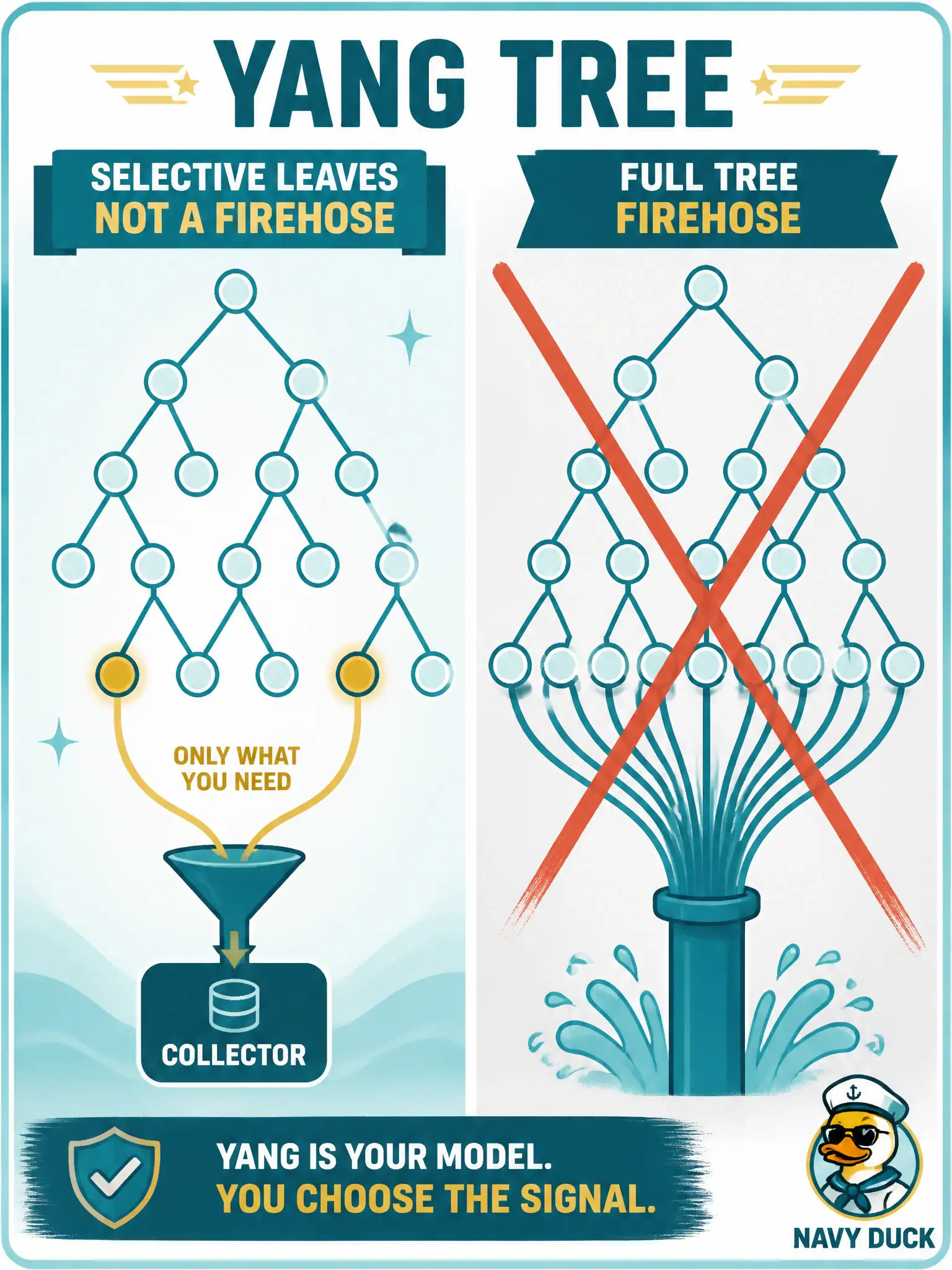
A developer enables a telemetry subscription that streams an entire operational YANG tree “in case we need it later,” though the app only graphs two interface counters. Which consumption consideration applies?
Select an answer to reveal the explanation.
Short Explanation
Order the ingredients you will cook—not the whole pantry on every delivery truck. Subscribe to the leaves the app will use; a firehose burns bandwidth and storage for nobody.
Full Explanation
Subscribe only to what the application will consume. Streaming an entire operational YANG tree “in case we need it later” when the app only graphs two interface counters wastes bandwidth, collector CPU, and storage on civic WAN paths. Path filtering to the needed leaves is a first-class consumption consideration for model-driven telemetry design reviews and keeps edge routers from publishing unused subtrees.
Always subscribing to the full operational tree so collectors never need another subscription fails efficiency and often feasibility at fleet scale. Replacing path selection with SNMP bulk walks of unrelated MIBs does not fix over-subscription and abandons the MDT design the team enabled. Encoding the entire configuration datastore into every telemetry packet for completeness creates operational risk and massive noise unrelated to the two counters the application actually graphs.
Exam caveat: start narrow, then widen with evidence; separate cadence for different paths rather than one giant tree. Model updates may rename paths—keep subscription definitions under version control with the municipal automation repo.
Operational check: compare ingest volume for full-tree versus two-counter subscriptions in lab, confirm dashboards remain unchanged for the counters that matter, and adopt the narrow paths in production.