
A proposal claims civic IOS XE switches will “run Grafana themselves” for model-driven telemetry without a separate receiver or store. Which correction reflects proper MDT pipeline roles?
Select an answer to reveal the explanation.
Short Explanation
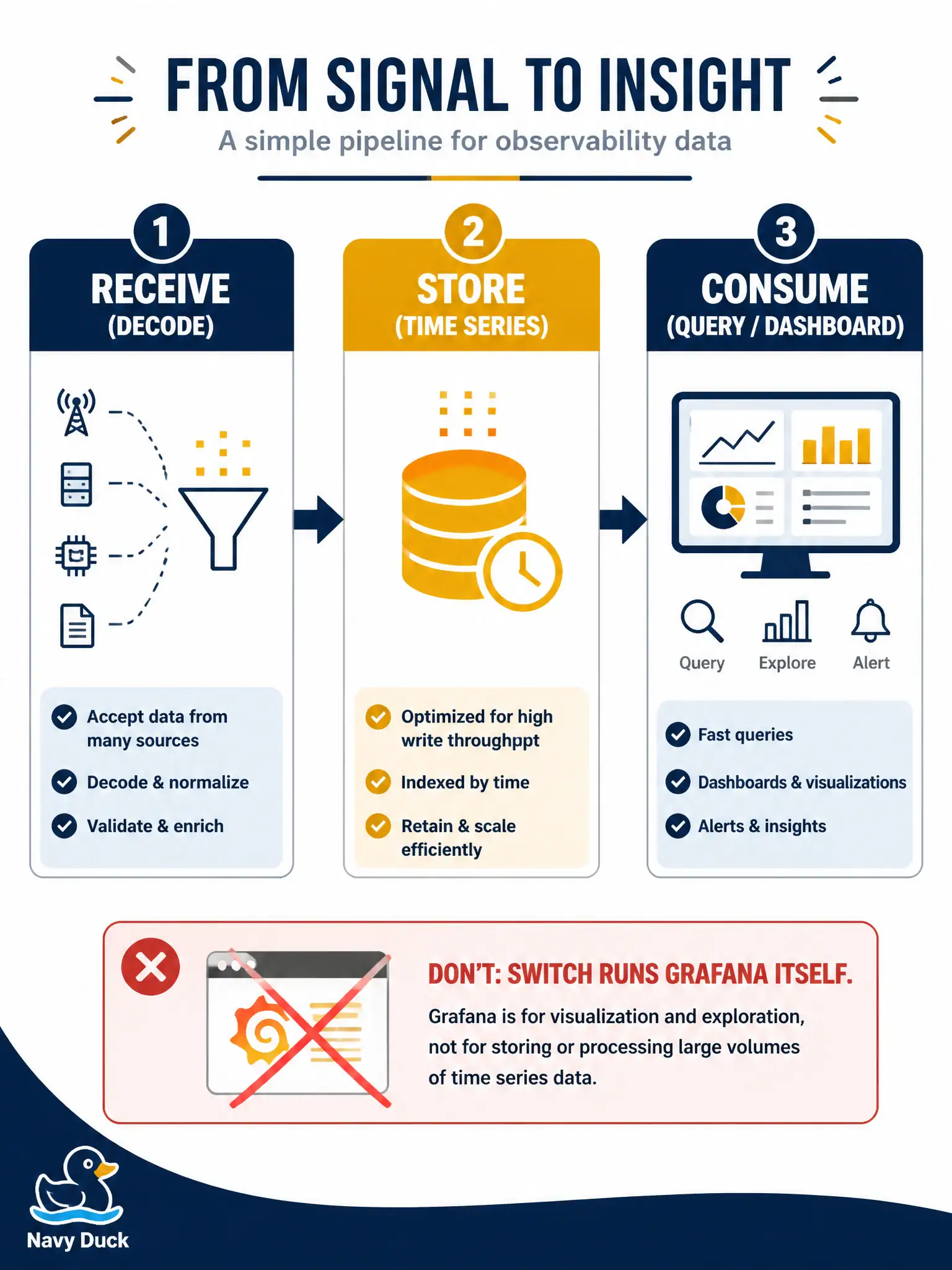
The radio operator, the archive room, and the newsroom are three jobs—not one switch wearing all three hats. Receive, store, then query; the box does not Grafana itself.
Full Explanation
Model-driven telemetry pipelines separate roles: a receiver that accepts and decodes the stream, a store that retains samples, and an application that queries the store (dashboards such as Grafana). Claiming civic IOS XE switches will “run Grafana themselves” without a separate receiver or store misunderstands those roles—the switch publishes; it is not the collector, database, and UI by design for MDT in production municipal networks.
Saying the switch replaces the collector, time-series store, and dashboard in one process by design fails architecture and scale across a campus fleet. Requiring dashboards to scrape device flash directly over Telnet instead of using a store is brittle and non-model-driven. Claiming only SNMP trap receivers are valid and that YANG telemetry never uses an external collector contradicts standard MDT practice and documentation.
Exam caveat: receivers may be vendor collectors or open stacks; the exam cares that publication is not the same as on-box visualization. Keep credentials for receivers out of dial-out device configs in cleartext wherever the platform allows secret references.
Operational check: document the pipeline boxes (device → receiver → store → app), point a subscription at the receiver, and open graphs from the store—not from an interactive Telnet session into the switch.