
Which AppDynamics capability alerts when instrumented application traffic departs from learned normal?
Select an answer to reveal the explanation.
Short Explanation
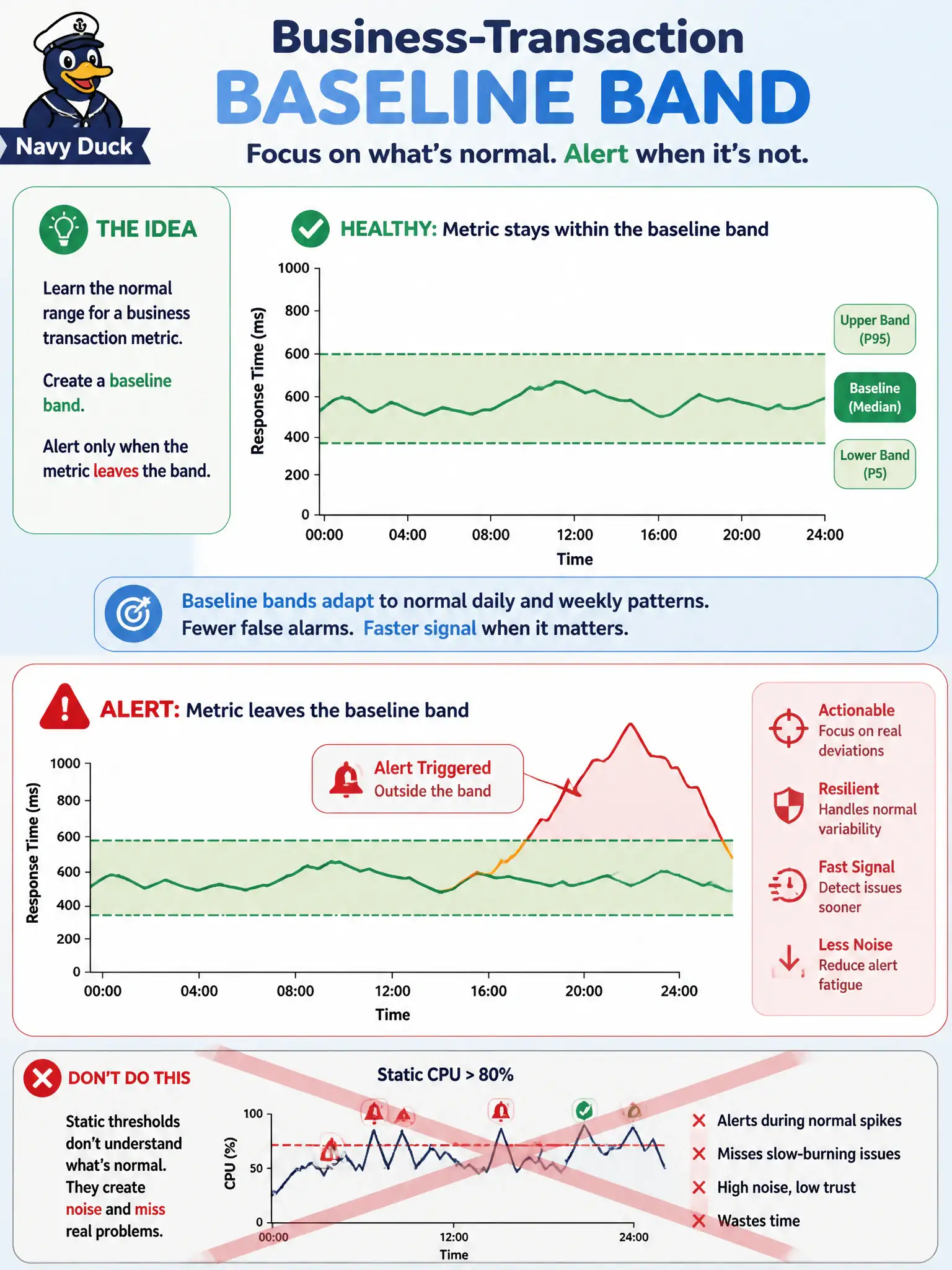
The controller learns each transaction’s normal rhythm, then health rules ring when the beat skips—smarter than a blunt “CPU over 80” sticker on the VM.
Full Explanation
AppDynamics alerts on departure from learned normal using dynamic baselines per business transaction plus health rules/policies. The controller learns each transaction’s typical performance and fires when traffic departs from that baseline, which fits variable municipal load better than a single static host CPU threshold.
A static VM alert that fires only when host CPU exceeds 80 percent fails as the AppDynamics BT baseline capability—host CPU can be fine while a specific checkout transaction collapses. Manual eyeballing of raw packet captures with no controller baselines fails as an alerting strategy and is not AppDynamics health rules. Replacing AppDynamics with Splunk as the only correct 3.7 product answer fails the task’s AppDynamics focus even if Splunk appears elsewhere in an enterprise stack.
Exam caveat: baselines need enough traffic history; brand-new business transactions can be noisy until the controller learns—tune sensitivity rather than disabling rules on day one of a city go-live.
Operational check: confirm each critical BT has a health rule tied to its baseline, generate a controlled latency injection in lower environments, and verify the rule notifies the on-call channel the municipality actually uses.