
A city script needs DNA Center client-health at a specific past moment. Which timestamp query shape is correct?
Select an answer to reveal the explanation.
Short Explanation
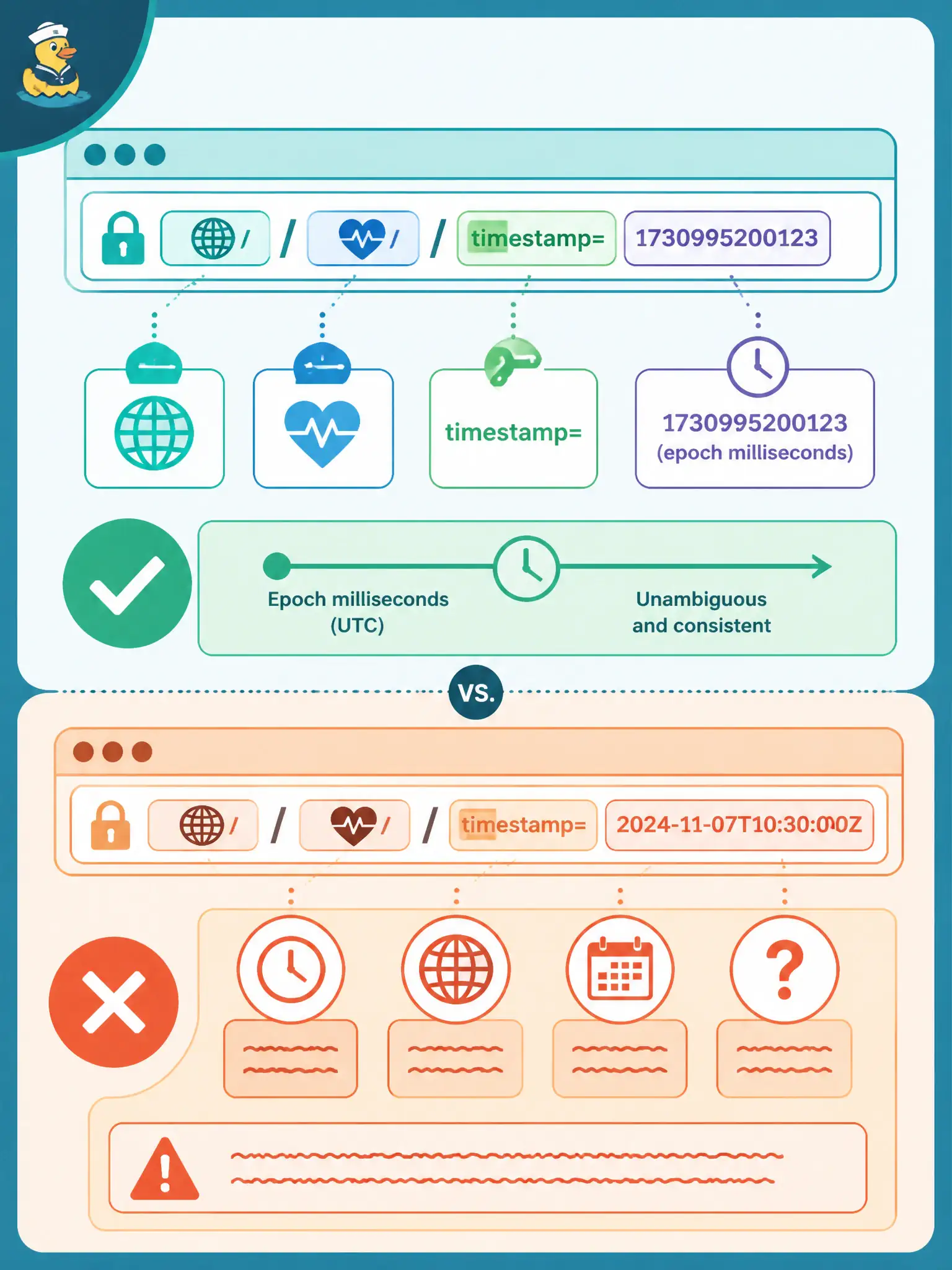
DNA Center’s point-in-time knob wants epoch milliseconds—like a stopwatch in thousandths—not a handwritten wall-clock string.
Full Explanation
DNA Center client-health point-in-time queries take timestamp as epoch milliseconds; omitting the parameter means “now.” A city script that must reconstruct wireless health at a past moment therefore converts the civic wall-clock instant to ms since epoch and passes that query value on the Intent GET.
Passing a wall-clock string such as 2024-01-15 09:00:00 fails because the constructed parameter expects epoch milliseconds, not a free-form datetime string. Passing seconds-since-epoch and assuming the controller multiplies by 1000 fails when the API expects milliseconds already—off-by-1000 errors land you at the wrong historical sample. Storing samples in an external time-series database may be good ops practice but fails as a substitute for the Intent timestamp query shape the question asks.
Exam caveat: timezone conversion bugs are common in municipal scripts—normalize to the epoch correctly (usually via UTC) before multiplying to milliseconds, or you will query the wrong assurance window.
Operational check: for a known incident window, GET client-health with an explicit ms timestamp and without one, compare wireless scores, and archive both the timestamp used and the scoreValue so auditors can replay the same Intent read later.