
A business-license Function invokes a fee-calculator Function, but Trace Explorer shows two unrelated traces. What is missing for a single tree covering both?
Select an answer to reveal the explanation.
Short Explanation
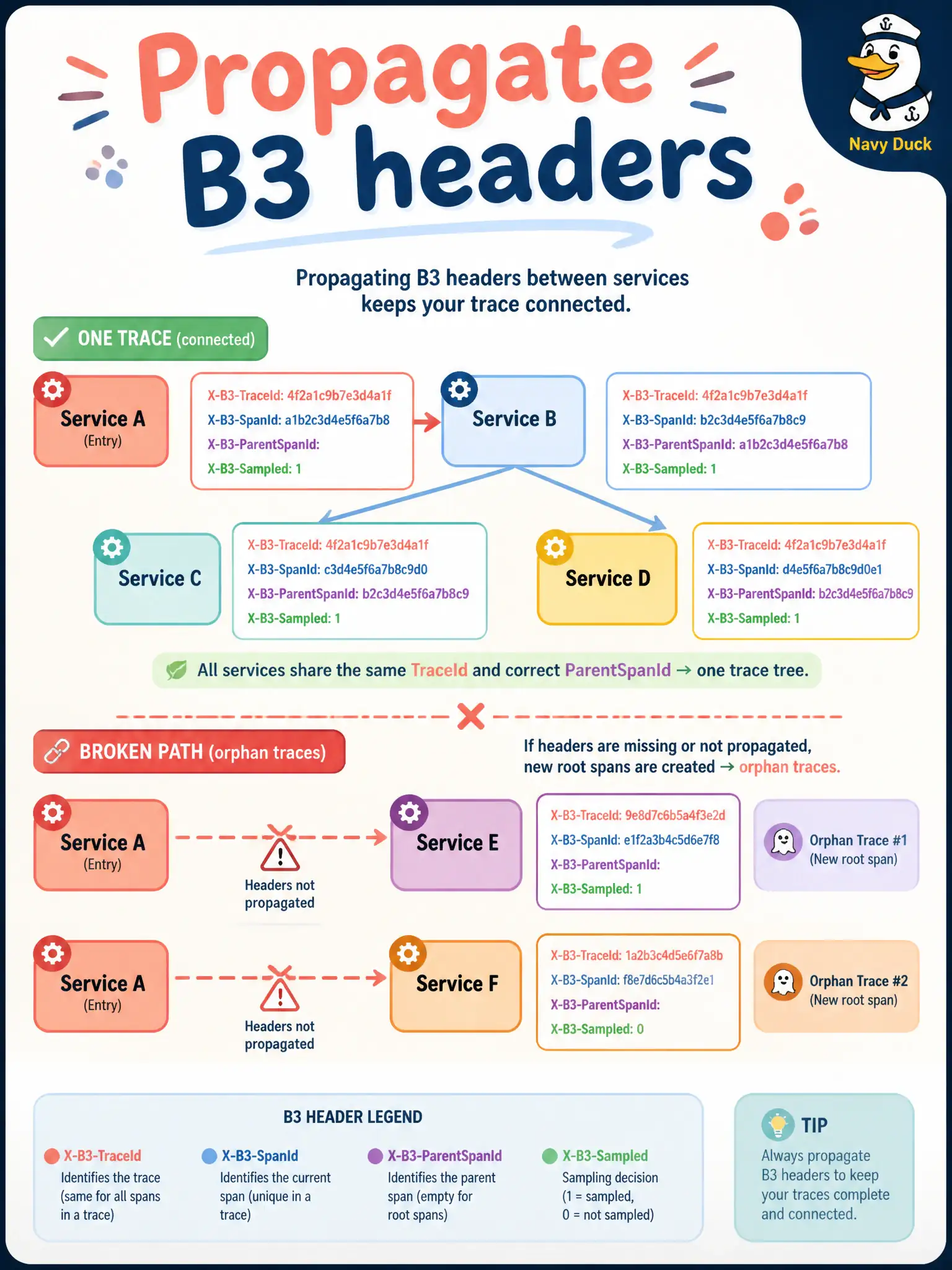
Chained functions need the Zipkin B3 headers passed along like a relay baton. Without them you get two orphaned traces and cannot see the hand-off.
Full Explanation
When a business-license Function invokes a fee-calculator Function, each side can produce spans, but they become one tree only if trace context propagates on the downstream invoke. Propagate Zipkin headers X-B3-TraceId, X-B3-SpanId, X-B3-ParentSpanId, and X-B3-Sampled so APM can parent the callee’s work under the caller’s trace. Missing those headers yields two unrelated traces in Trace Explorer even though the call chain is logically one citizen request.
Disabling tracing on the caller so only the callee emits spans guarantees a broken or partial picture—you lose the caller’s span and still may not join trees correctly. Replacing APM with Streaming partition keys as the trace identifier confuses event streaming with distributed trace context. Converting both functions into API Gateway usage plans does not merge traces; usage plans are API product/quota constructs, not trace join mechanisms.
Exam caveat: partial header sets or dropping Sampled can still split or omit traces—propagate the full documented B3 set on every downstream Functions invoke you care about. Operational check: log or inspect outbound invoke headers from the business-license function, confirm the four B3 headers are present, call fee-calculator, and verify Trace Explorer shows one parented tree instead of two roots.