
Developers want a named custom span around a downstream Function call from a code-enforcement Fn. Which approach matches the official custom-span path?
Select an answer to reveal the explanation.
Short Explanation
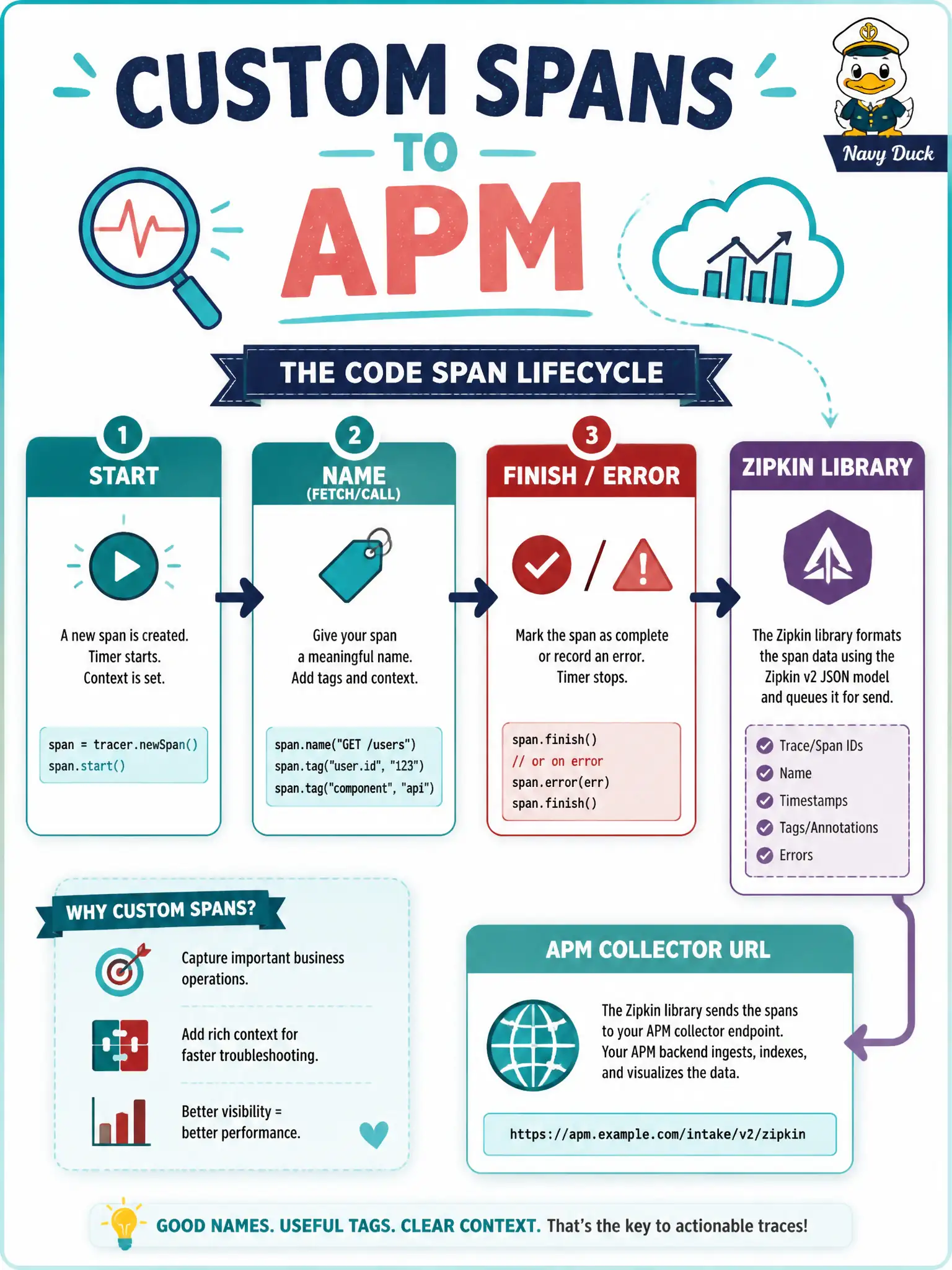
Custom spans are little named bookmarks you finish and error-tag, shipped with a Zipkin-capable library to the APM collector when tracing is on. Metrics and Audit are not span transport.
Full Explanation
The official custom-span path for Functions uses a Zipkin-capable library with supported FDK versions, honors OCI_TRACING_ENABLED (and tracing context) so the runtime detects tracing is on, and sends spans to the APM collector URL associated with the domain. That is how developers create a named custom span around a downstream Function call from a code-enforcement Fn—instrument in process, propagate context, export to APM—not by inventing metric-only or mesh-only substitutes.
Emitting the span only as an oci_faas metric statistic interval produces Monitoring data points, not an APM span in a trace tree. Writing the span exclusively into Audit logs with no collector URL misuses Audit and skips APM ingestion. Using Service Mesh sidecars as the only supported custom-span mechanism overstates mesh: Functions custom spans follow the Zipkin/APM path documented for Fn, not a mesh-only rule.
Exam caveat: unsupported FDK versions or ignoring OCI_TRACING_ENABLED yields missing custom spans even when application tracing looks enabled. Operational check: verify FDK meets the documented minimum, set/honor OCI_TRACING_ENABLED, emit a named Zipkin span around the downstream invoke to the APM collector URL, and confirm the span nests under the parent invocation in Trace Explorer.
Prefer to study offline? Printable PDF study book + test engine ($7.50, unofficial). These questions stay free here.