
After tracing is enabled for a utility-billing Function, Trace Explorer shows an outer invocation span but nothing for the Vault secret fetch inside. What does that indicate?
Select an answer to reveal the explanation.
Short Explanation
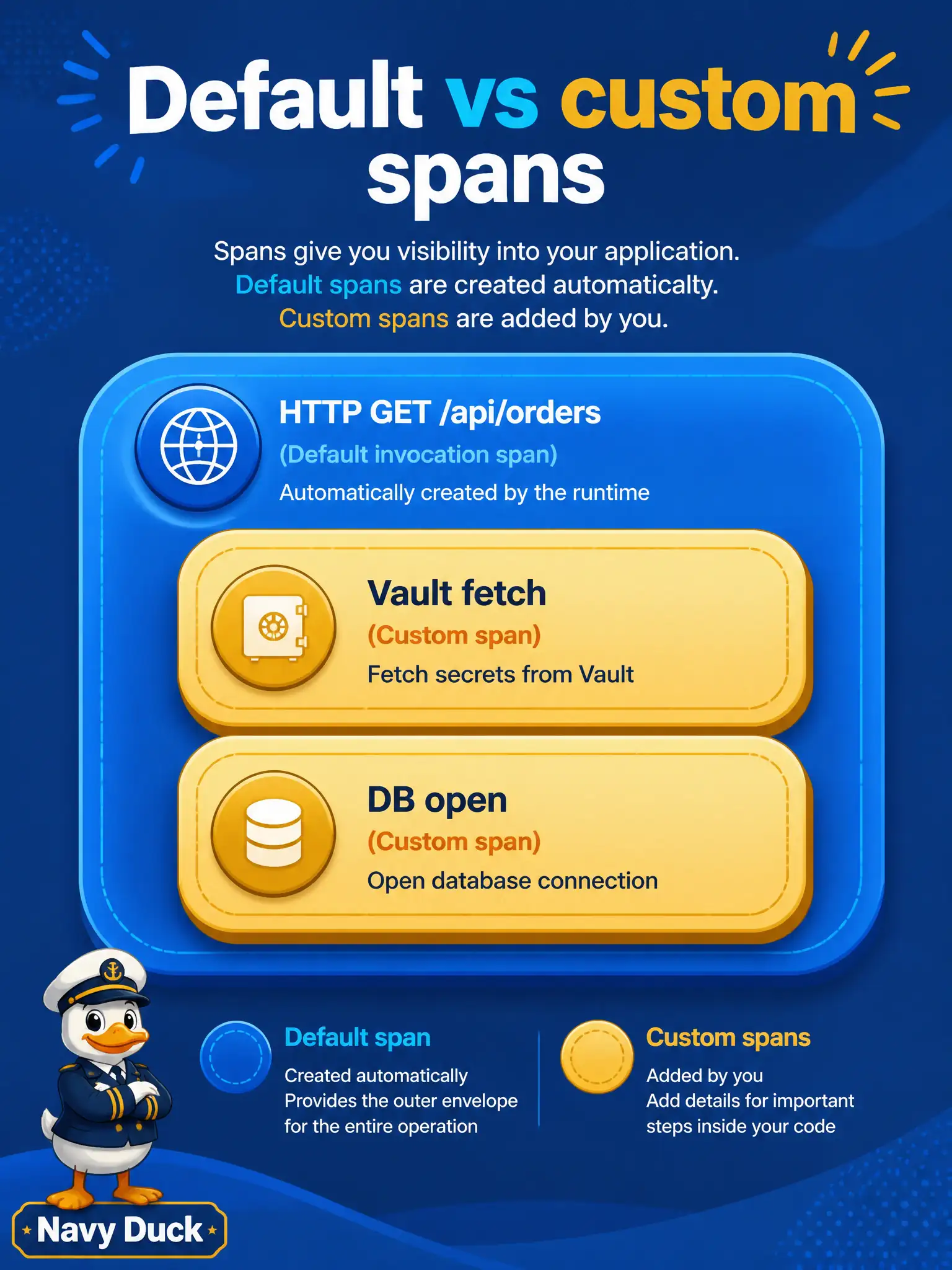
Functions already draws the outer accept-to-respond span for you. Anything inside—Vault, DB, downstream call—needs a custom span you add.
Full Explanation
Once tracing is enabled, Functions emits a default function-invocation span covering accept-through-respond. You do not hand-instrument that outer span. Seeing that outer invocation in Trace Explorer for a utility-billing Function while Vault secret fetch shows nothing indicates the expected split: platform default span is present; Vault retrieve and similar inner work need custom spans you add with supported instrumentation. Empty inner detail is a missing custom-span problem, not proof that defaults never exist.
Claiming the platform never emits any default span and that Zipkin must invent the outer invocation contradicts the default invocation span behavior. Interpreting empty inner detail as misconfigured Monitoring alarms as the collector confuses alarms with APM. Saying custom spans are impossible and only RUM session replay can show Vault calls is false—custom spans are supported via the Zipkin-capable path into APM, and RUM is browser-session oriented, not the server-side Vault-fetch span mechanism.
Exam caveat: libraries, FDK version floors, and OCI_TRACING_ENABLED/context matter for custom spans; enabling tracing alone does not auto-wrap every Vault SDK call. Operational check: confirm the outer invocation span exists, add a named custom span around the Vault retrieve, redeploy, invoke, and verify the child span appears under the invocation in Trace Explorer.