
The municipal snow-route dispatcher wants an alarm that pages on-call when permit-API latency stays high, but a single one-minute spike should not wake anyone. Which alarm design matches OCI Monitoring practice?
Select an answer to reveal the explanation.
Short Explanation
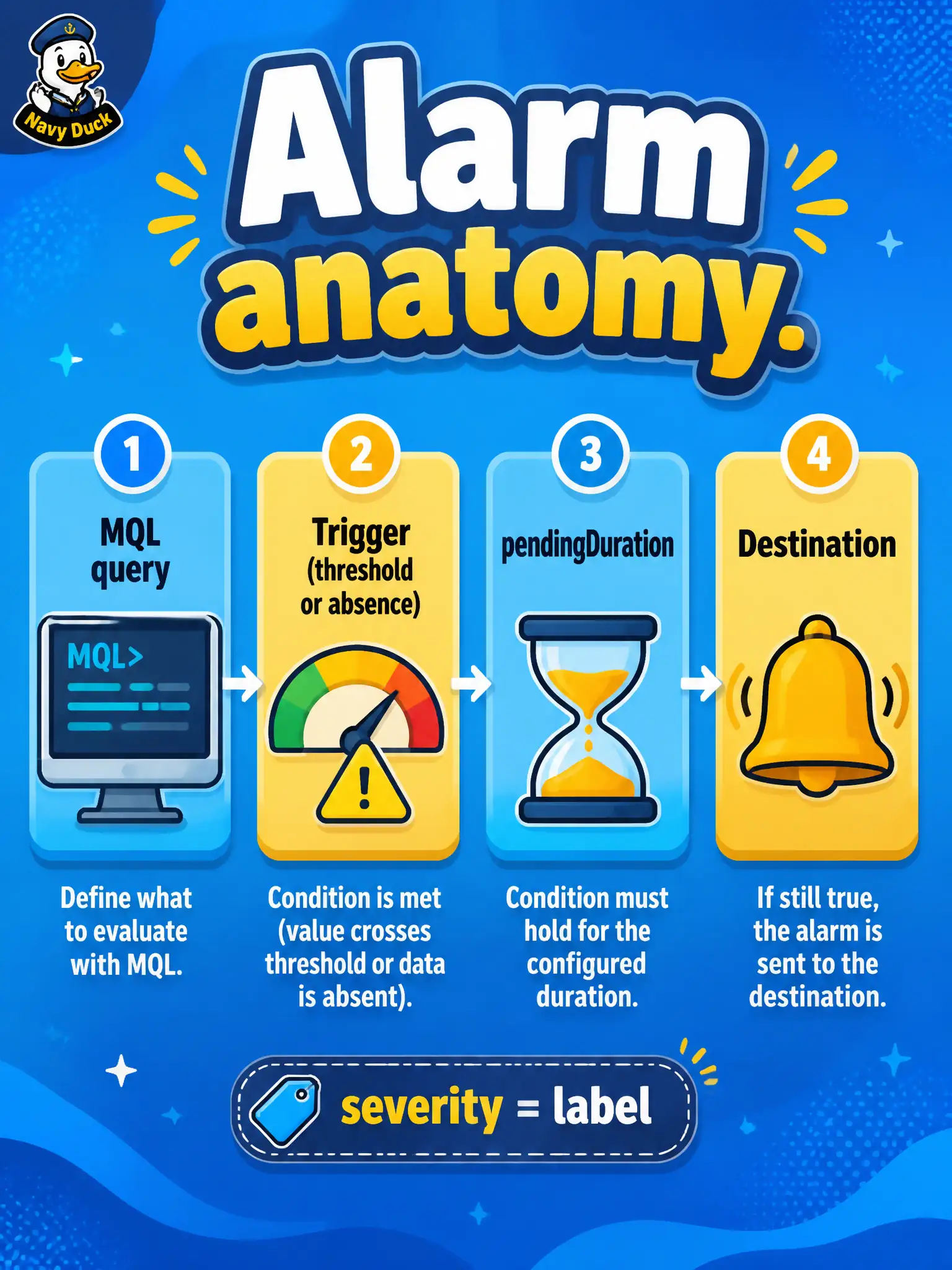
An alarm is a smoke detector with a short fuse delay: it watches a query, decides threshold or absence, waits out brief blips, then notifies. Severity is just a label you pick, not another product.
Full Explanation
OCI Monitoring alarms are built from a coherent design: attach an MQL query that selects the permit-API latency signal, choose a trigger style (threshold breach or missing data), set pendingDuration so a single one-minute spike does not page, and pick a destination such as a Notifications topic. That pendingDuration is the deliberate delay fuse—evaluation continues, but the alarm does not fire until the condition holds long enough to matter for on-call. Severity is a label you assign for triage priority; it is not a separate Oracle product you must license or invent.
Publishing a custom metric alone does not create the delay behavior; metrics without an alarm definition never page anyone, and claiming alarms cannot delay evaluation contradicts how pendingDuration works. Writing the firing message into a Logging custom log and searching hourly replaces push notification with slow pull—Logging is for diagnostic lines, not the primary alarm destination path. Creating an APM synthetic monitor and treating WARNING severity as another product mixes up synthetic checks and alarm severity labels; synthetics watch availability from outside, while this requirement is latency-based paging with blip tolerance on Monitoring.
Exam caveat: pendingDuration shortens false pages but also delays true ones—tune it to municipal on-call tolerance, not to zero and not to hours. Operational check: fire a test condition that lasts under pendingDuration and confirm no notification, then hold the same condition past pendingDuration and verify the snow-route dispatcher’s destination receives the page.