
A public-works telemetry reader needs to start at a specific time in an OCI Streaming partition without deleting messages when they are read. Which construct points at that location?
Select an answer to reveal the explanation.
Short Explanation
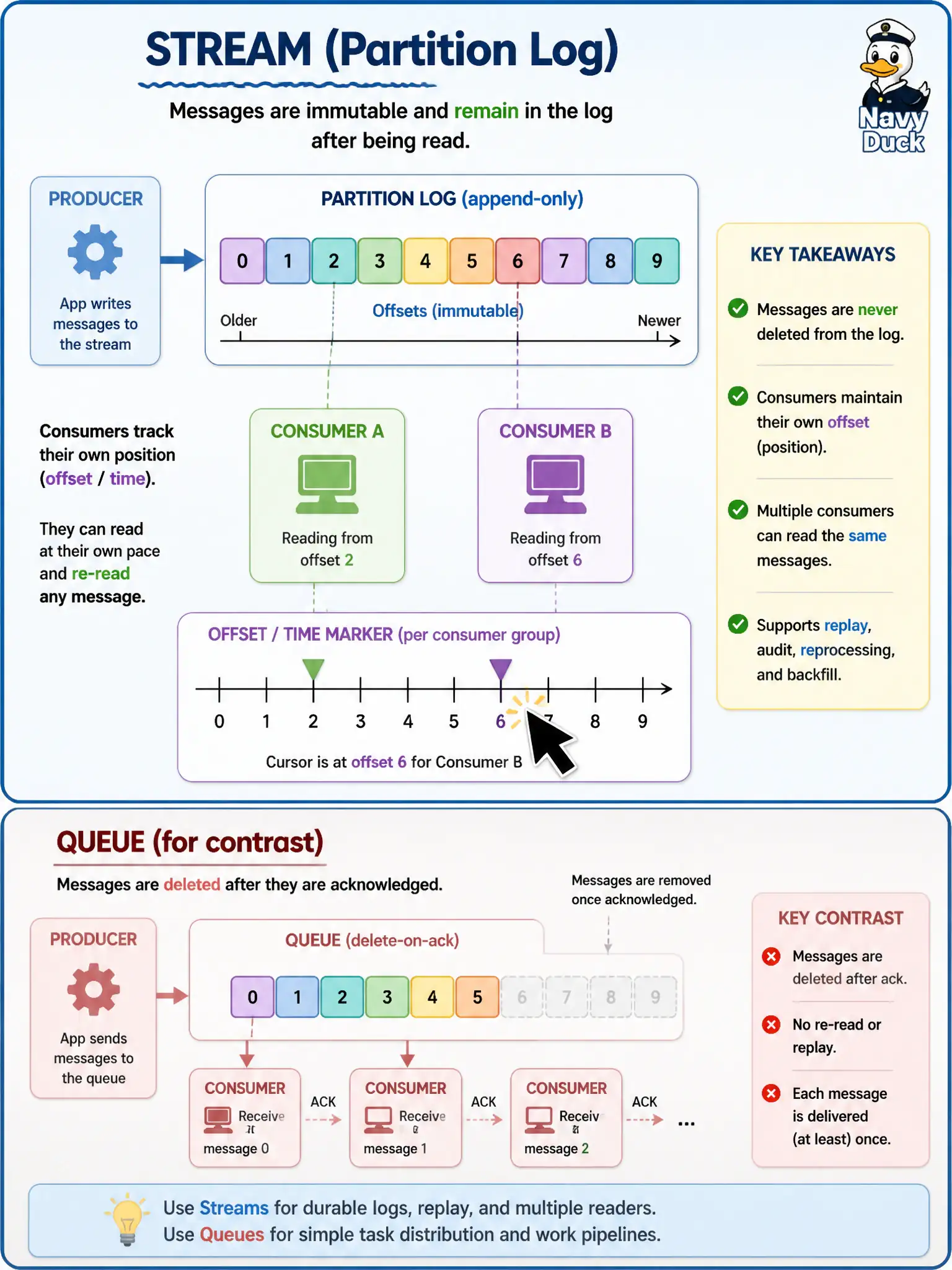
A cursor is a finger on the map—pointing at an offset, a time, or a group’s place—without tearing the page out. Clients move cursors; Streaming does not delete a message just because someone read it. That is the opposite of Queue’s consume-then-delete model.
Full Explanation
A cursor points at a location in an OCI Streaming stream: a specific offset or time in a partition, or a consumer group’s current place. Public-works telemetry readers use cursors to start at a chosen time without deleting messages when they are read. Clients advance cursors as they consume; Streaming retains data until the retention window expires. That is the opposite of a consume-and-delete queue and is why multiple municipal readers can share the same historical telemetry within retention for auditing, late analytics, or recovery.
A Queue visibility timeout that permanently erases on first read describes Queue semantics, not Streaming cursors. Functions provisioned concurrency controls how many function instances stay warm; it does not store partition positions. A Monitoring alarm body is an observability signal, not a stream commit log or a cursor you can seek.
Exam caveat: reading through a cursor does not remove the message for other consumers. Retention—not acknowledgment—determines when telemetry disappears from the stream.
Operational check: create a cursor at a specific timestamp for the public-works feed, read forward, confirm messages remain available for a second cursor over the same time range, and verify no delete-on-read behavior occurs while both readers progress independently.