
Several inspector-app instances must jointly consume a multi-partition work-order stream on OCI Streaming so each partition is handled by only one instance at a time. Which feature coordinates that assignment?
Select an answer to reveal the explanation.
Short Explanation
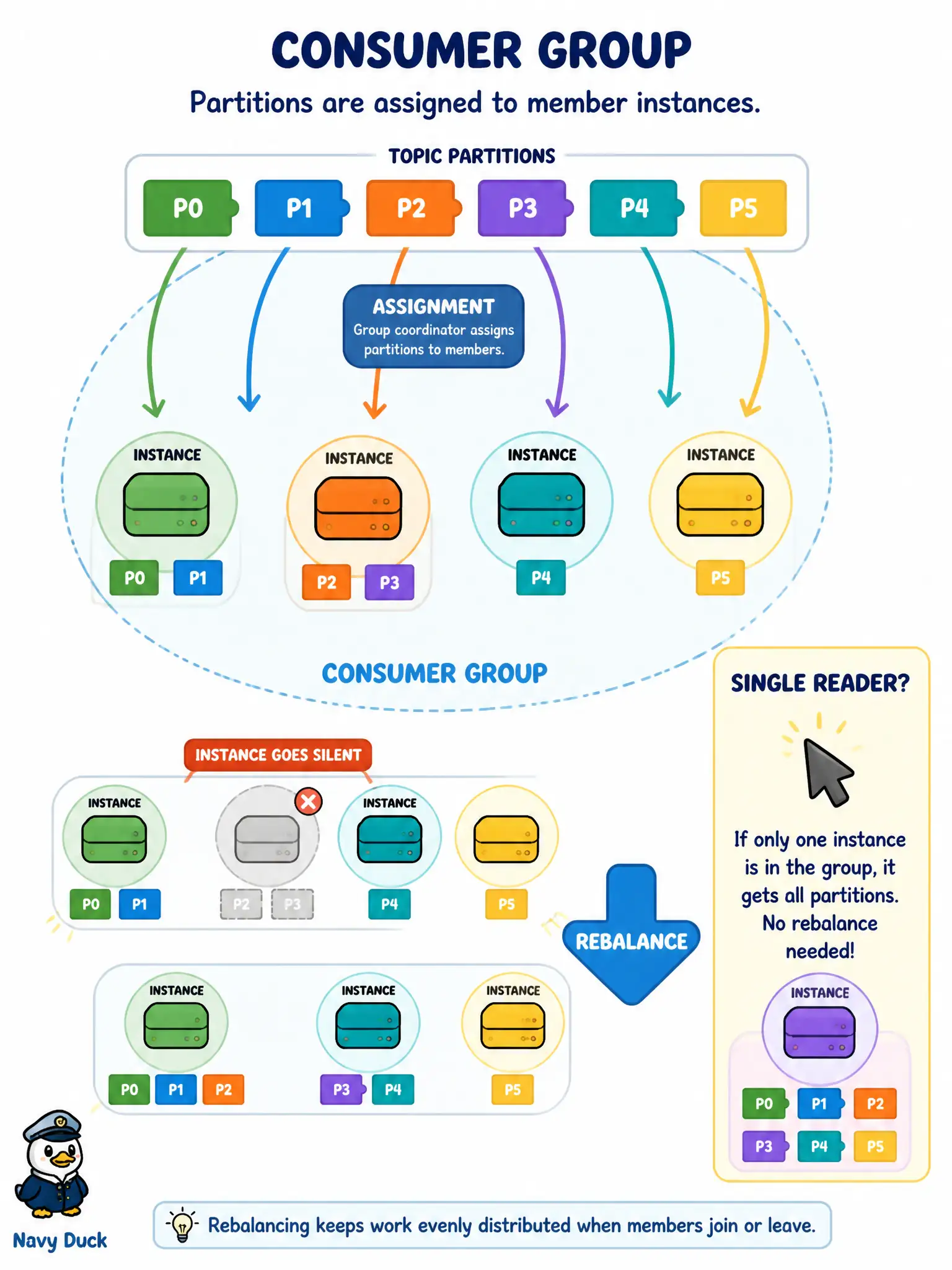
A consumer group is like assigning each neighborhood’s case pile to one inspector at a time and reshuffling when someone clocks out. Instances in a group coordinate so each partition has one active member; groups rebalance when members join or go silent (roughly thirty seconds without heartbeat/consume). Production multi-partition consumers should use a group; a lone cursor is the simpler single-reader path.
Full Explanation
When several inspector-app instances must jointly consume a multi-partition work-order stream so each partition has only one active reader, use a consumer group. The group assigns partitions to member instances and rebalances when instances join or stop heartbeating or consuming for roughly thirty seconds. That coordination gives parallel processing across partitions without two members fighting over the same partition. Production consumers reading multiple partitions should participate in a group; a lone cursor remains the simpler path for a single reader without group assignment.
A lone cursor without group membership does not automatically load-balance every partition across unlimited instances the way a group does. An API Gateway authorizer mapping partitions to Vault secrets is unrelated to Streaming consumer coordination. An OKE Horizontal Pod Autoscaler may add pods but does not change the stream’s partition count or replace consumer-group assignment logic.
Exam caveat: more group members than partitions yields idle members. Scale instances to partition count for useful parallelism, and size partitions at create time for the fan-out you need.
Operational check: start a consumer group with N members on an N-partition stream, confirm one-to-one assignment, stop one member, and verify rebalance moves its partition to a surviving instance within the expected silence window.