
After a restart, a city’s smart-meter consumer must resume reading an OCI Streaming partition without replaying the entire retention window. Which concept marks the consumer’s place in that partition?
Select an answer to reveal the explanation.
Short Explanation
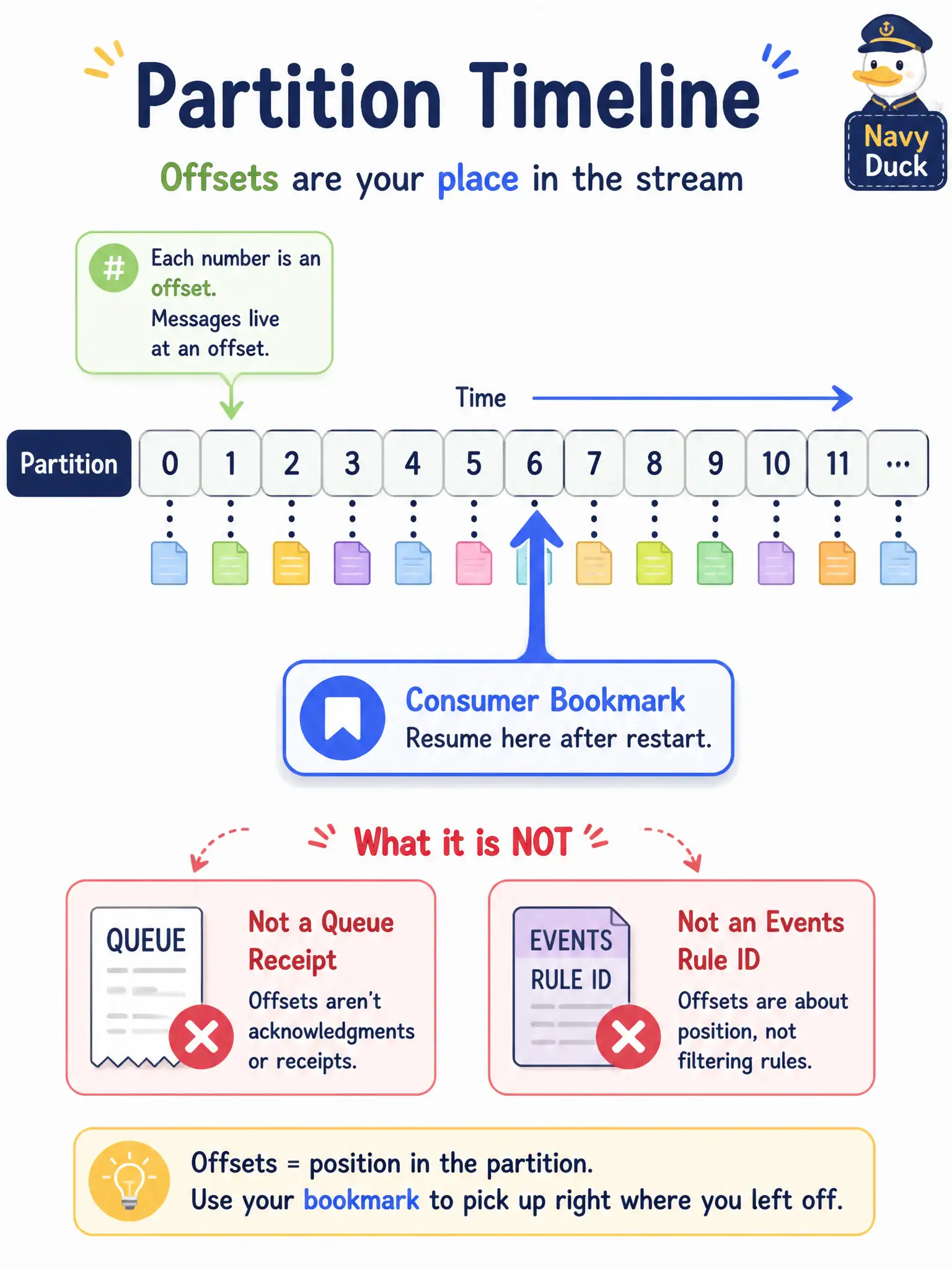
An offset is a bookmark in the chapter you were reading—close the book, reopen it, and continue from that page. Every message in a Streaming partition has an offset; consumers resume from it after a restart, enabling replay and pick-up-where-you-left-off behavior. Offsets are not Queue receipts and not Events rule IDs.
Full Explanation
Every message in an OCI Streaming partition has an offset that marks its position in that partition’s log. After a restart, a city’s smart-meter consumer (or its consumer group) resumes from the committed offset instead of replaying the entire retention window by default. Offsets enable both pick-up-where-you-left-off behavior and intentional replay when operators deliberately rewind within retention. That bookmark model is how Streaming consumers track durable progress across process restarts and rolling deployments without treating the stream like a transient queue.
A Queue receipt handle and visibility timeout belong to OCI Queue’s delete-on-ack work-queue model, not Streaming offsets. An OCI Events rule OCID identifies an event rule; it is not a durable consumer bookmark in a stream partition. An API Gateway deployment OCID is unrelated to stream encryption keys or read positions and must not be used as a stand-in for consumer progress.
Exam caveat: retaining messages until the retention window ends means offsets can be rewound for replay; design idempotent handlers whenever reprocessing of meter events is possible.
Operational check: consume and commit through a known offset, restart the consumer, confirm it resumes at the next offset, then intentionally seek earlier within retention and verify replay of already-seen smart-meter messages while handlers remain safe under duplicates.