
A library IT team will implement an OCI Function using the documented Fn Development Kit. Which statement matches official runtime guidance?
Select an answer to reveal the explanation.
Short Explanation
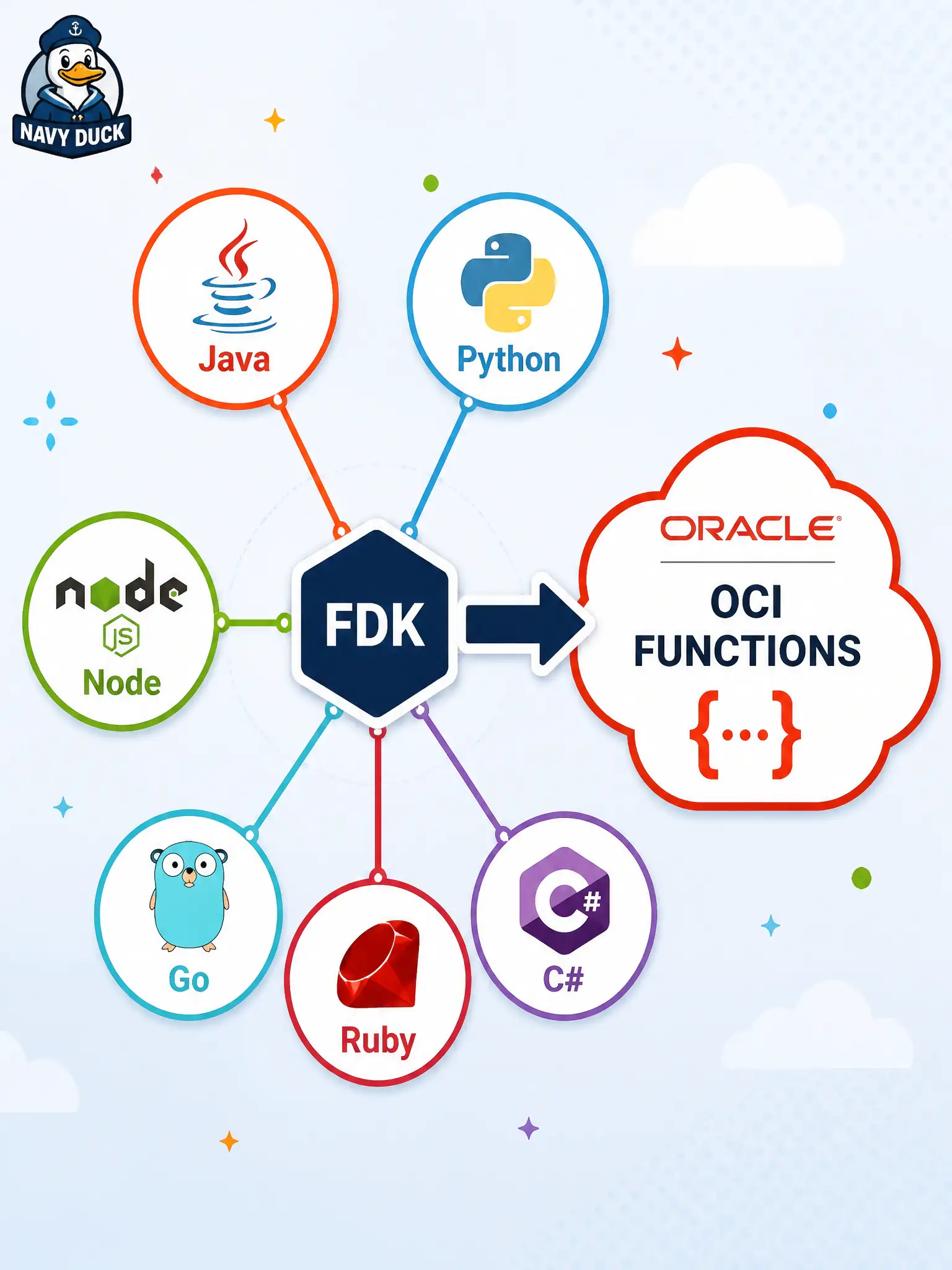
Pick the language your team already ships—Java, Python, Node, Go, Ruby, or C#—and use that language’s FDK as the handler contract. The tenancy does not force a single runtime for everyone.
Full Explanation
When a library IT team implements an OCI Function with the documented Fn Development Kit, official runtime guidance is that supported FDK languages include Java, Python, Node, Go, Ruby, and C#. Teams pick the language they already ship and use that language’s FDK as the handler contract. The tenancy does not force a single runtime for every municipal function.
Claiming only Java is supported and other languages require a separate tenancy fails by concept because the FDK catalog explicitly spans multiple languages in one Functions service, not language-per-tenancy isolation. Requiring handlers to be written as Oracle SQL stored procedures fails because Functions handlers are containerized code units via Fn/FDK, not database stored procedures as the primary model. Requiring Rust WASM modules for every production function fails because WASM/Rust is not the mandated universal production runtime in the documented FDK language set.
Exam caveat: “supported FDK language” is not the same as “any container will behave identically”—memory, timeout, and cold-start characteristics still vary by runtime and packaging. Operational check: scaffold with fn init --runtime for the team’s chosen language, deploy to a Functions application, invoke once, and confirm the FDK entrypoint contract matches library coding standards before expanding the estate.