
A municipal development team wants a CNCF-conformant Kubernetes API on OCI without operating control-plane VMs. Which OCI service provides that?
Select an answer to reveal the explanation.
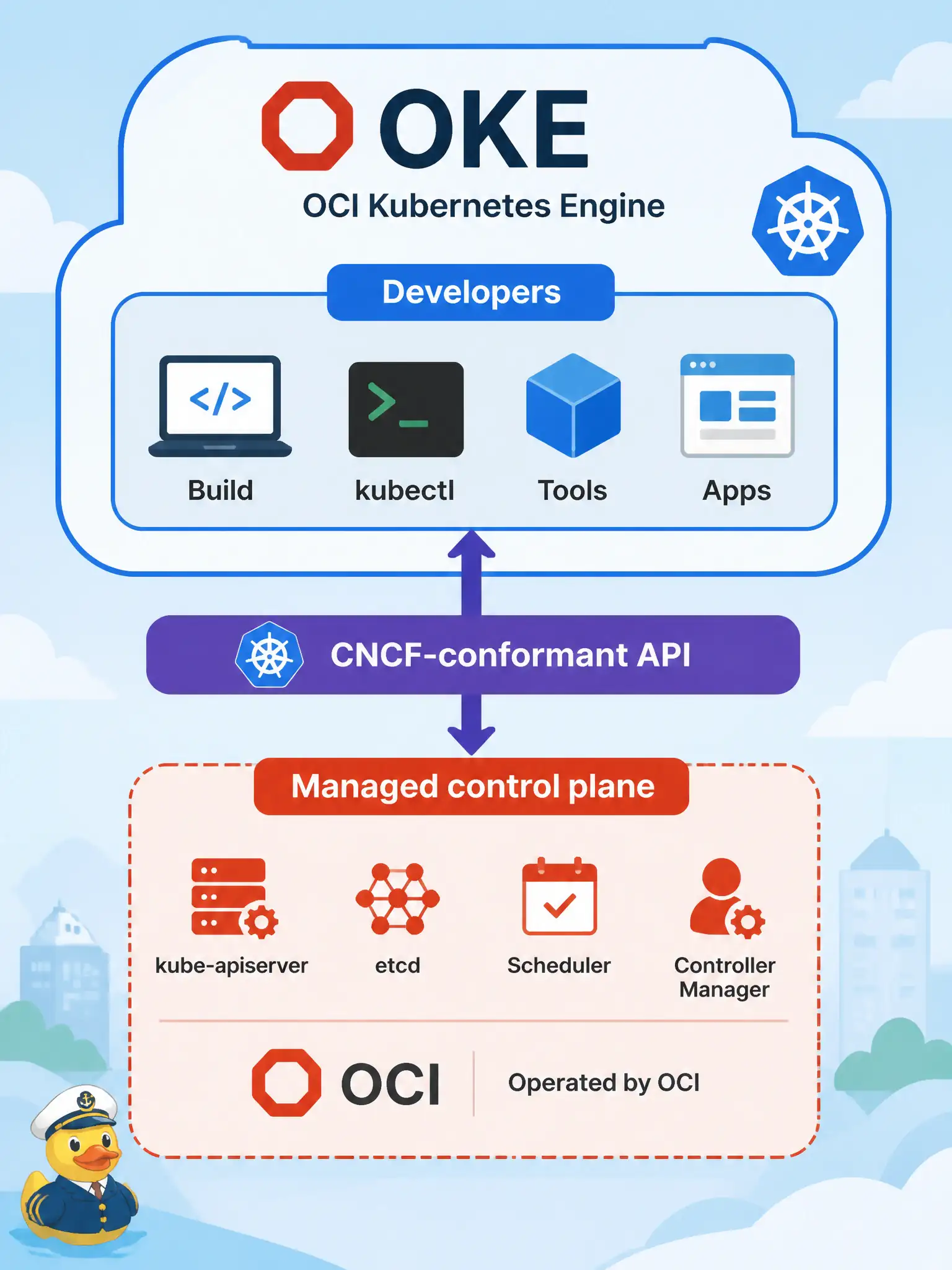
Short Explanation
OKE is OCI’s managed Kubernetes: you get a CNCF-conformant API and OCI runs the control plane. Older materials saying Container Engine for Kubernetes mean the same service. It is not Object Storage, Vault, or Streaming wearing a cluster hat.
Full Explanation
Municipal teams that want a CNCF-conformant Kubernetes API on OCI without operating control-plane VMs use Oracle Cloud Infrastructure Kubernetes Engine (OKE)—historically also called Container Engine for Kubernetes in older materials. OKE exposes the standard Kubernetes API so kubectl and controllers work as elsewhere; OCI runs the managed control plane while your node pools run the workloads. Object Storage is an object store for blobs and backups; configuring a bucket as kube-apiserver is not a supported control plane and cannot schedule Pods. Vault manages secrets, keys, and certificates; it is not a managed etcd offering that replaces the Kubernetes control plane for application Pods. Streaming topics move messages between producers and consumers; they are not the cluster scheduler and do not place containers onto workers. Exam caveat: older documentation saying “Container Engine for Kubernetes” refers to the same OKE service—do not treat the legacy product name as a different SKU you must pick separately on the exam. Operational check: provision OKE, obtain kubeconfig for the cluster endpoint, run kubectl cluster-info and get nodes, and confirm no self-managed control-plane VMs were required to expose the Kubernetes API.