
A clerk is debugging a single container locally, and a separate short-lived event handler will run as an Oracle Function. When does a multi-node orchestrated cluster earn its keep?
Select an answer to reveal the explanation.
Short Explanation
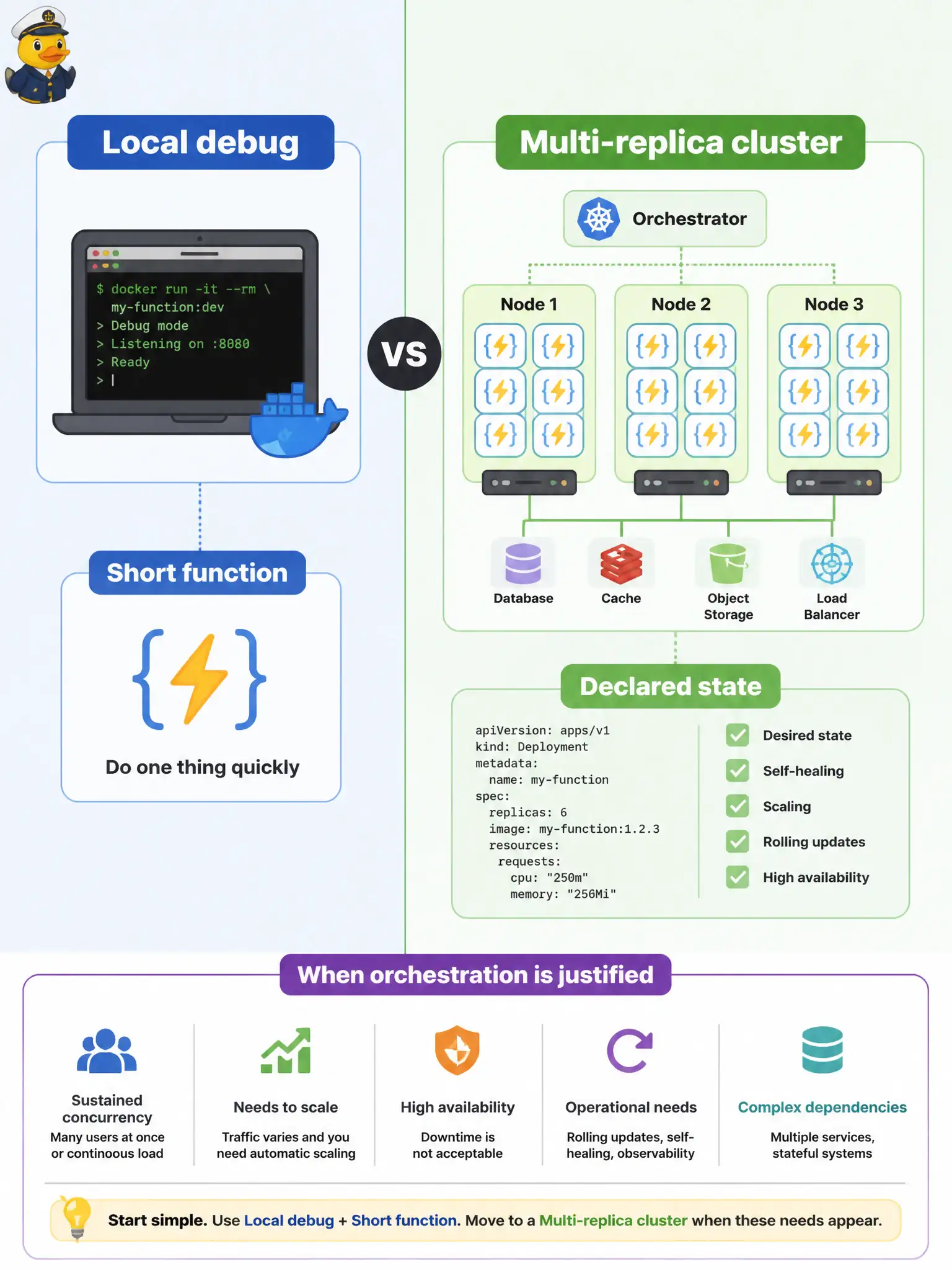
Not every process needs a city transit control center. Local debug and short Functions often skip a multi-node control plane. Orchestration pays off when many replicas and hosts must stay at a declared state without manual babysitting.
Full Explanation
A multi-node orchestrated cluster earns its keep when many replicas across hosts must honor a declared desired state you refuse to babysit by hand—scheduling, healing, scaling, and discovery at cluster scope. Local debugging of a single container does not need that control plane, and a short-lived Oracle Function is an event-driven invocation model without a standing replica set to reconcile. Always creating a three-node OKE cluster before every local debug container wastes time and money and confuses develop-inner-loop with production orchestration. Treating any process that might run—including one-off Fn calls—as requiring a multi-node cluster over-applies Kubernetes to workloads that have a different runtime contract. Claiming orchestration applies only when Autonomous Database is the application runtime confuses a managed database with a container orchestrator. Exam caveat: small always-on services can still warrant OKE for consistency with the city’s platform standards even at low replica counts—the deciding factor is whether you need declarative multi-host lifecycle, not database brand. Operational check: keep local docker/Podman for single-container debug, use Functions for short event handlers, and reserve OKE for multi-replica declared workloads you will not SSH-heal.