
A transit app team needs scheduling, desired replica state, horizontal scale, and stable service discovery on OKE. Which product family correctly covers those needs for this exam item?
Select an answer to reveal the explanation.
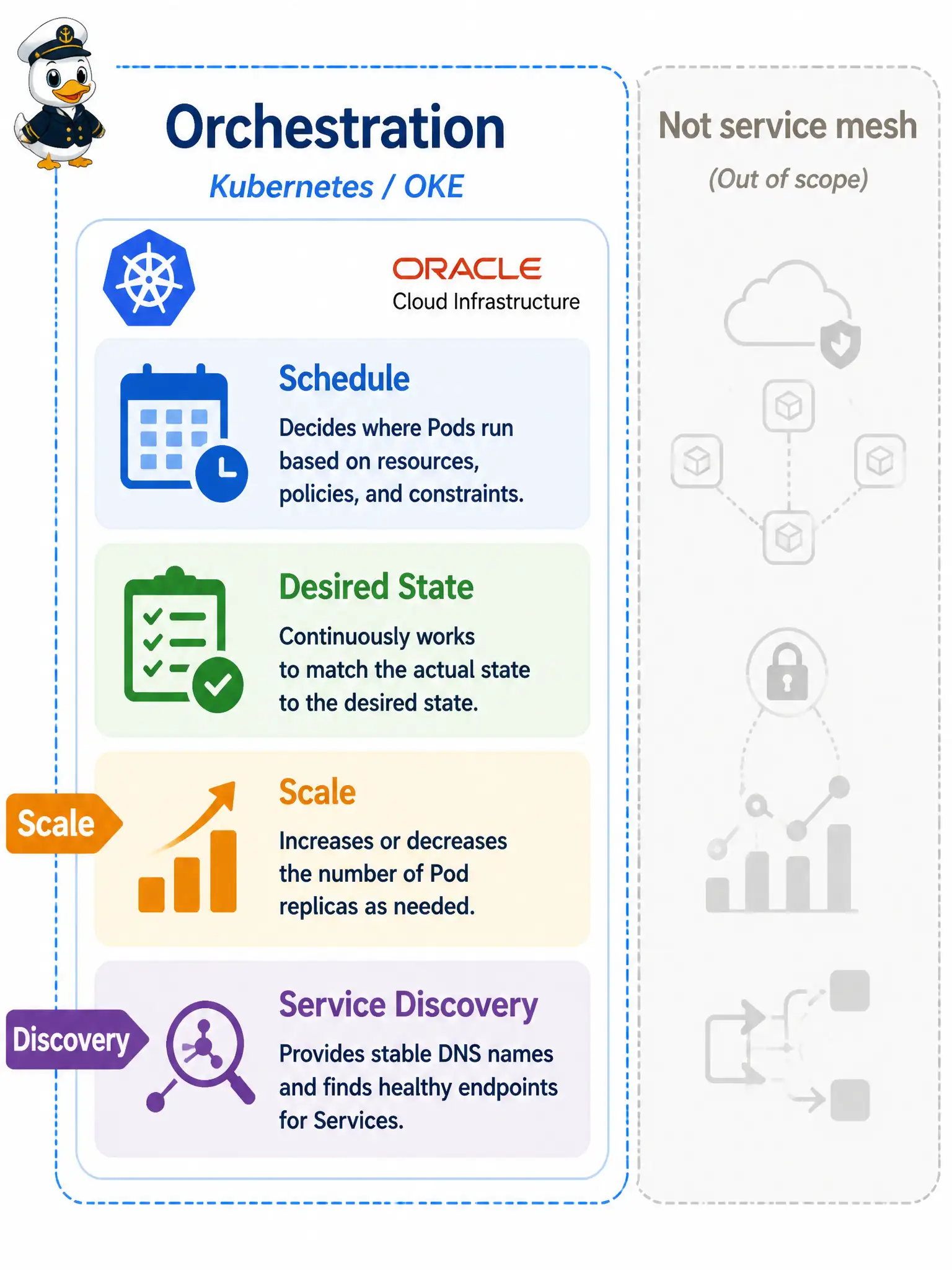
Short Explanation
Scheduling, desired state, scale, and discovery are orchestration jobs. A sidecar mesh that rewrites traffic and manages mTLS is a different product family. This bank keeps answers inside orchestration—not Service Mesh or Istio syllabi.
Full Explanation
Scheduling containers onto workers, maintaining desired replica state, scaling horizontally, and providing stable service discovery are container orchestration responsibilities—exactly what Kubernetes on OKE is designed to cover. The exam item is asking for that product family as the primary answer, not for a traffic-management mesh layered on top of an already orchestrated cluster. A sidecar service mesh that issues mTLS identities and stores retry policies is valuable for zero-trust east-west traffic and resiliency, but it does not replace the scheduler, Deployment replica counts, or core Service discovery. Calling OCI Service Mesh the required control plane for replica counts misattributes replica controllers and the Kubernetes API to the mesh product. Istio gateways terminate and route mesh or edge traffic; they do not replace Deployments and ReplicaSets as the objects that keep replicas running and updated. Exam caveat: meshes often assume orchestration already exists—you still need Pods, Services, and controllers underneath before sidecars and gateways add value. Operational check: map each stated need (schedule, desired state, scale, discovery) to Kubernetes primitives on OKE, and treat mesh mTLS or retries as an optional adjacent concern rather than the orchestration answer on this item.