
A parks department team deploys containers on OKE. Which split correctly describes how orchestration separates decision-making from execution?
Select an answer to reveal the explanation.
Short Explanation
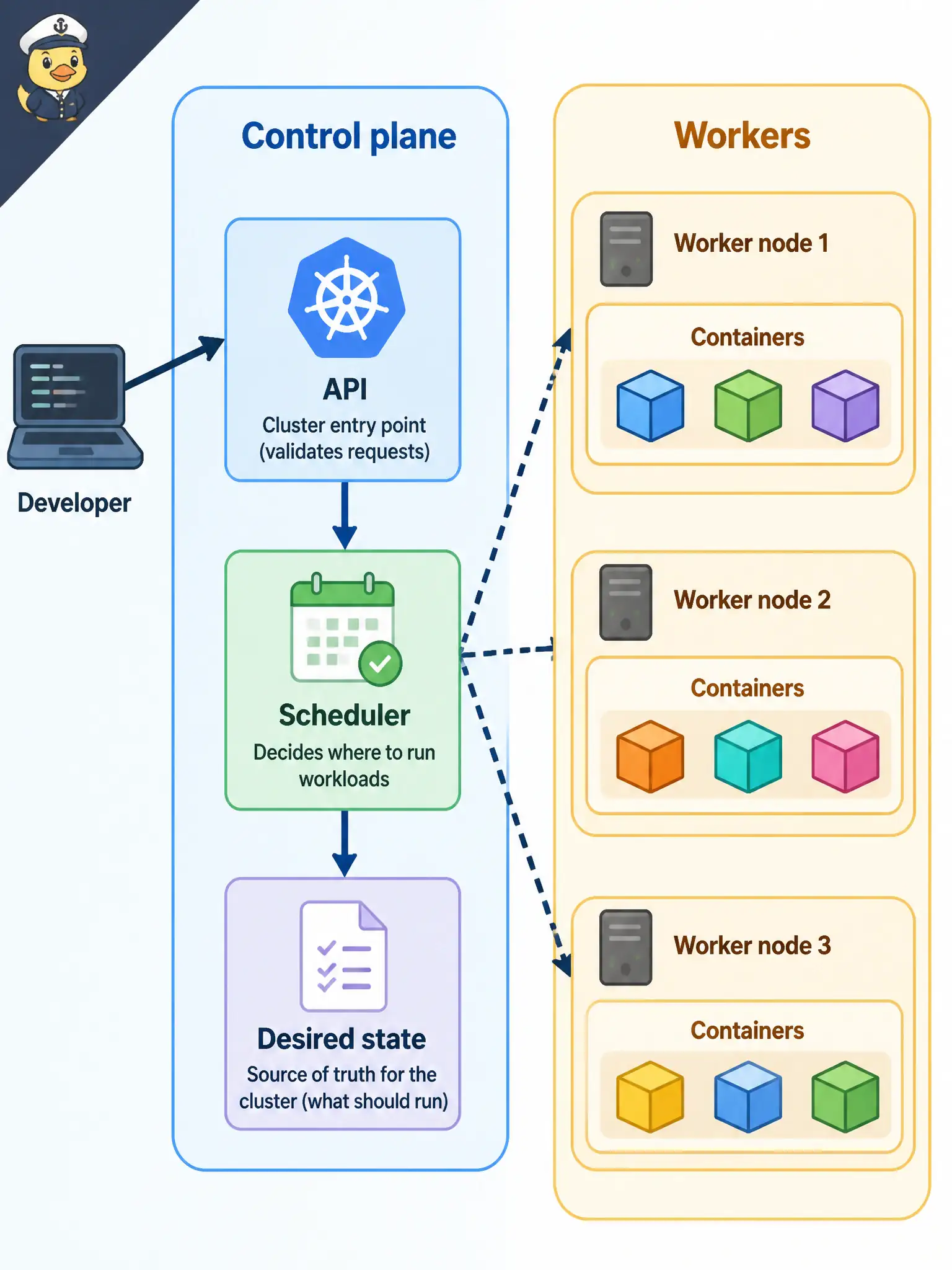
The control plane is the brain; workers are the hands. Developers talk to the API about desired state, and workers actually run the containers. You do not SSH host-by-host to start every process.
Full Explanation
Orchestration separates decision-making from execution: the control plane exposes the API, runs the scheduler, and stores desired state; worker machines pull assignments and run the containers. Developers declare what should run; workers are the execution surface. That split lets the cluster reconcile continuously without humans starting processes host by host. Having developers SSH to every worker while the control plane only stores billing tags inverts the model—placement and lifecycle become imperative chores, and desired state is not enforced. Letting each worker invent desired state without a shared API produces drift and conflicting local truths; there is no cluster-wide contract to converge. Object Storage holds blobs; it is not the scheduler and does not place Pods onto CPU and memory. Exam caveat: managed OKE still has this split—Oracle operates the control plane APIs, and your node pools are the workers—yet you still talk to the Kubernetes API rather than SSHing apps onto nodes. Operational check: confirm kubectl talks to the API server endpoint from kubeconfig, list nodes as workers, and verify new Pods appear via scheduling events rather than manual process starts on hosts.