
A county IT board asks which industry orchestrator this OCI developer path standardizes on, and which OCI service delivers that API without the city running control-plane VMs. What is the correct pairing?
Select an answer to reveal the explanation.
Short Explanation
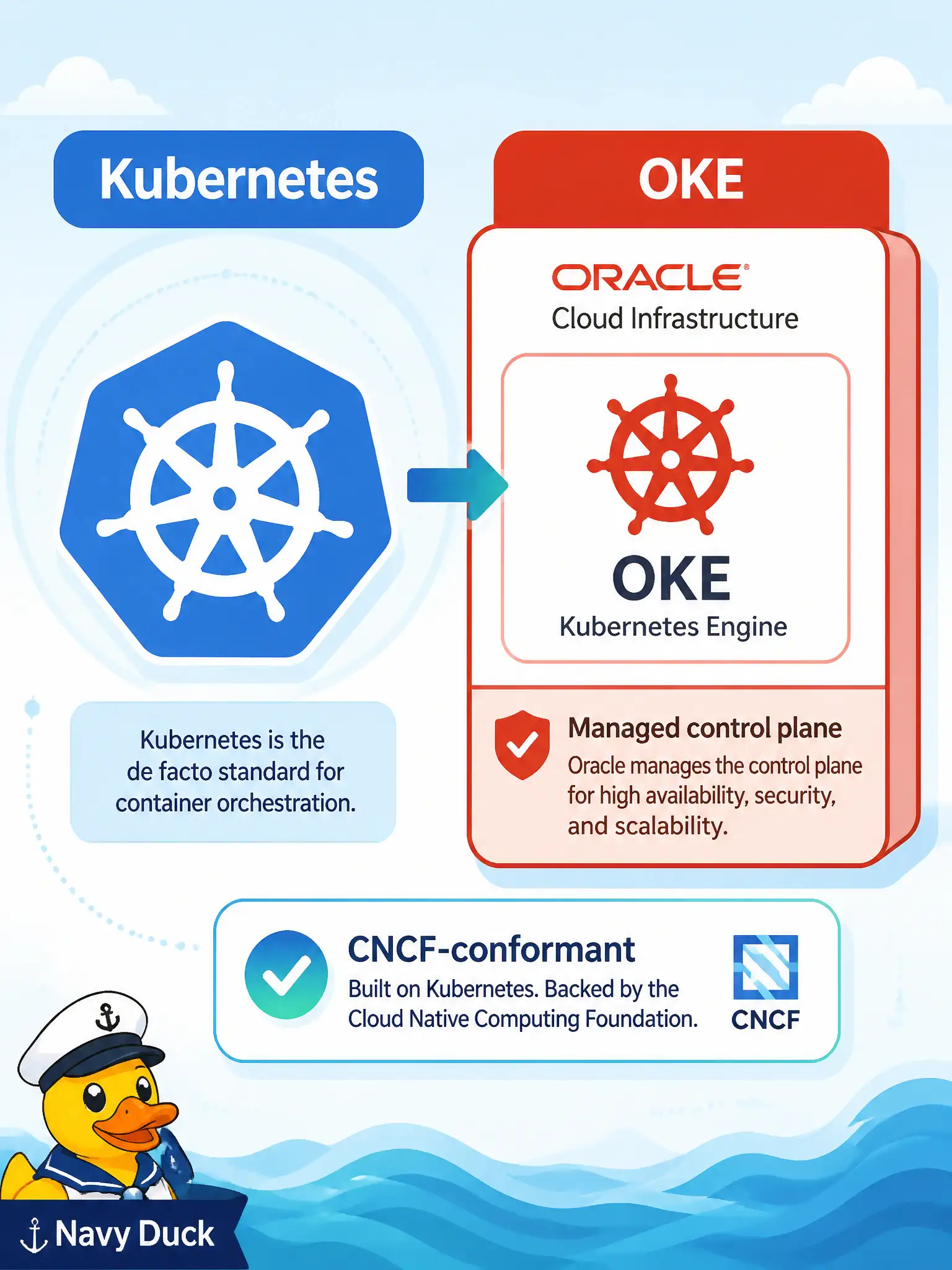
Kubernetes is the industry orchestrator this exam names; OKE is OCI’s managed way to get that API. You get CNCF-conformant Kubernetes without babysitting control-plane VMs. Older “Container Engine for Kubernetes” branding is the same OKE service.
Full Explanation
This OCI developer path standardizes on Kubernetes as the CNCF-conformant orchestrator and on Oracle Cloud Infrastructure Kubernetes Engine (OKE) as the managed service that delivers that API without the city running control-plane VMs. You get the industry Kubernetes contract for scheduling, desired state, and services; OCI operates the apiserver and related control-plane components. Docker Swarm is a different orchestrator and is not paired with Autonomous Database as a managed Kubernetes control plane—ADB is a database service, not etcd/apiserver. Apache Mesos is not the named orchestrator for this exam path, and Functions replace event-driven compute workloads rather than worker node pools that run Kubernetes Pods. Nomad is another orchestrator family outside this standardization, and API Gateway terminates and routes HTTP APIs—it does not host etcd or serve as the Kubernetes control plane. Exam caveat: “managed” means you still operate workloads, node pools, networking, IAM mappings, and RBAC—you simply do not babysit etcd and apiserver VMs yourself. Operational check: create or inspect an OKE cluster, download kubeconfig, run kubectl get nodes against the Kubernetes API, and confirm you never SSH’d to a control-plane VM to start kube-apiserver.