
A single Docker Engine on one host can docker run the city’s FAQ API. Why is that still not container orchestration?
Select an answer to reveal the explanation.
Short Explanation
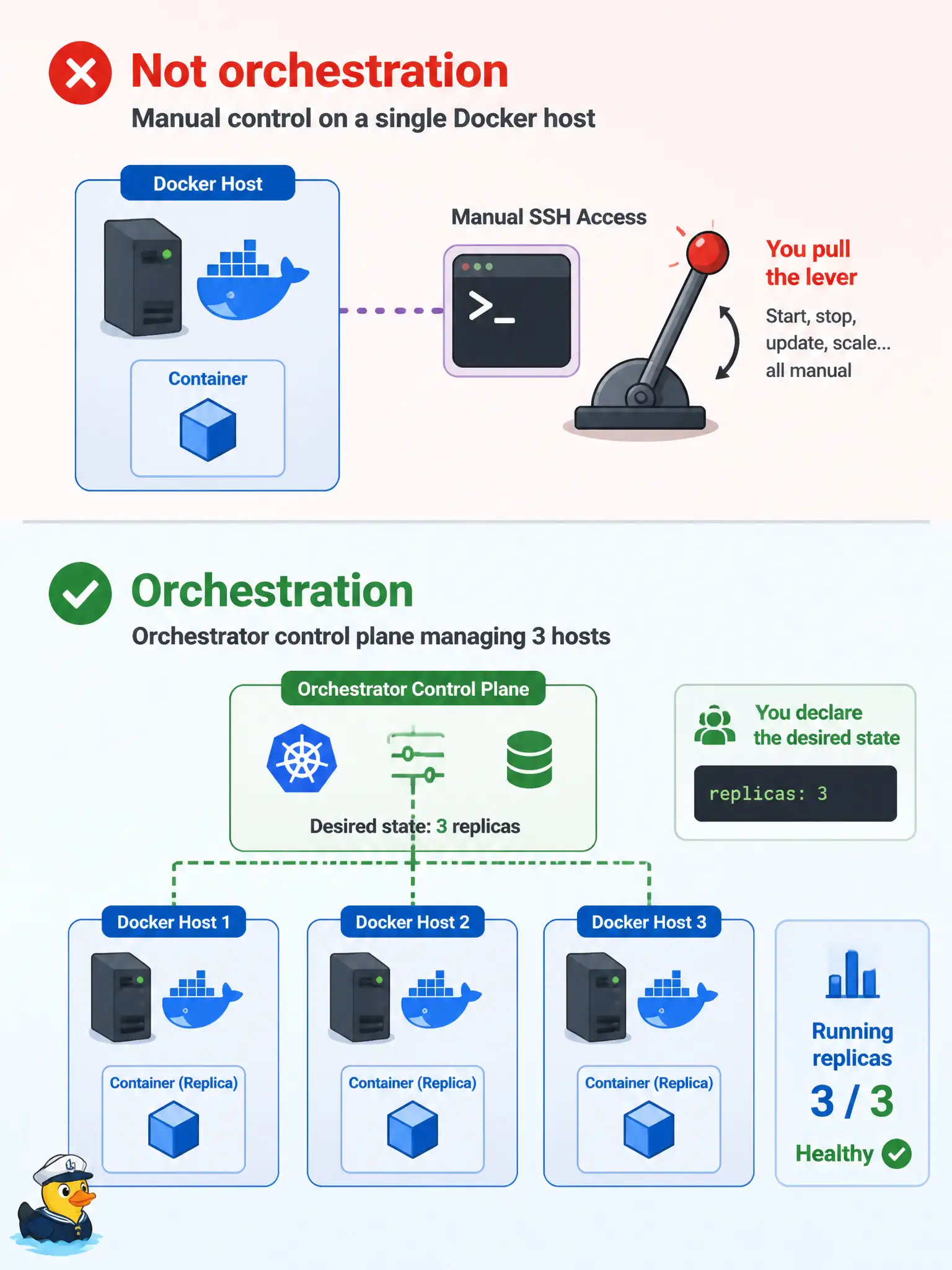
SSH plus docker run can start a container. It cannot place replicas across failed hosts, hold a declared count, or roll images without you. That gap is orchestration.
Full Explanation
Container orchestration is more than starting a process. A single Docker Engine on one host can docker run the city’s FAQ API, but that host—typically operated by SSH—does not place replicas across failed machines, continuously maintain a declared replica count, or roll a new image across a fleet without a human driving each step. Those gaps are exactly why orchestrators exist: scheduling, self-healing, and controlled rollout across a cluster.
docker run does not automatically place replicas across failed hosts without an orchestrator. A lone Engine does not continuously reconcile a declared replica count by itself the way a control plane does. Docker Engine does not refuse to start containers until OKE is installed on the laptop; local Engine use is valid for development and single-host runs—it simply is not orchestration.
Exam caveat: compose on one host can start multiple containers together but still lacks multi-host placement and cluster-level reconciliation. Operational check: list what happens if the FAQ host dies—if the answer is “someone SSHs to another box and docker runs again,” you have demonstrated the orchestration gap and the case for a scheduler that recreates the workload elsewhere from desired state.