
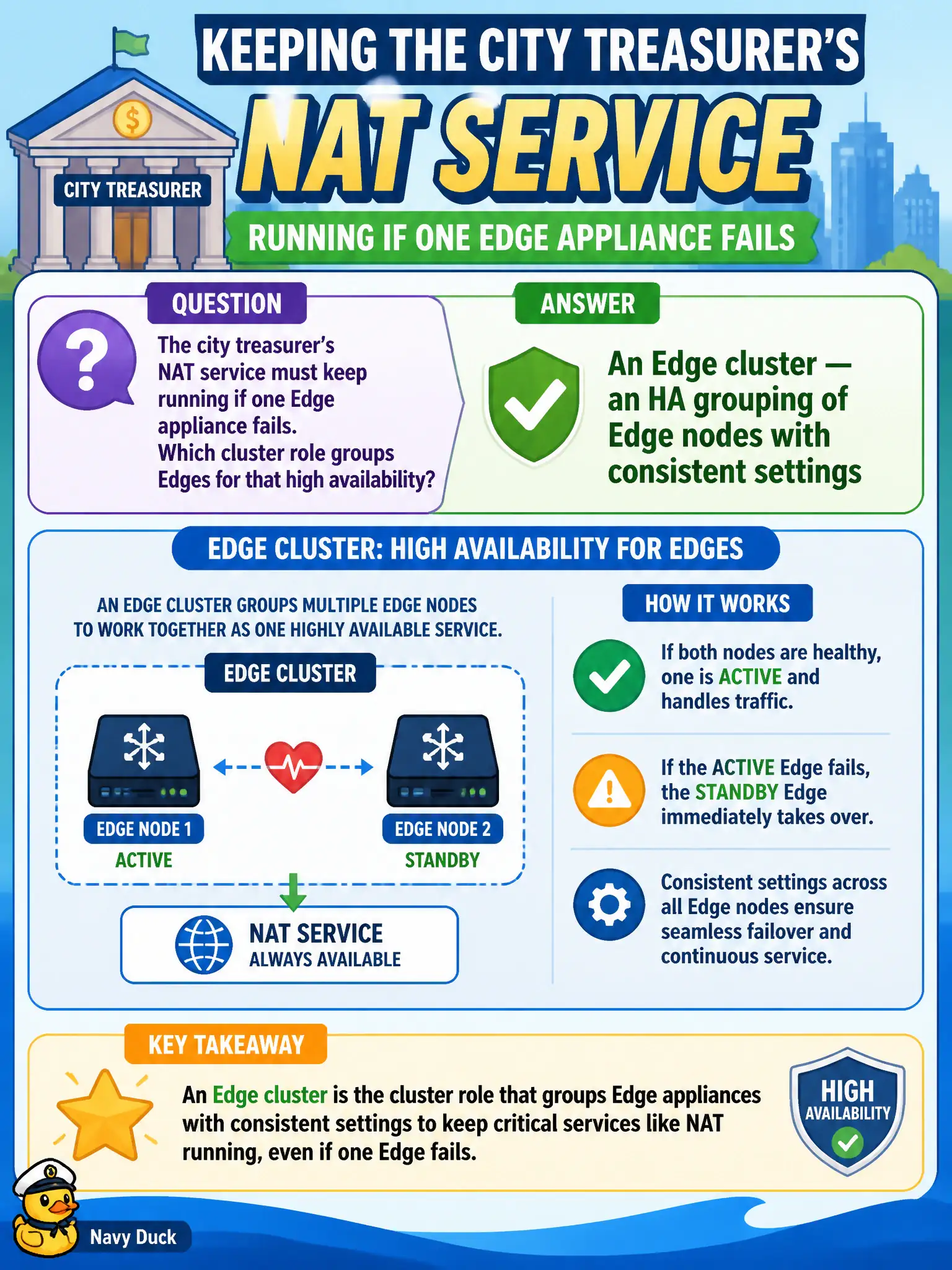
The city treasurer's NAT service must keep running if one Edge appliance fails. Which cluster role groups Edges for that high availability?
Select an answer to reveal the explanation.
Short Explanation
Put two Edge booths in one Edge cluster so the treasurer's NAT still has a booth if one appliance fails. DRS seats VMs, a Horizon pod is desktops, and a vSAN fault domain is disks — none of those is the Edge HA group.
Full Explanation
An Edge cluster is a high-availability grouping of NSX Edge nodes that share consistent settings so centralized services such as the city treasurer's NAT can fail over if one Edge appliance fails. Put two Edge booths in one Edge cluster so NAT still has a booth when one appliance is down. A vSphere DRS cluster balances compute placement of VMs; it is not the NAT engine and does not group Edges for service HA. A Horizon pod is an EUC construct for desktop services, not NSX Edge HA. A vSAN fault domain organizes storage failure domains and does not terminate VPN or NAT for finance. Exam caveat: Edge cluster membership and consistent sizing matter for stateful services; simply deploying two unrelated Edges without an Edge cluster is not the HA construct the exam names. Operational check: place treasurer NAT on an Edge cluster with at least two nodes, simulate one Edge failure or maintenance, confirm NAT continuity on the surviving member, and verify DRS, Horizon pods, and vSAN fault domains were not used as the HA group. Keep the civic framing visible in runbooks so the next operator can restate why the correct control fits the agency outcome, why each distractor fails by concept, and which Manager or fabric view proves the design after change.