
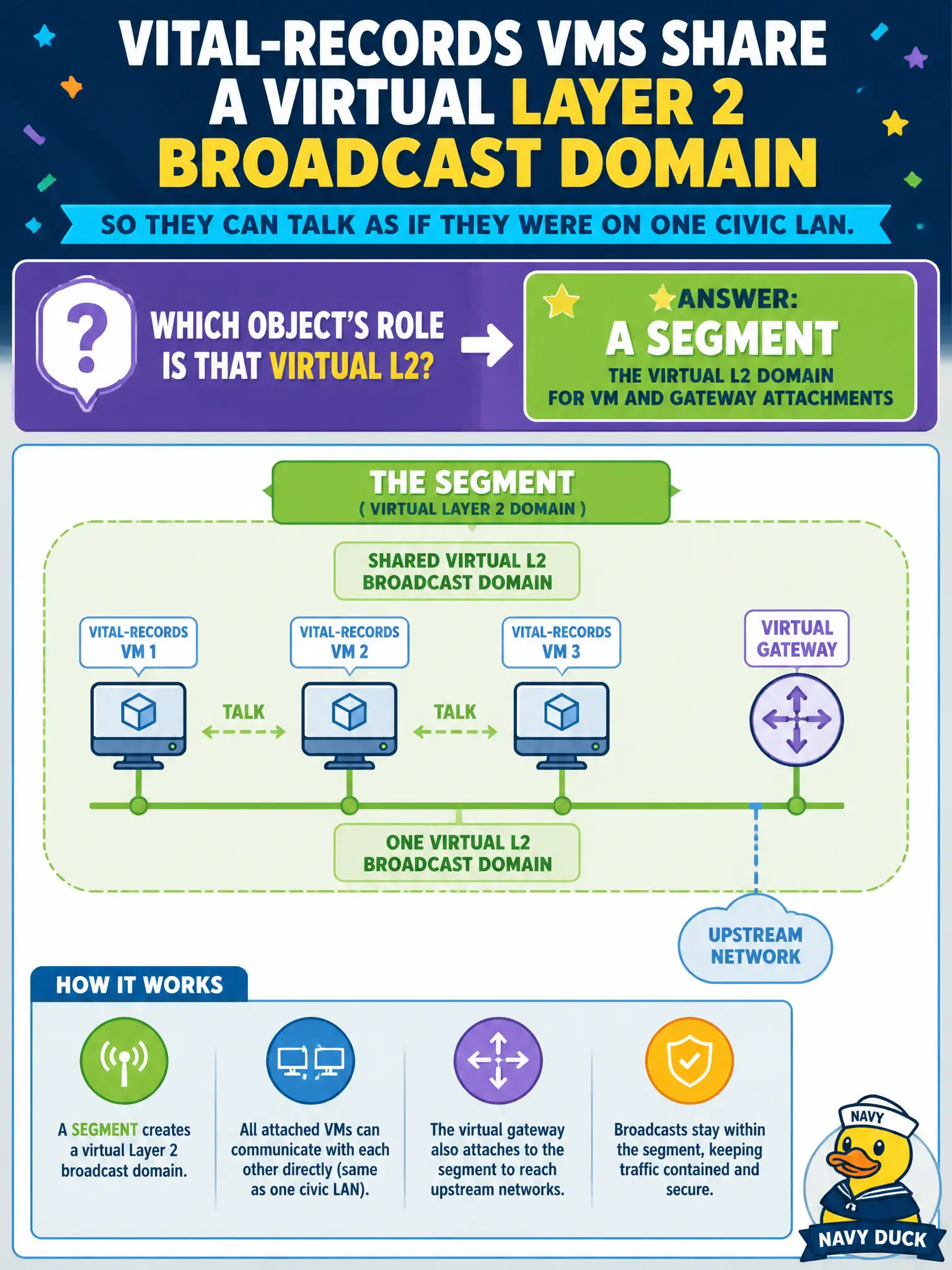
Vital-records VMs must share a virtual Layer 2 broadcast domain so they can talk as if they were on one civic LAN. Which object's role is that virtual L2?
Select an answer to reveal the explanation.
Short Explanation
A segment is the virtual hallway the vital-records VMs share — one Layer 2 room, even across hosts. Disk groups, alarms, and Horizon pools are not that hallway.
Full Explanation
A segment is the Policy-mode virtual Layer 2 broadcast domain. Vital-records VMs and gateways attach to it so they share L2 connectivity across transport nodes in the segment's transport zone—one virtual hallway even when the VMs sit on different prepared hosts in the civic cluster. A vSAN disk group is a storage construct and does not provide that civic LAN. A vCenter alarm is a compute alerting object, not a broadcast domain for application traffic. A Horizon application pool publishes applications to entitlements and is not the NSX L2 construct. Exam caveat: segment span is still bounded by transport-zone membership; creating a segment without placing hosts in the correct zone will not yield the shared L2 the vital-records team expects. Operational check: attach two vital-records test VMs on different hosts to the same segment, verify L2 adjacency such as ARP or ping, confirm the segment's transport zone includes both hosts, and reject disk groups, alarms, and Horizon pools as substitutes for the segment. Keep the civic framing visible in runbooks so the next operator can restate why the correct control fits the agency outcome, why each distractor fails by concept, and which Manager or fabric view proves the design after change.