
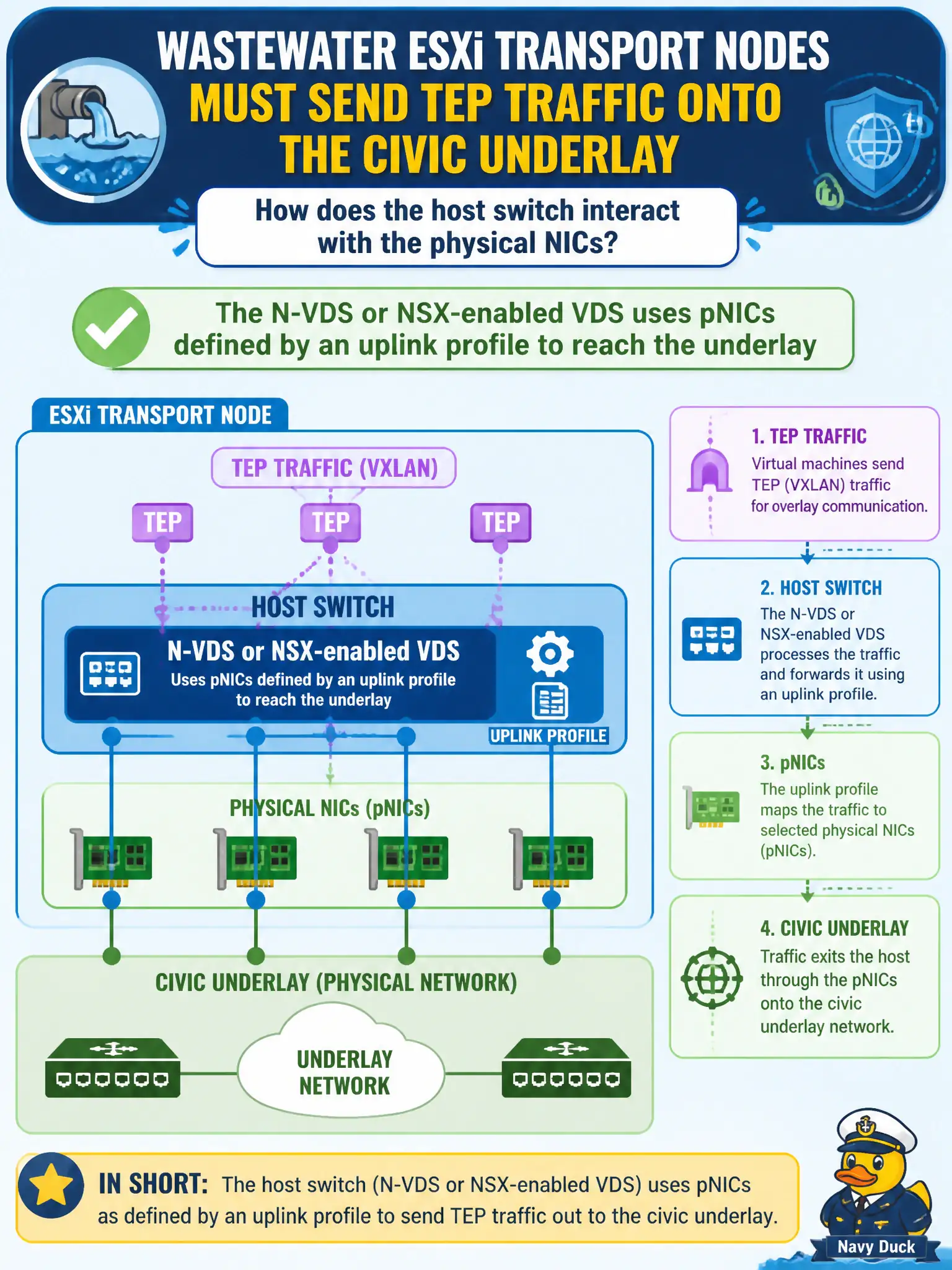
Wastewater ESXi transport nodes must send TEP traffic onto the civic underlay. How does the host switch interact with the physical NICs?
Select an answer to reveal the explanation.
Short Explanation
The host switch is the on-ramp; the uplink profile names which physical NICs hit the street. TEP traffic rides those pNICs onto the underlay. vSAN, Horizon BLAST, and a sensor are not that on-ramp.
Full Explanation
On a transport node, the N-VDS or NSX-enabled VDS uses physical NICs listed in an uplink profile to reach the underlay that carries TEP traffic for wastewater ESXi hosts. The host switch is the on-ramp; the uplink profile names which pNICs hit the street so Geneve-encapsulated TEP traffic can leave the hypervisor toward the civic underlay. Geneve does not run only inside vSAN and never use pNICs; storage fabrics are not a substitute underlay path for overlay TEPs. Horizon BLAST is a desktop display protocol and is not the underlay uplink for TEP frames. Carbon Black sensors inspect endpoints and do not become the host uplinks for NSX. Exam caveat: uplink teaming, VLAN tagging for TEPs, and MTU must align with the underlay design—wrong pNIC mapping in the uplink profile is a common transport-node preparation failure that breaks overlay adjacency. Operational check: review the uplink profile applied to wastewater hosts, confirm the named pNICs show underlay connectivity for TEP interfaces, generate a test overlay flow between hosts, and validate TEPs are not mistakenly associated with vSAN-only, BLAST, or sensor paths. Keep the civic framing visible in runbooks so the next operator can restate why the correct control fits the agency outcome, why each distractor fails by concept, and which Manager or fabric view proves the design after change.