
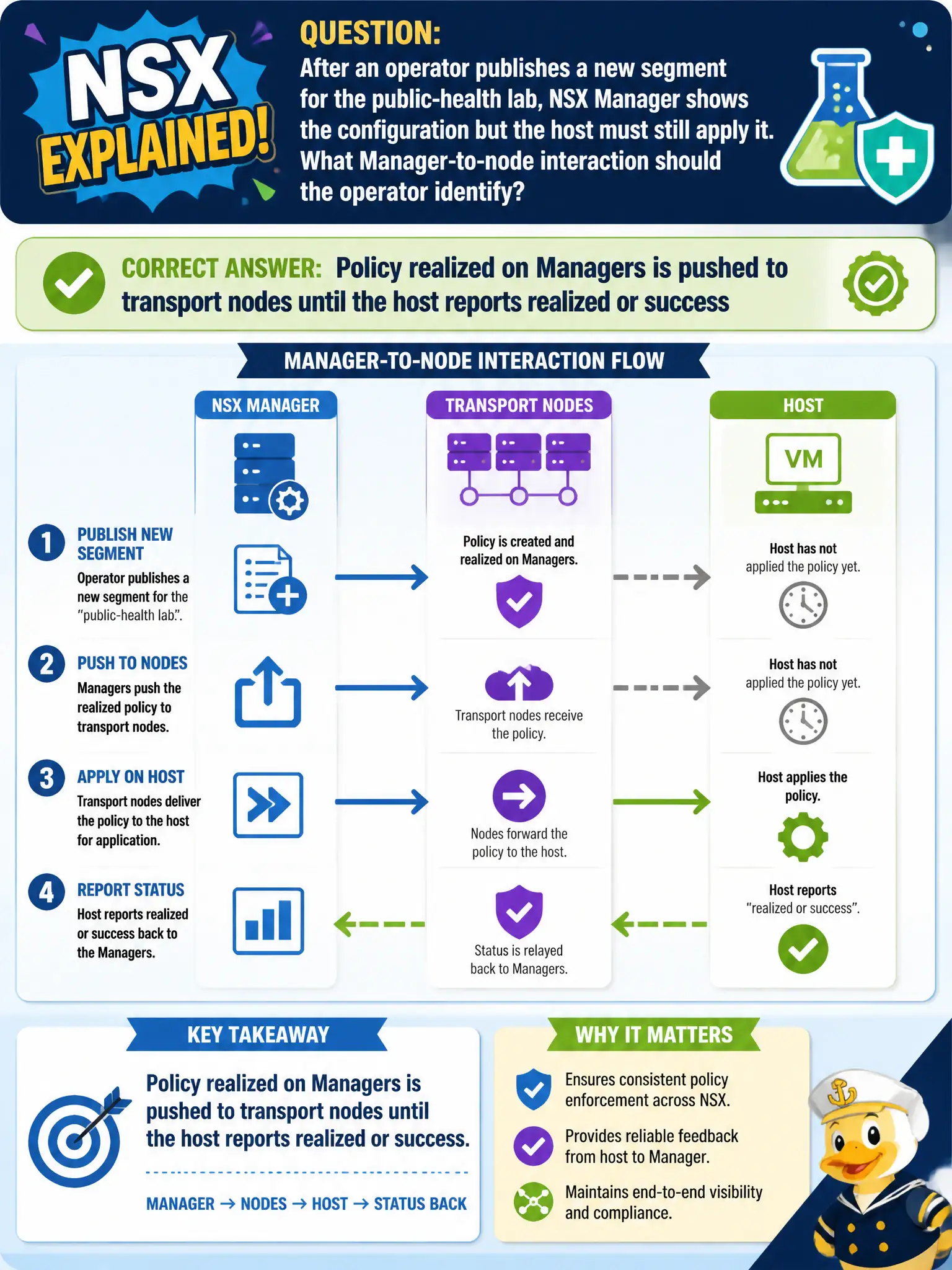
After an operator publishes a new segment for the public-health lab, NSX Manager shows the configuration but the host must still apply it. What Manager-to-node interaction should the operator identify?
Select an answer to reveal the explanation.
Short Explanation
Publishing the lab segment is like filing a work order at city hall. Manager still has to deliver that order to each prepared host and wait for a realized or success stamp. Content libraries, Horizon, and vSAN health are not that delivery.
Full Explanation
Configuration realized on NSX Manager is pushed to transport nodes until the host reports realized or success. Publishing a new segment for the public-health lab is like filing a work order at city hall—Manager must still deliver that order to each prepared host and wait for the realized stamp before operators treat the change as live on the fabric. Operators identify that Manager-to-node realization path in the UI rather than treating the problem as an unrelated packet-capture hobby. vCenter content libraries distribute images and templates; they do not push NSX segments to hosts. Horizon Connection Server does not realize NSX segments on transport nodes. Realization is not a vSAN health check and must not be read from storage dashboards alone. Exam caveat: a segment can look correct in Manager while unrealized on a host—always confirm realization status on the transport nodes that should carry the lab network before blaming the underlay. Operational check: after publishing the lab segment, open realization details for affected hosts, confirm success on prepared nodes, and verify a host that never received realization cannot attach VMs to that segment in inventory. Keep the civic framing visible in runbooks so the next operator can restate why the correct control fits the agency outcome, why each distractor fails by concept, and which Manager or fabric view proves the design after change.