
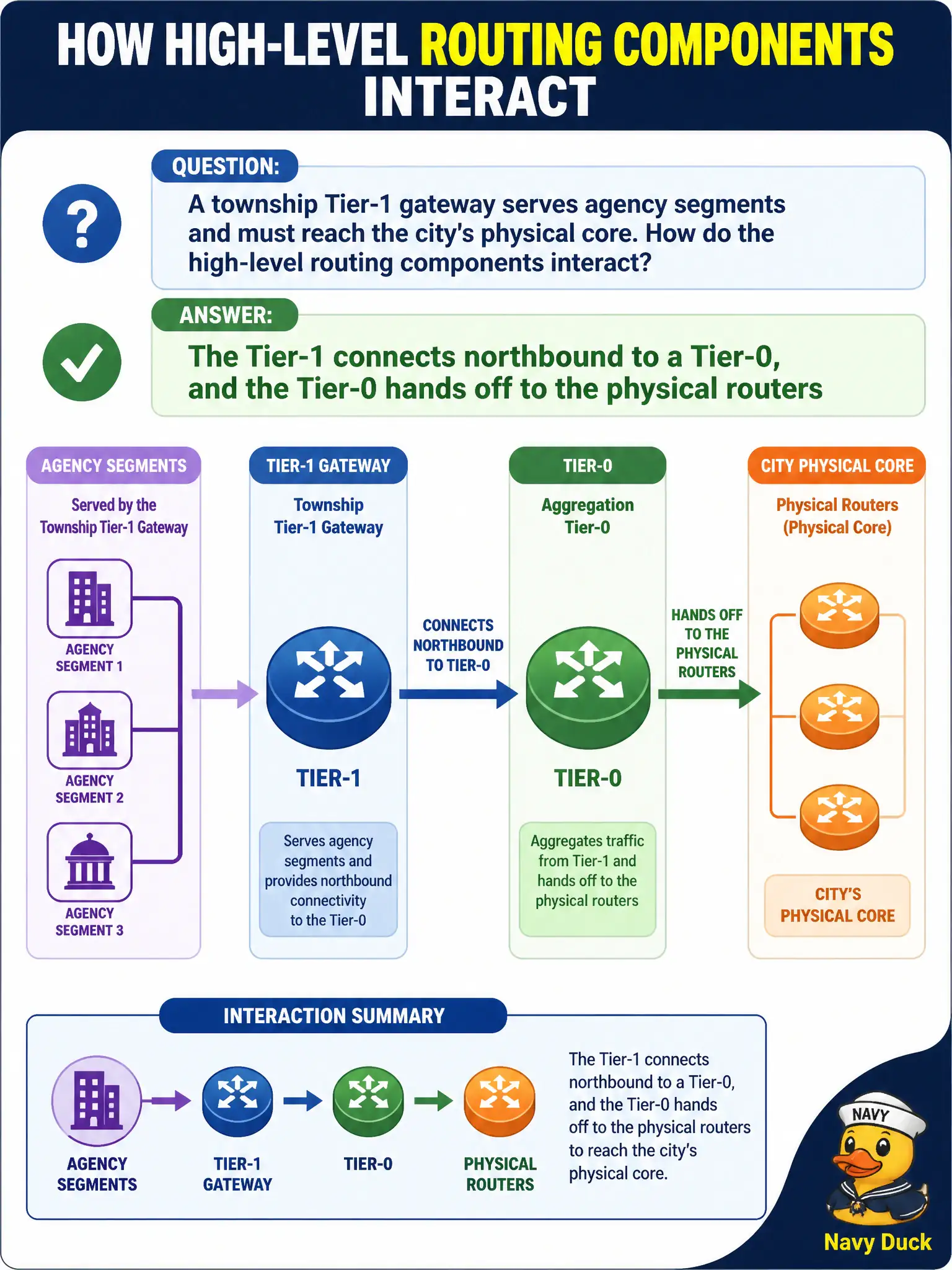
A township Tier-1 gateway serves agency segments and must reach the city's physical core. How do the high-level routing components interact?
Select an answer to reveal the explanation.
Short Explanation
Think of Tier-1 as the agency lobby and Tier-0 as the street exit. Segments hang off Tier-1; Tier-0 talks to the physical core. Skipping Tier-0 or routing through Horizon is the wrong handoff.
Full Explanation
In NSX two-tier routing, a Tier-1 gateway is southbound to agency segments and northbound to a Tier-0 gateway; the Tier-0 provides the handoff to the city's physical core routers. Think of Tier-1 as the agency lobby and Tier-0 as the street exit—segments hang off Tier-1, and Tier-0 talks to the physical core on behalf of those agencies. The Tier-1 does not peer directly with the civic core while skipping Tier-0 in the standard two-tier model this item tests. Agency segments do not bypass both gateways and plug into vSAN for routing; vSAN provides shared storage, not the northbound IP handoff to core routers. Horizon Connection Server brokers virtual desktops and is not the northbound router for the Tier-1. Exam caveat: single-tier designs can attach segments directly to Tier-0, but when the stem describes a Tier-1 serving agency segments that must reach the physical core, the interaction is Tier-1 to Tier-0 to physical routers. Operational check: confirm the township Tier-1 shows a connected Tier-0, verify northbound routes toward the civic core via that Tier-0 with a test VM using the Tier-1 linked gateway as default gateway, and reject designs that treat Horizon or vSAN as the routing handoff.