
Two ESXi transport nodes in the same overlay transport zone host permitting VMs on one segment. How do those hosts interact to exchange overlay frames?
Select an answer to reveal the explanation.
Short Explanation
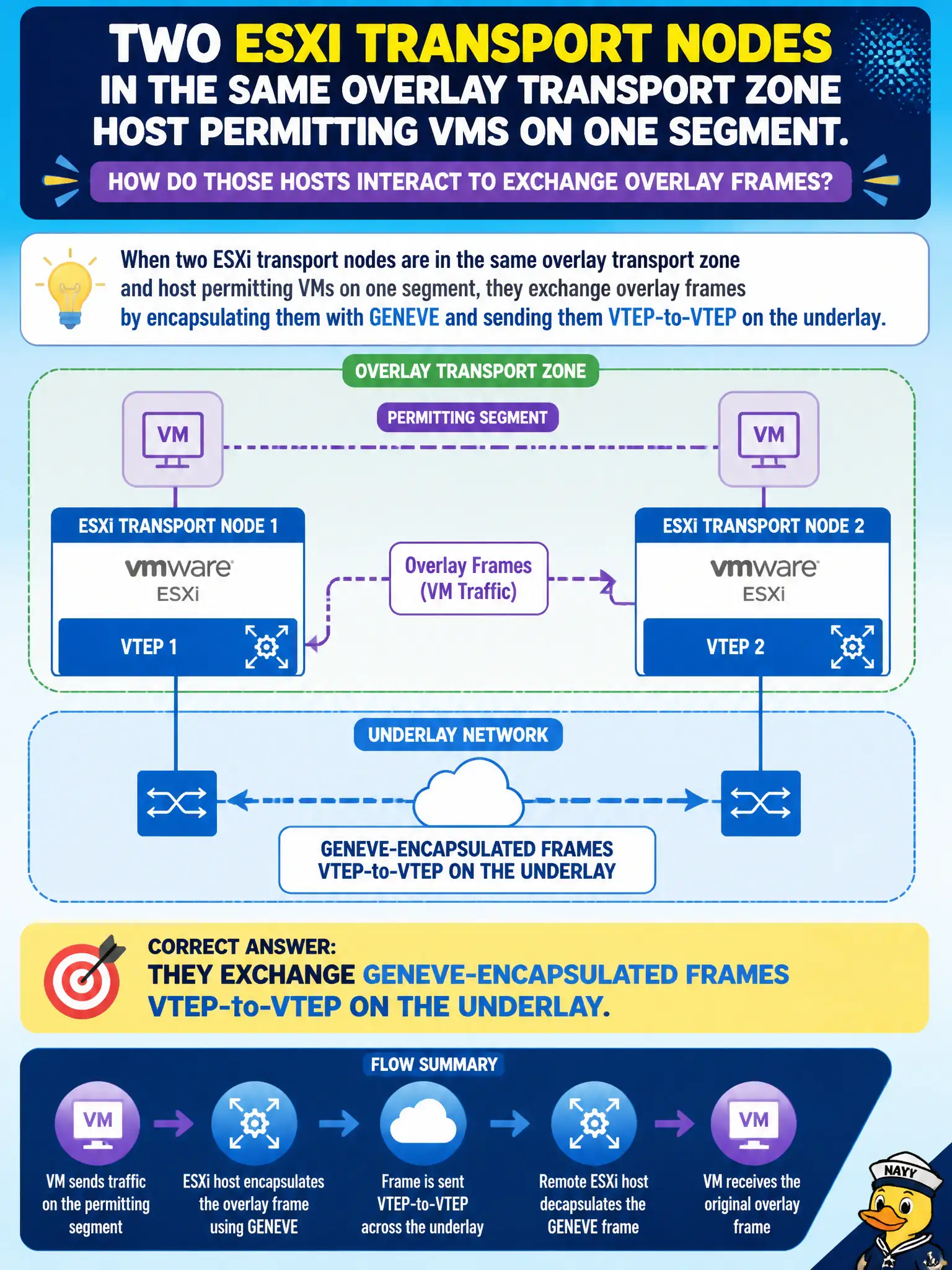
Each prepared host has a tunnel endpoint, like a civic mail chute. Same-segment VMs on different hosts talk Geneve from VTEP to VTEP on the underlay. They do not need Horizon or a firewall hairpin for that hop.
Full Explanation
When two ESXi transport nodes share an overlay transport zone and host permitting VMs on one segment, overlay frames between those VMs on different hosts are encapsulated in Geneve and exchanged VTEP-to-VTEP across the IP underlay. Each prepared host has a tunnel endpoint—like a civic mail chute—and same-segment traffic rides that chute rather than relying on raw VLAN flooding between racks. The hosts do not flood unencapsulated frames onto every physical VLAN as the NSX-T overlay switching method. They do not send tenant frames through Horizon Client instead of the underlay, because Horizon Client is an end-user protocol path, not a VTEP. They do not require a hardware firewall hairpin for every same-segment hop between prepared transport nodes on that overlay segment. Exam caveat: underlay MTU and TEP reachability must support Geneve overhead; encapsulation or underlay failure often looks like "the segment is broken" even when vSphere cluster health is green. Operational check: place test permitting VMs on the same segment on two hosts, use Traceflow or packet captures to confirm Geneve VTEP-to-VTEP forwarding, and verify Horizon Client and hardware hairpin were not part of the overlay path.