
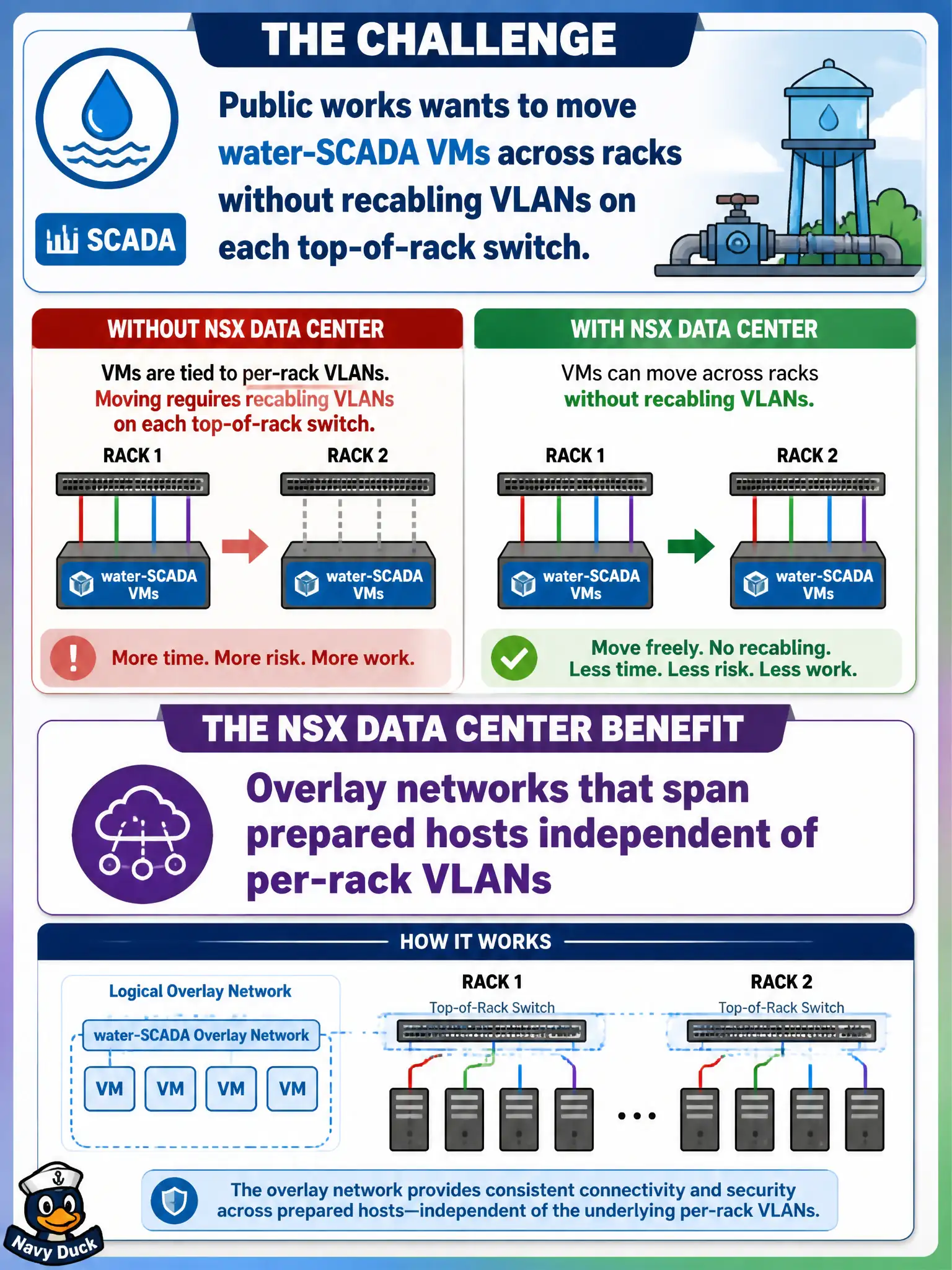
Public works wants to move water-SCADA VMs across racks without recabling VLANs on each top-of-rack switch. Which NSX Data Center benefit matches that use case?
Select an answer to reveal the explanation.
Short Explanation
The overlay is like a city bus route that keeps the same number even when the bus changes streets. Logical networks ride prepared hosts without a per-rack VLAN recable. That independence is the NSX benefit for public-works mobility.
Full Explanation
Moving water-SCADA VMs across racks without recabling VLANs on each top-of-rack switch is enabled by overlay networks that span prepared hosts independent of per-rack VLAN identity. NSX segments ride Geneve between transport-node TEPs, so workload mobility is not blocked by a missing rack VLAN once hosts join the transport zone. Binding each VM to a unique physical switchport for every move restores traditional coupling and defeats the mobility benefit. Requiring a new VLAN on every rack before any vMotion can occur is exactly the underlay dependency overlays remove for tenant networks. Replacing Geneve with per-rack hardware VRFs as the only mobility option keeps the problem in the physical domain. Exam caveat: overlays still need a prepared underlay and TEP reachability, but they do not require the tenant VLAN on every rack. Operational check: vMotion a SCADA test VM between hosts in different racks that share the overlay transport zone, confirm the segment IP and DFW groups remain intact, and verify no emergency ToR VLAN was added for that public-works move. In municipal operations, record the chosen control and the rejected distractors in the change ticket so future on-call staff understand which failure modes would affect city services. Re-validate after the next maintenance window that the same design still holds for the current NSX build and the agency workloads that depend on it.