
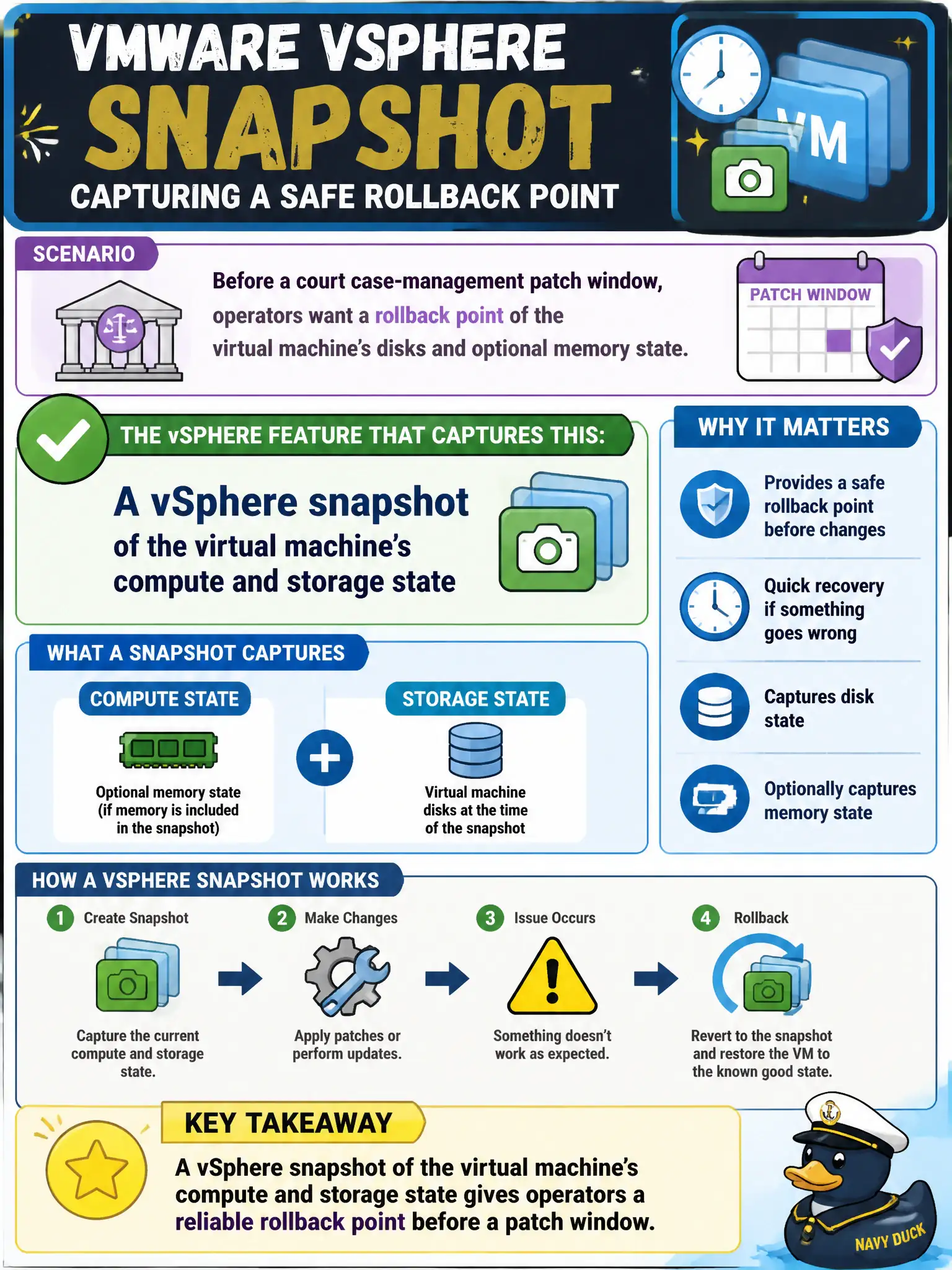
Before a court case-management patch window, operators want a rollback point of the virtual machine's disks and optional memory state. Which vSphere feature captures that?
Select an answer to reveal the explanation.
Short Explanation
A vSphere snapshot is a bookmark in the court VM's diary—disks and maybe RAM—so the patch can be undone. NSX drafts and DFW sections save network policy, not the guest's disks. Intelligence records conversations, not a rollback image.
Full Explanation
Before a court case-management patch window, operators who want a rollback point of the virtual machine’s disks and optional memory state need a vSphere snapshot of the virtual machine’s compute and storage state. A snapshot is a bookmark in the court VM’s diary—disks and maybe RAM—so a bad patch can be undone without restoring from a full backup first. An NSX configuration draft saved in Manager mode preserves fabric configuration intent, not the guest’s virtual disks or in-guest application state. A Distributed Firewall section snapshot is not a standard guest rollback mechanism and confuses security policy versioning with VM snapshots. An NSX Intelligence recording of east-west flows captures traffic visibility for policy design, not a disk rollback point for the case-management guest. Exam caveat: snapshots are powerful but can affect performance and storage if left for long periods; they are not a substitute for backups or replication. Associate depth is identifying the vSphere snapshot feature for VM rollback before risky change windows. Operational check: take a snapshot before patching the court VM, apply the patch, and either consolidate after success or revert if the patch fails; confirm NSX drafts and Intelligence recordings were not mistaken for the guest rollback point in the change plan.