
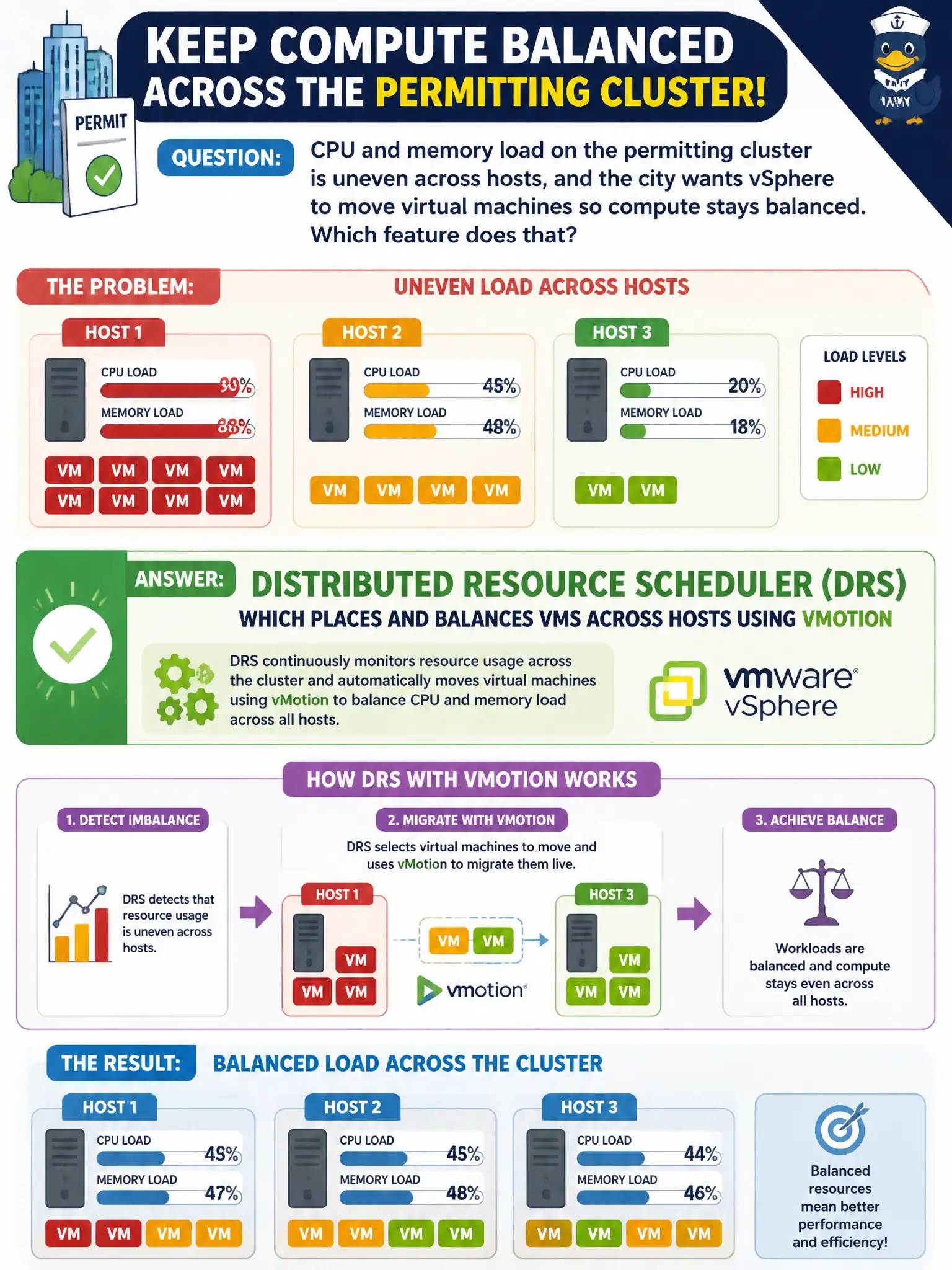
CPU and memory load on the permitting cluster is uneven across hosts, and the city wants vSphere to move virtual machines so compute stays balanced. Which feature does that?
Select an answer to reveal the explanation.
Short Explanation
DRS is the traffic cop that slides busy VMs onto quieter hosts with vMotion. That is compute placement, not a website VIP. NSX load balancing sprays TCP or HTTP sessions at backend IPs, which is a different job.
Full Explanation
When CPU and memory load on the permitting cluster is uneven across hosts and the city wants vSphere to move virtual machines so compute stays balanced, the feature is Distributed Resource Scheduler (DRS). DRS monitors cluster CPU and memory and uses vMotion to place or rebalance virtual machines across ESXi hosts so civic permitting workloads share the pool fairly. NSX (or Avi) load balancing of HTTP connections to a virtual IP distributes client sessions to backend application endpoints; it is an application-delivery function, not a host-placement engine for VMs. vSphere HA admission control reserves failover capacity so new VMs cannot exhaust the restart budget; it does not rebalance live load and does not "restart failed hosts." NSX Intelligence recommended firewall rules improve micro-segmentation from observed flows; they do not move VMs between hosts for compute balance. Exam caveat: "load balancing" in casual speech often confuses DRS with ADC VIPs. On the exam, DRS balances VMs on hosts; NSX/Avi load balancing balances connections to IPs. Admission control is capacity reservation for HA, not continuous rebalancing. Operational check: enable or review DRS automation on the permitting cluster, watch a rebalance or manual recommendation after inducing uneven load, confirm vMotion completes without guest outage, and keep any NSX load-balancer VIP for the permitting portal documented as a separate L4/L7 service path.