
A city asks whether vSphere can be dropped from the SDDC because NSX-T is already licensed. What should the candidate identify?
Select an answer to reveal the explanation.
Short Explanation
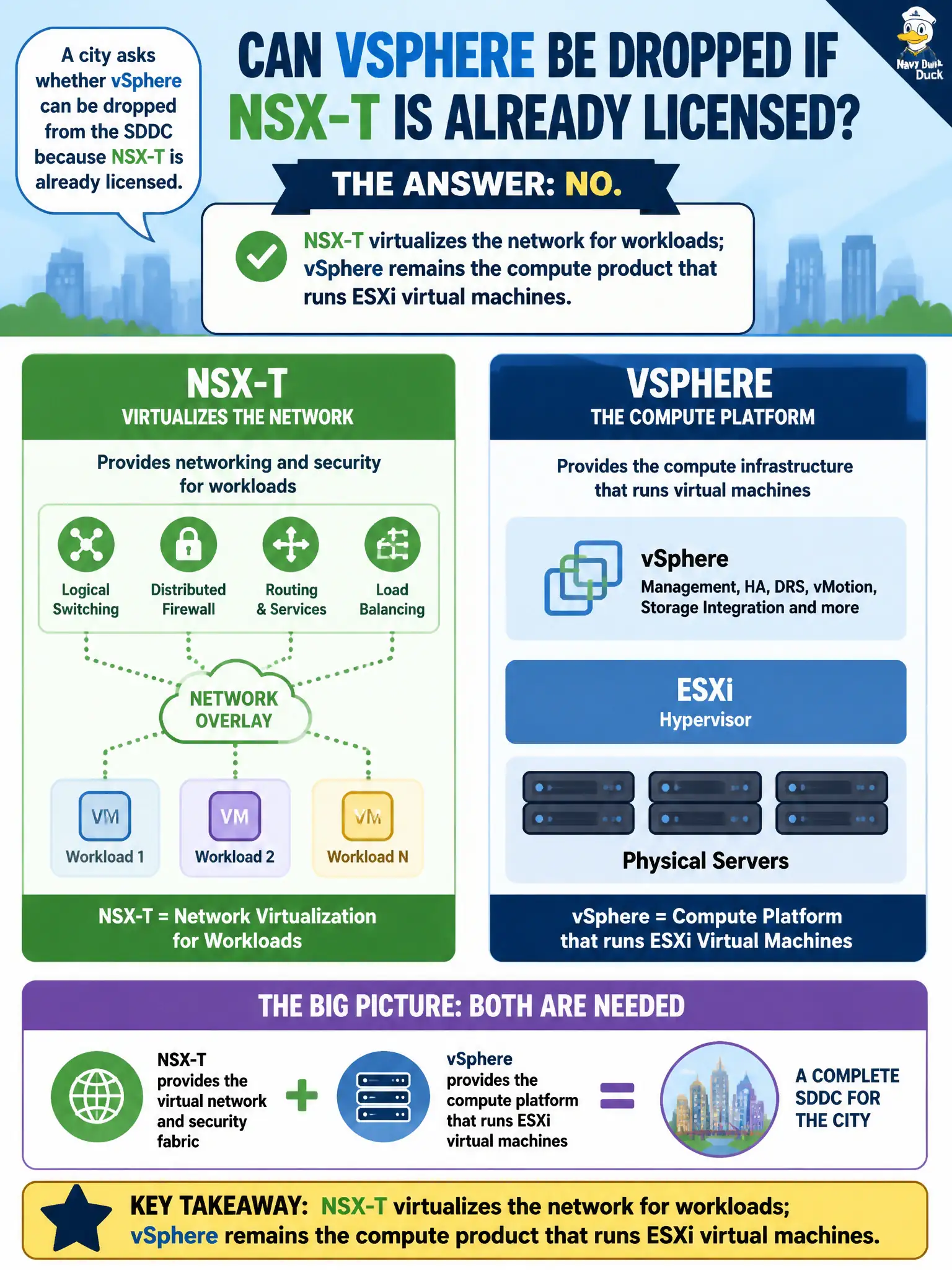
NSX paves virtual streets; it does not become the building the VMs live in. Those buildings still run on vSphere. Licensing NSX does not retire ESXi, and vSAN or Horizon does not take vSphere's compute job.
Full Explanation
A city asking whether vSphere can be dropped from the SDDC because NSX-T is already licensed must be told that NSX-T virtualizes the network for workloads while vSphere remains the compute product that runs ESXi virtual machines. NSX paves virtual streets; it does not become the building the VMs live in, and civic guests still need the hypervisor platform underneath those streets. Claiming NSX-T includes a hypervisor that replaces ESXi is incorrect for this associate framing—NSX prepares transport nodes on hypervisors such as ESXi rather than replacing the compute pillar. Claiming vSAN replaces both vSphere and NSX confuses software-defined storage with compute and network virtualization. Claiming Horizon replaces vSphere once desktops are published confuses end-user computing with the hypervisor platform that still hosts those desktops and server VMs. Exam caveat: licensing NSX does not retire vCenter or ESXi; in typical municipal designs NSX registers vCenter as a compute manager and prepares ESXi hosts as transport nodes. Operational check: verify ESXi hosts still run the VMs, vCenter still manages clusters, and NSX Manager shows those hosts as transport nodes—three cooperating products, not a single license that deletes compute—and record that dependency in the license and architecture brief for council review.