
Library IT asks whether NSX Intelligence is a required fourth SDDC pillar alongside vSphere, vSAN, and NSX. How should that product be identified?
Select an answer to reveal the explanation.
Short Explanation
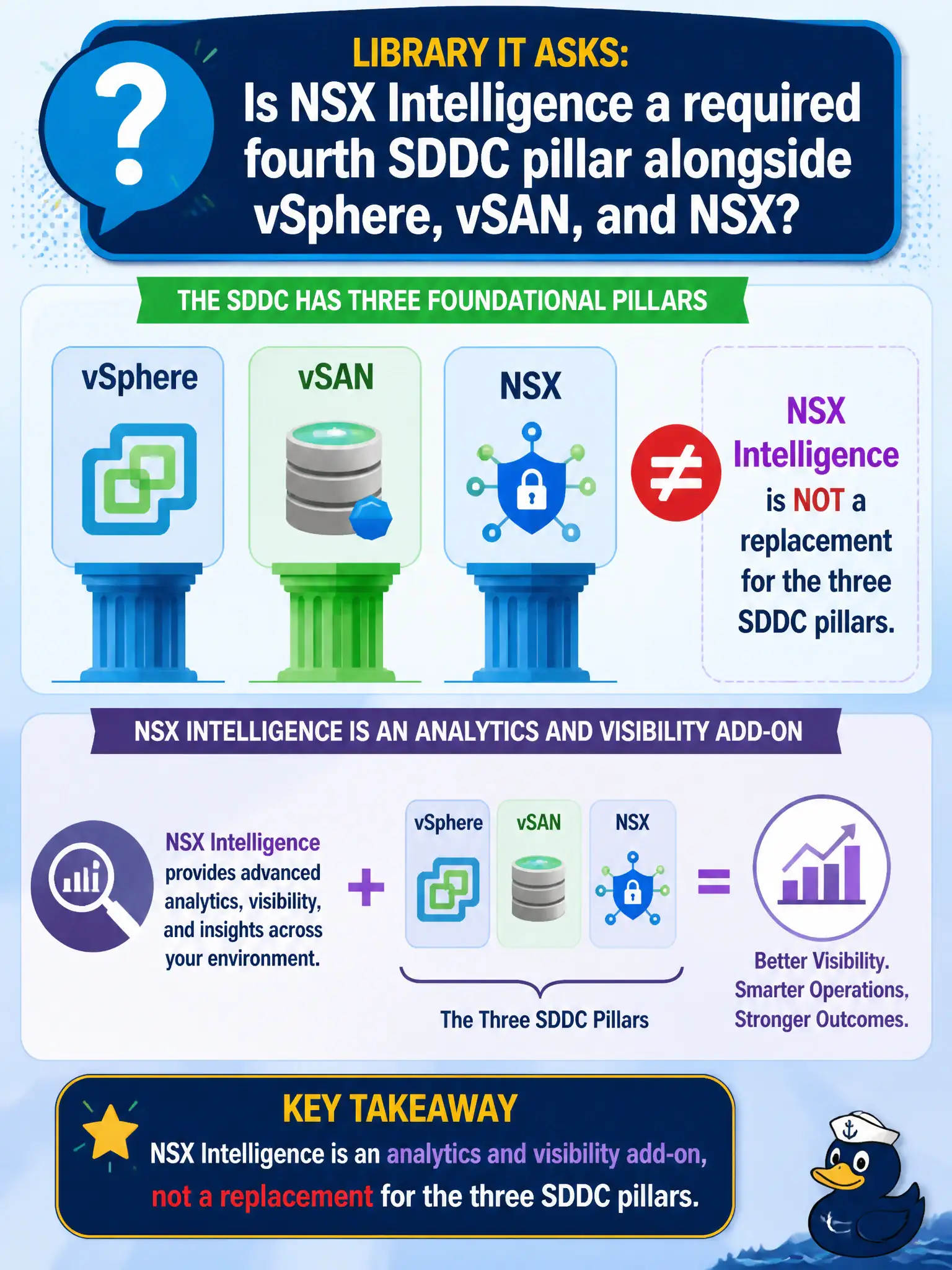
Intelligence is a flow-analytics add-on, like a traffic-study report on the civic overlay. It is not a fourth pillar and it does not replace vSphere, vSAN, or NSX-T. It is not the hypervisor or the datastore.
Full Explanation
Library IT asking whether NSX Intelligence is a required fourth SDDC pillar alongside vSphere, vSAN, and NSX should hear that NSX Intelligence is an analytics and visibility add-on, not a replacement for the three SDDC pillars. Intelligence is like a traffic-study report on the civic overlay: it visualizes east-west flows and can recommend Distributed Firewall policies, but it is not a fourth mandatory pillar and it does not replace compute, storage, or the base NSX fabric. NSX Intelligence is not the ESXi hypervisor, not the required storage product instead of vSAN, and not “the only network product” that makes NSX-T optional—without NSX, Intelligence has no fabric context to analyze in that product sense. Exam caveat: add-ons and analytics improve operations and security posture; associate exams still expect the core three pillars to be named correctly when architecture stacks are tested. Do not inflate Intelligence into a pillar that retires NSX-T or vSphere. Operational check: if the library deploys Intelligence, confirm NSX-T is already in place with prepared hosts and segments, then use Intelligence views for east-west visibility and recommended policies; keep vSphere and vSAN labeled as compute and storage pillars on the architecture slide and in the BOM.