
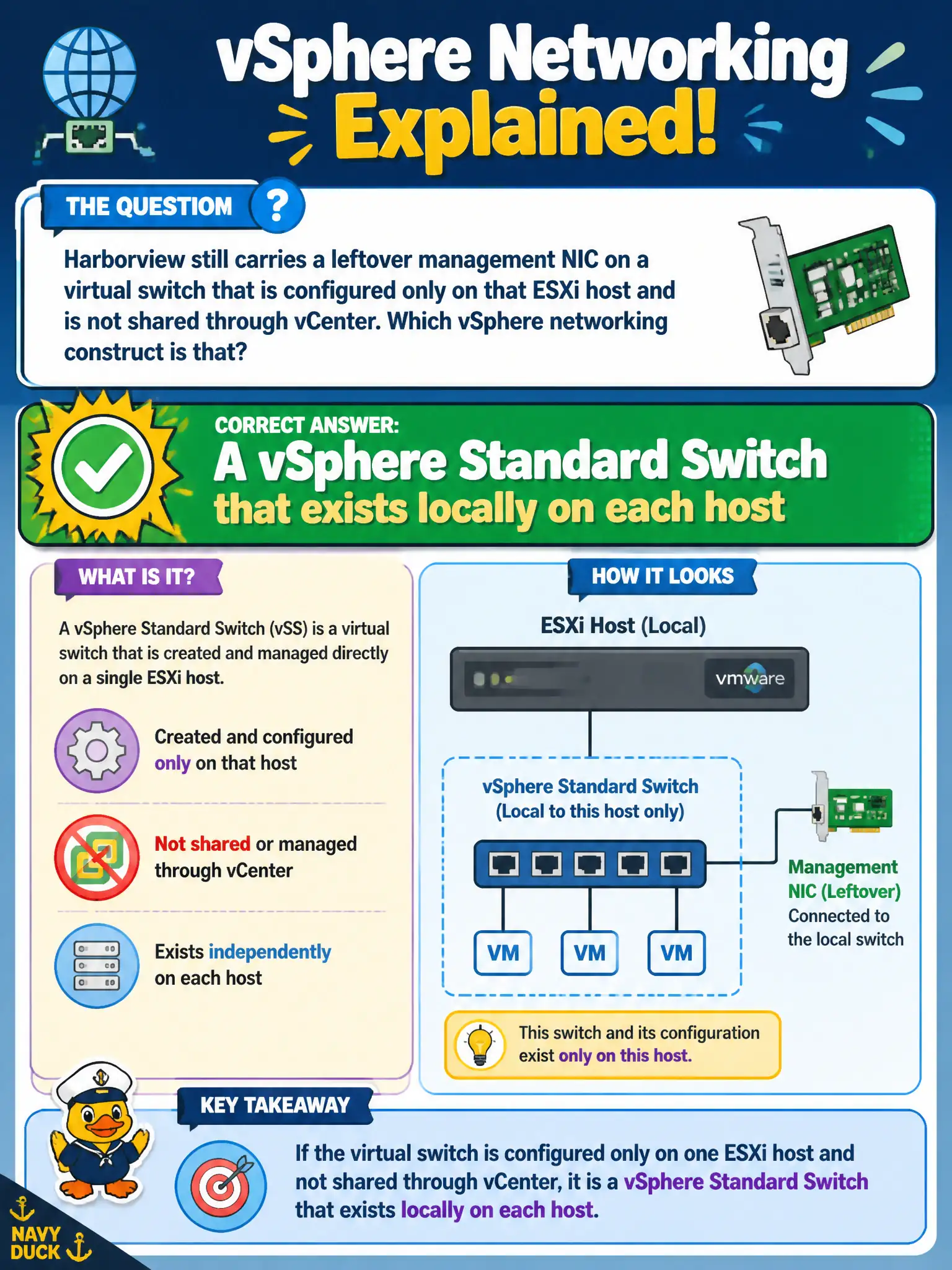
Harborview still carries a leftover management NIC on a virtual switch that is configured only on that ESXi host and is not shared through vCenter. Which vSphere networking construct is that?
Select an answer to reveal the explanation.
Short Explanation
Think of a standard switch as a light switch that only works in one room. Harborview's leftover management NIC lives on that host-local vSphere Standard Switch. A distributed switch is the cluster-wide plan, and an overlay segment or transport zone is NSX, not that per-host vSwitch.
Full Explanation
Harborview’s leftover management NIC sits on a virtual switch that exists only on that ESXi host and is not defined once in vCenter for the whole cluster. That construct is a vSphere Standard Switch (VSS): each host carries its own local switch and port groups, so configuration is per host rather than centrally shared. In civic terms, it is a light switch that works in one room only—useful for a leftover management NIC, but not a city-wide traffic plan. A vSphere Distributed Switch whose port groups are defined once for the whole cluster is the opposite pattern: centralized configuration applied to member hosts. An NSX overlay segment that encapsulates Geneve traffic for tenant VMs is an NSX logical network object, not the host-local vSphere switch type named in the question. An NSX transport zone lists which prepared hosts may attach to overlay or VLAN-backed NSX networks; it does not create the leftover per-host VSS. Exam caveat: associates must distinguish VSS (host-local) from VDS (vCenter-centralized) before introducing NSX host-switch preparation; leftover management on a VSS is still common and is not automatically an overlay segment. Operational check: in the ESXi host client or vCenter Networking view for that single host, confirm a Standard Switch and local port group bind the management NIC; verify the same switch object is not listed as a cluster-wide Distributed Switch shared by peer hosts.