
The city design shows two transport-zone types on the same NSX-T fabric. How do those SDN span constructs differ?
Select an answer to reveal the explanation.
Short Explanation
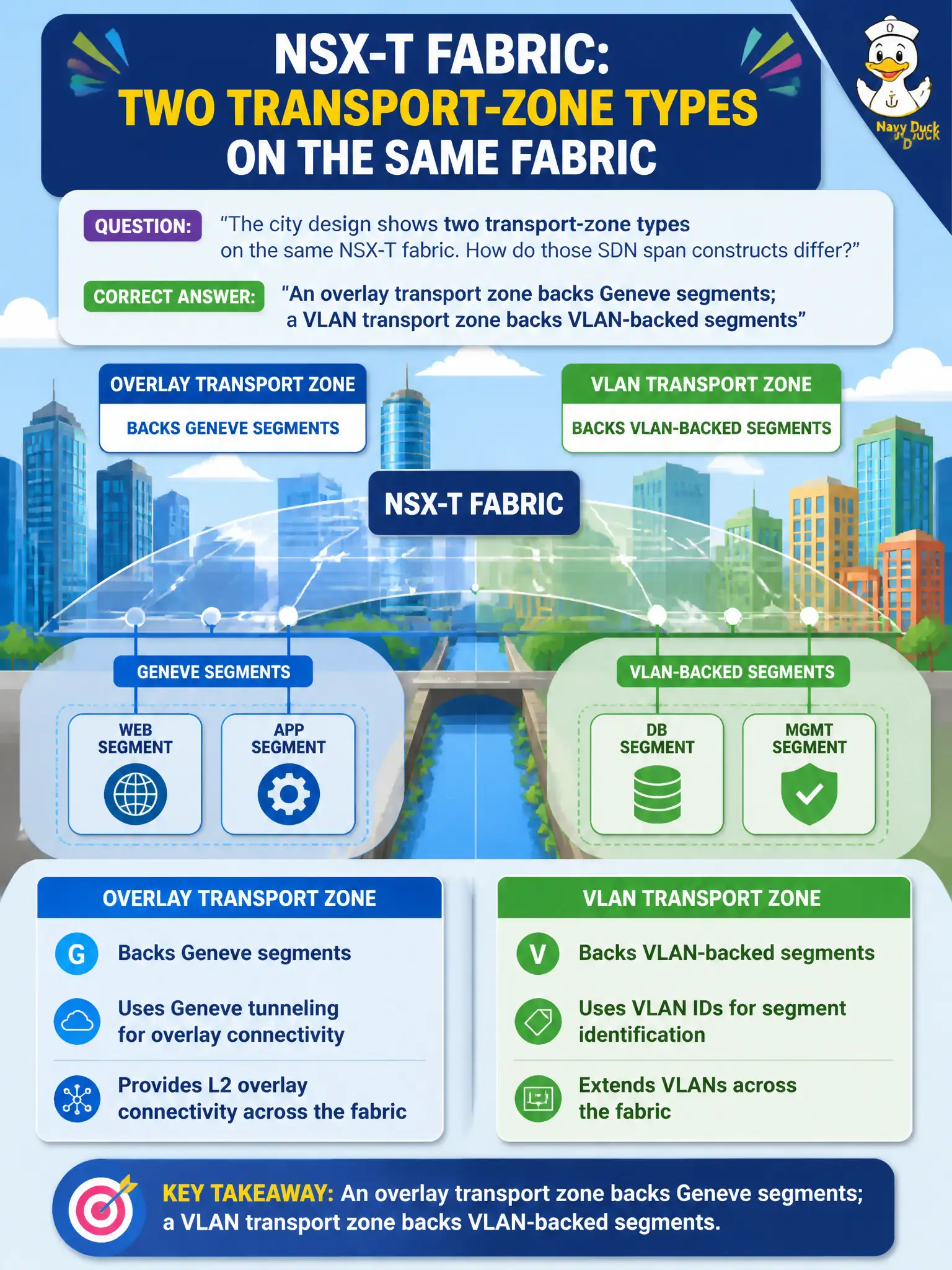
Same kind of map, two kinds of pavement: overlay zones carry Geneve segments, VLAN zones carry VLAN-backed segments. Neither map is Horizon, Carbon Black, vSAN, or a plain vSphere port group by definition.
Full Explanation
On the same NSX-T fabric the city can define two transport-zone types as SDN span constructs for different segment classes. An overlay transport zone is the membership map for Geneve-backed segments, while a VLAN transport zone is the membership map for VLAN-backed segments that ride tagged underlay VLANs. Both answer “which transport nodes may host this segment,” but they differ in how guest frames are carried on the physical network. Overlay zones are not Horizon desktop networks, and VLAN zones are not Carbon Black quarantine constructs. Neither zone type is merely an ordinary vSphere port group with no NSX backing. Overlay zones are also not vSAN fault domains, and VLAN zones are not iSCSI targets; those storage ideas do not define NSX segment span. Exam caveat: a host may join multiple transport zones when the design needs both Geneve and VLAN-backed segments. Do not assume one zone type replaces the other for every municipal use case. Operational check: inventory transport zones by type in NSX Manager, place a Geneve segment only in an overlay zone and a VLAN-backed segment only in a VLAN zone, then verify VMs can attach only on transport nodes that are members of the matching zone.