
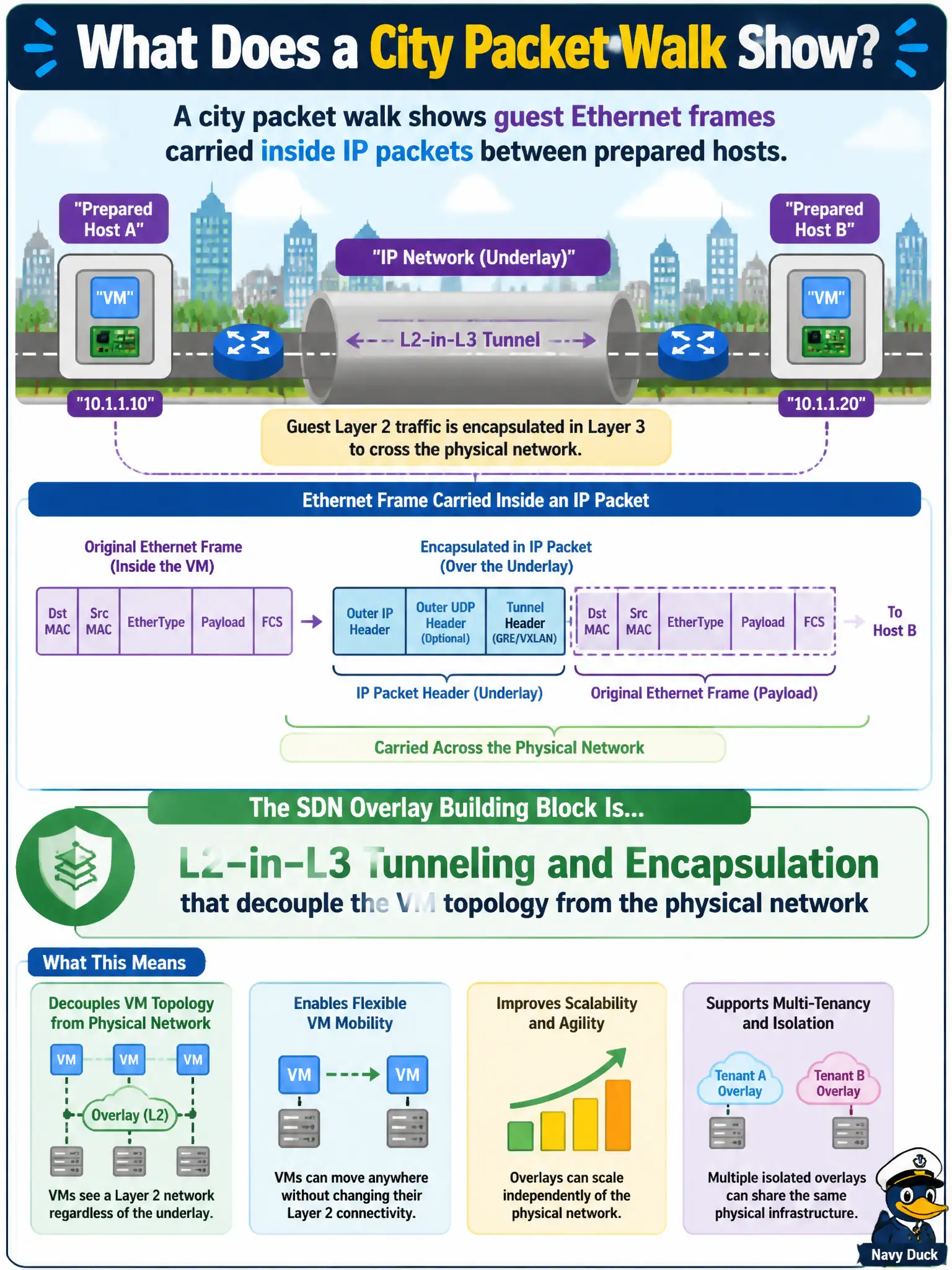
A city packet walk shows guest Ethernet frames carried inside IP packets between prepared hosts. Which SDN overlay building block is that?
Select an answer to reveal the explanation.
Short Explanation
Overlay is stuffing a neighborhood letter inside a city-mail envelope so it can ride any street. The guest Ethernet frame goes inside an IP packet—tunneling—not a snapshot, a display protocol, or a threat event.
Full Explanation
When a city packet walk shows guest Ethernet frames carried inside IP packets between prepared hosts, the SDN overlay building block is Layer-2-in-Layer-3 tunneling and encapsulation. That encapsulation—Geneve in NSX-T—decouples the VM topology from the physical underlay so civic logical networks can span racks without stretching tenant VLANs everywhere. A vSphere snapshot freezes virtual-machine disk (and optionally memory) state on storage; it does not encapsulate live frames between hosts. Horizon BLAST remotes an interactive desktop session to a client; it is a display protocol, not overlay tunneling for guest Ethernet. Carbon Black event forwarding ships endpoint telemetry to the cloud and does not create Geneve tunnels between TEPs. Exam caveat: identify the overlay concept (L2-in-L3 encapsulation) rather than memorizing every Geneve header field. Overlay still requires underlay IP connectivity and adequate MTU between tunnel endpoints. Operational check: capture or trace traffic between two overlay-attached VMs on different hosts and confirm Geneve (or equivalent overlay) encapsulation between TEP addresses, while verifying snapshots, BLAST, and sensor forwarding are not the path carrying those guest frames.