
City Wi-Fi for guest, staff, and IoT each required more VLANs trunked to every access layer, and the same pattern is spreading in the data center. Which traditional challenge do overlays reduce there?
Select an answer to reveal the explanation.
Short Explanation
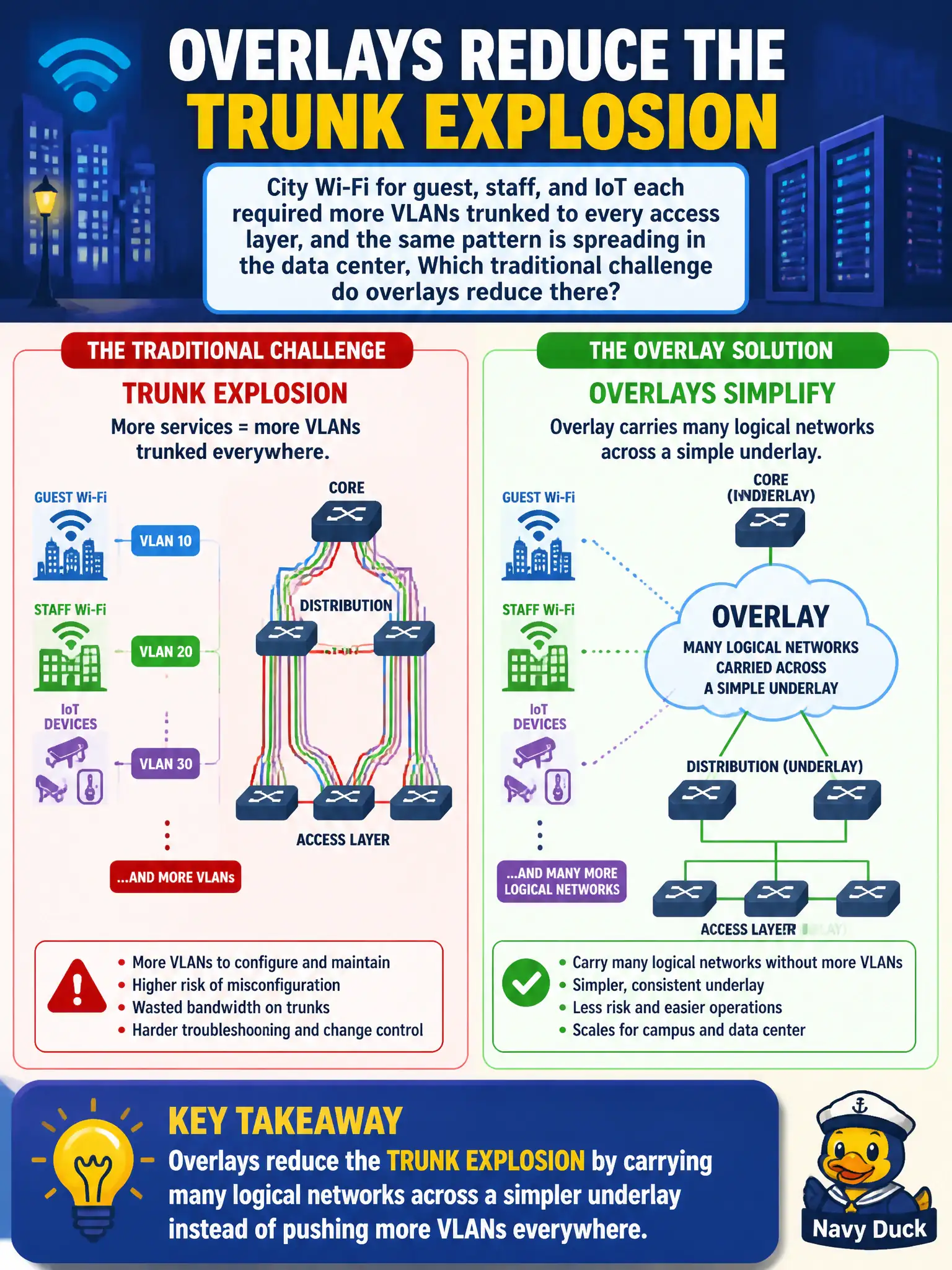
Trunk explosion is spraying a new VLAN down every switch because each Wi-Fi class wanted its own tag. In the data center, overlays ride a small underlay instead of a fat trunk of every tenant VLAN. Guest, staff, and IoT logical nets should not each become another citywide trunk.
Full Explanation
Trunk explosion happens when guest, staff, and IoT each push more VLANs trunked everywhere, a pattern that also spreads in the data center. Overlays reduce that challenge by carrying many logical networks across a simpler underlay instead of pushing more VLANs to every ToR. Overlays do not require every logical network to be trunked to every ToR. Horizon Client networks do not replace overlays via access-switch trunks. IoT isolation does not require a unique VLAN on every city access port as the only design. Exam caveat: underlay still needs carefully chosen VLANs for VTEPs; the win is not zero VLANs but far less tenant VLAN sprawl. Operational check: count tenant VLANs trunked to a civic ToR before and after moving workloads to overlay segments and confirm trunk lists shrink. Keep municipal naming and change tickets aligned with the software objects so civic audits can trace intent. Prefer verifying with a non-production agency workload before promoting the same pattern to life-safety systems. Record realization state and underlay health in the runbook used by on-call city operators. Keep municipal naming and change tickets aligned with the software objects so civic audits can trace intent.