
City auditors ask what still lives on physical hardware in an on-premises software-defined data center. What should the candidate identify?
Select an answer to reveal the explanation.
Short Explanation
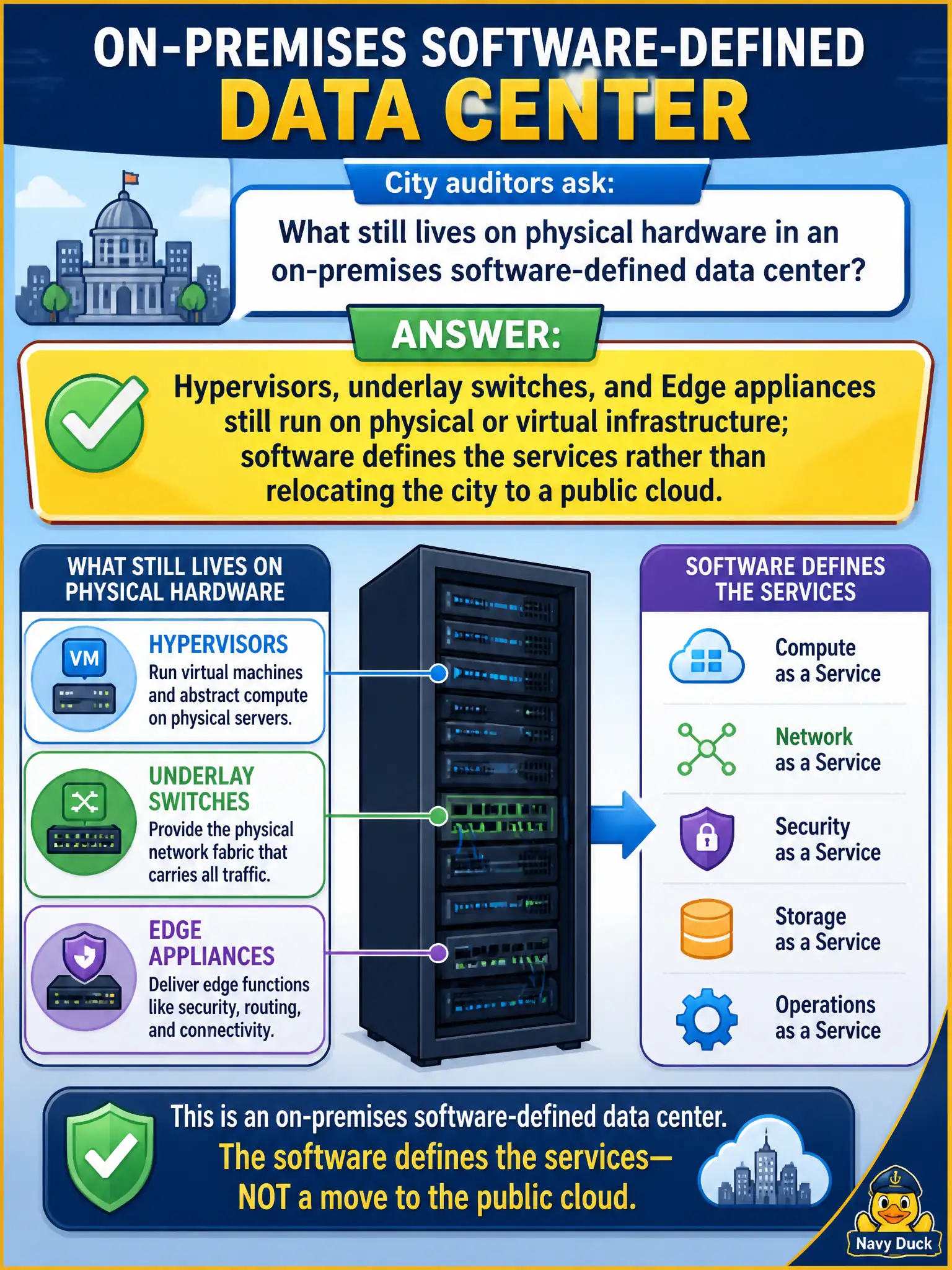
Software-defined is not “the city vanished into a public API.” Hosts, underlay switches, and Edge boxes are still there. Software defines the services on that hardware.
Full Explanation
In an on-premises SDDC, hypervisors, underlay switches, and Edge appliances still run on physical or virtual infrastructure; software defines the services rather than relocating the city to a public cloud. Auditors should expect tangible hosts and networks that deliver software-defined compute, storage, and networking services. Claiming nothing physical remains and the data center exists only as a SaaS mailbox is false. Saying only Horizon Connection Servers remain denies NSX underlay and Edges. Replacing physical hardware entirely with Carbon Black Cloud confuses endpoint security SaaS with data-center infrastructure. Exam caveat: "software-defined" describes how services are created and operated, not a promise of zero hardware. Operational check: inventory ESXi hosts, underlay switches, and NSX Edge nodes that back the civic SDDC and show auditors which services those platforms deliver as software objects. Keep municipal naming and change tickets aligned with the software objects so civic audits can trace intent. Prefer verifying with a non-production agency workload before promoting the same pattern to life-safety systems. Record realization state and underlay health in the runbook used by on-call city operators.