
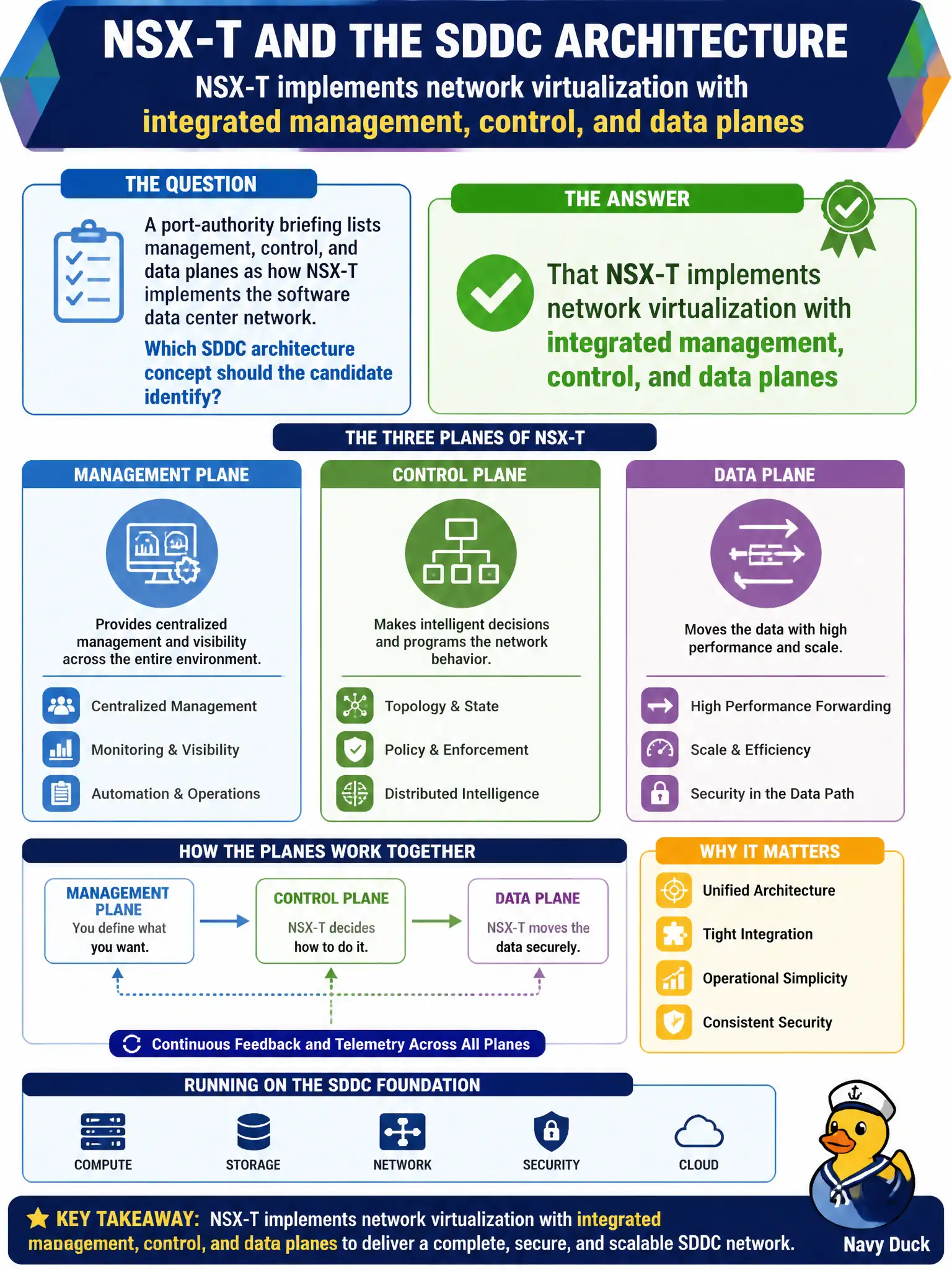
A port-authority briefing lists management, control, and data planes as how NSX-T implements the software data center network. Which SDDC architecture concept should the candidate identify?
Select an answer to reveal the explanation.
Short Explanation
NSX-T is not one magic box. Management, control, and data planes work together the way a city has a clerk’s office, a dispatcher, and the trucks on the road.
Full Explanation
NSX-T implements network virtualization with integrated management, control, and data planes. A port-authority briefing that lists those planes is identifying the SDN architecture model: management for UI/API and desired configuration, control for computing runtime state, and data for forwarding on hosts and Edges. NSX-T is not management-only with no data plane. Those planes are not Horizon Cloud Pod Architecture roles. They are not Carbon Black, Workspace ONE, and vSAN. Exam caveat: in NSX-T the Manager cluster consolidates management and central control functions, while local control and data plane components still run on transport nodes—knowing the plane names matters more than appliance folklore. Operational check: on a civic whiteboard, map NSX Manager UI/API to management, runtime distribution to control, and host/Edge forwarding to data plane, then confirm packet path troubleshooting starts at the data plane with config checked at management. Keep municipal naming and change tickets aligned with the software objects so civic audits can trace intent. Prefer verifying with a non-production agency workload before promoting the same pattern to life-safety systems. Record realization state and underlay health in the runbook used by on-call city operators.