
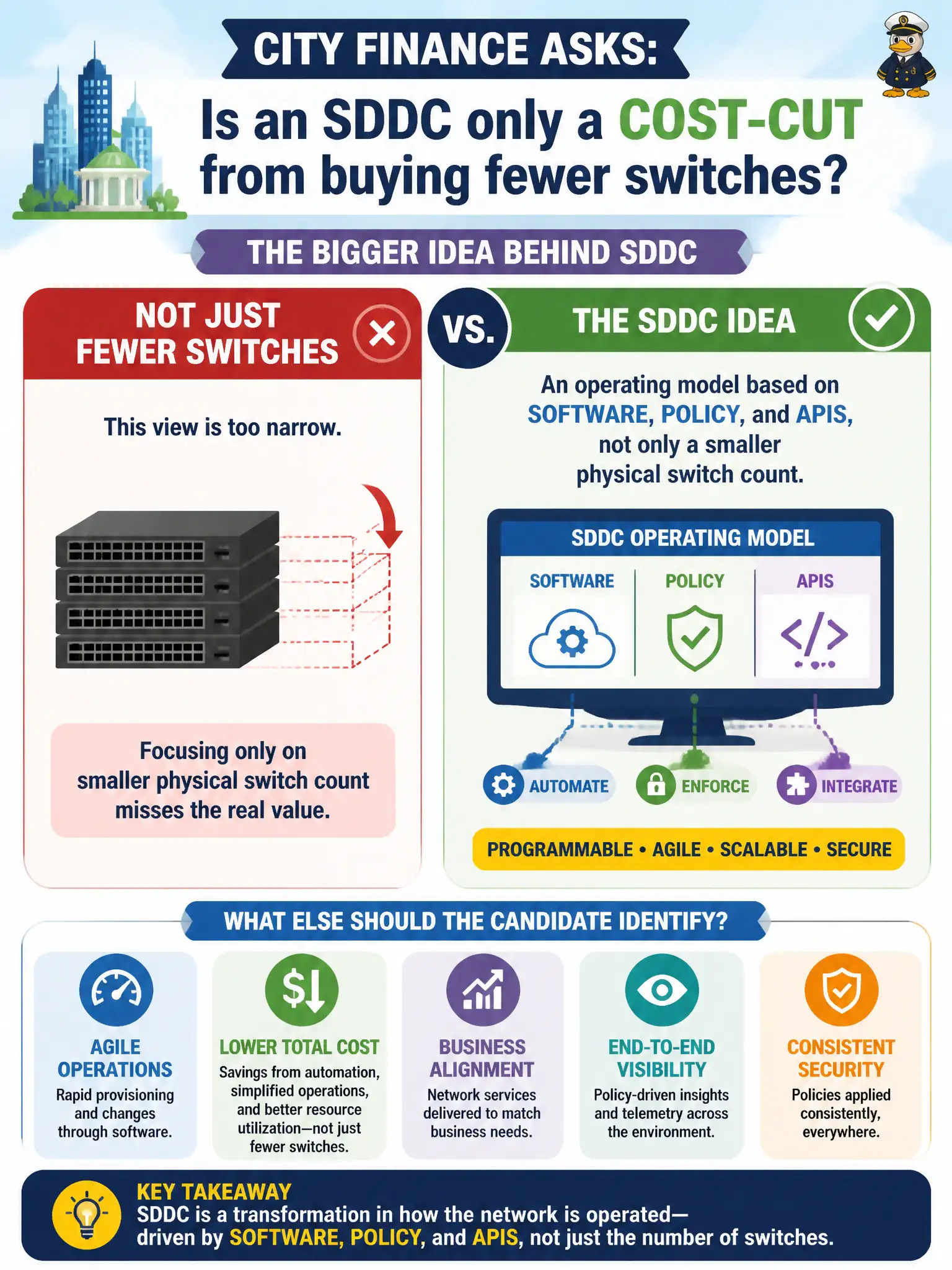
City finance asks whether an SDDC is only a cost-cut from buying fewer switches. What else should the candidate identify as part of the SDDC idea?
Select an answer to reveal the explanation.
Short Explanation
Fewer switches can be a side effect, not the whole story. An SDDC is how the city runs: policy, APIs, and software services—not just a smaller hardware invoice.
Full Explanation
An SDDC is an operating model based on software, policy, and APIs, not only a smaller physical switch count. City finance may see fewer chassis over time, but the defining idea is that civic infrastructure services are created, governed, and changed as software rather than as unique hardware projects. Treating decommissioned top-of-rack count as the only metric misses agility, micro-segmentation, and automation. Completing SDDC merely by moving email to SaaS leaves the fabric hardware-defined. Equating the operating model with Horizon application publishing confuses EUC delivery with network and infrastructure policy. Exam caveat: cost reduction can be a benefit, yet exam answers emphasize the software-defined operating model across compute, storage, and networking. Operational check: ask finance and ops whether a new agency environment can be stood up primarily through NSX/vSphere APIs and policy templates without a net-new physical design package; that is the SDDC operating-model test. Keep municipal naming and change tickets aligned with the software objects so civic audits can trace intent. Prefer verifying with a non-production agency workload before promoting the same pattern to life-safety systems.