
A city change-advisory board thinks an SDDC means operators never use switching or routing concepts again. What should the candidate identify?
Select an answer to reveal the explanation.
Short Explanation
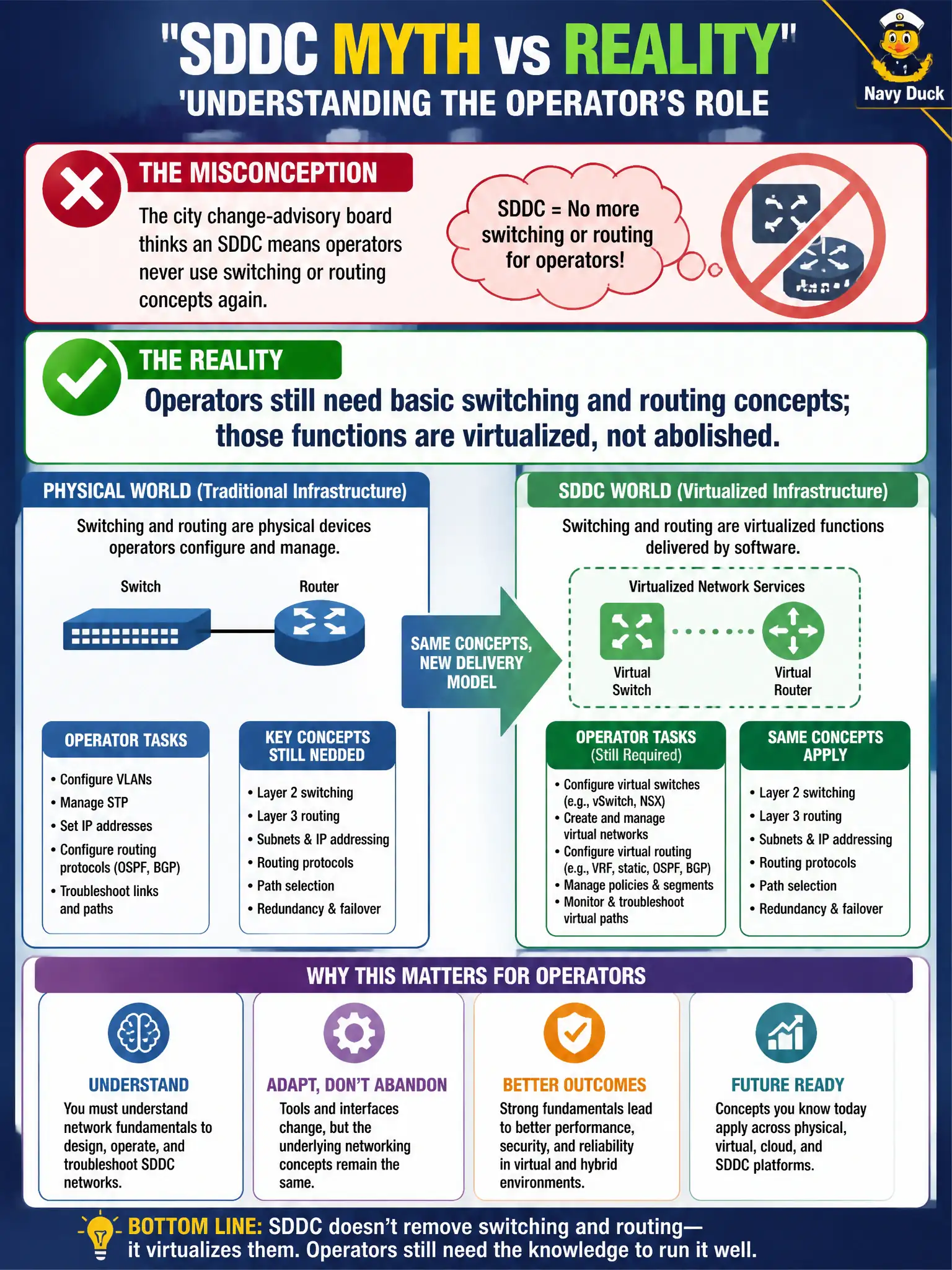
Virtualizing the network does not delete Ethernet and IP from the job. Operators still switch and route—they just do it as software services instead of only on a chassis.
Full Explanation
Operators still need basic switching and routing concepts in an SDDC; those functions are virtualized, not abolished. Segments still provide Layer-2 domains, gateways still route between them, and troubleshooting still uses MAC, ARP, IP, and route logic—just applied to software objects and overlays. The change-advisory board is wrong if it thinks Ethernet and IP knowledge disappear when the city virtualizes the fabric. Abolishing switching and routing in favor of only Carbon Black tags removes the networking model rather than virtualizing it. Ignoring Layer 2 and Layer 3 because Horizon handles isolation confuses EUC with data-center networking. Claiming switching and routing apply only on physical chassis denies the purpose of NSX logical switching and routing. Exam caveat: some operational details differ (encapsulation, VTEPs, distributed routers), but fundamentals remain exam-relevant for VCTA-level design and ops questions. Operational check: have an operator explain how a VM on segment A reaches a VM on segment B through a Tier-1/Tier-0 path using switching and routing vocabulary against NSX objects, not only against a chassis CLI. Keep municipal naming and change tickets aligned with the software objects so civic audits can trace intent.