
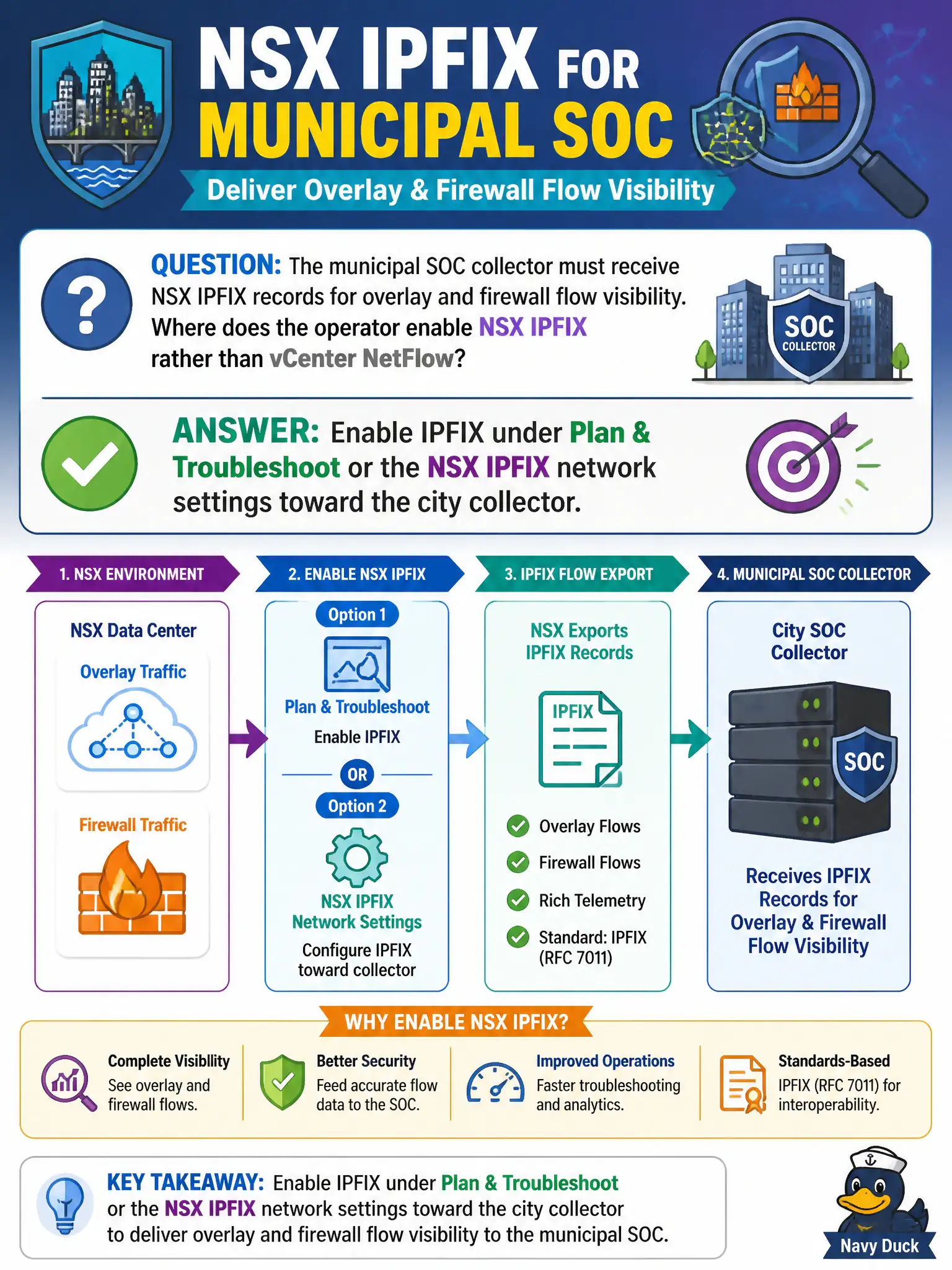
The municipal SOC collector must receive NSX IPFIX records for overlay and firewall flow visibility. Where does the operator enable NSX IPFIX rather than vCenter NetFlow?
Select an answer to reveal the explanation.
Short Explanation
NSX IPFIX is the city’s own flow postcard, mailed from NSX Manager’s Plan & Troubleshoot (or NSX IPFIX settings) to the SOC. vSphere NetFlow, Horizon Blast, and the ISP router are different mailboxes.
Full Explanation
The municipal SOC collector needs NSX IPFIX for overlay and firewall flow visibility. Operators enable IPFIX under Plan & Troubleshoot or the NSX IPFIX network settings toward the city collector—NSX’s flow-export method—rather than substituting vCenter NetFlow on a compute VDS. Enabling vSphere distributed-switch NetFlow is a vSphere NetFlow path; the question asks for the NSX IPFIX method toward the civic collector. Horizon Blast UDP metrics are display-protocol telemetry, not NSX IPFIX records. Exporting BGP communities from the ISP router provides routing policy signals, not NSX overlay/firewall IPFIX. Exam caveat: collector IP, port, and domain (switch/firewall IPFIX) must match SOC expectations; mis-pointed exporters silently starve the municipal SOC of NSX visibility. Operational check: configure NSX IPFIX to the SOC collector, confirm packets arrive (or collector shows NSX exporters), sample a known library/utility flow, and document exporter settings in the SOC onboarding runbook. In municipal operations, record the chosen control and the rejected alternatives in the change ticket so future on-call staff understand which failure modes would affect city services. Re-validate after the next maintenance window that the same GUI path and realized state still hold under the current NSX build used by the civic platform team.