
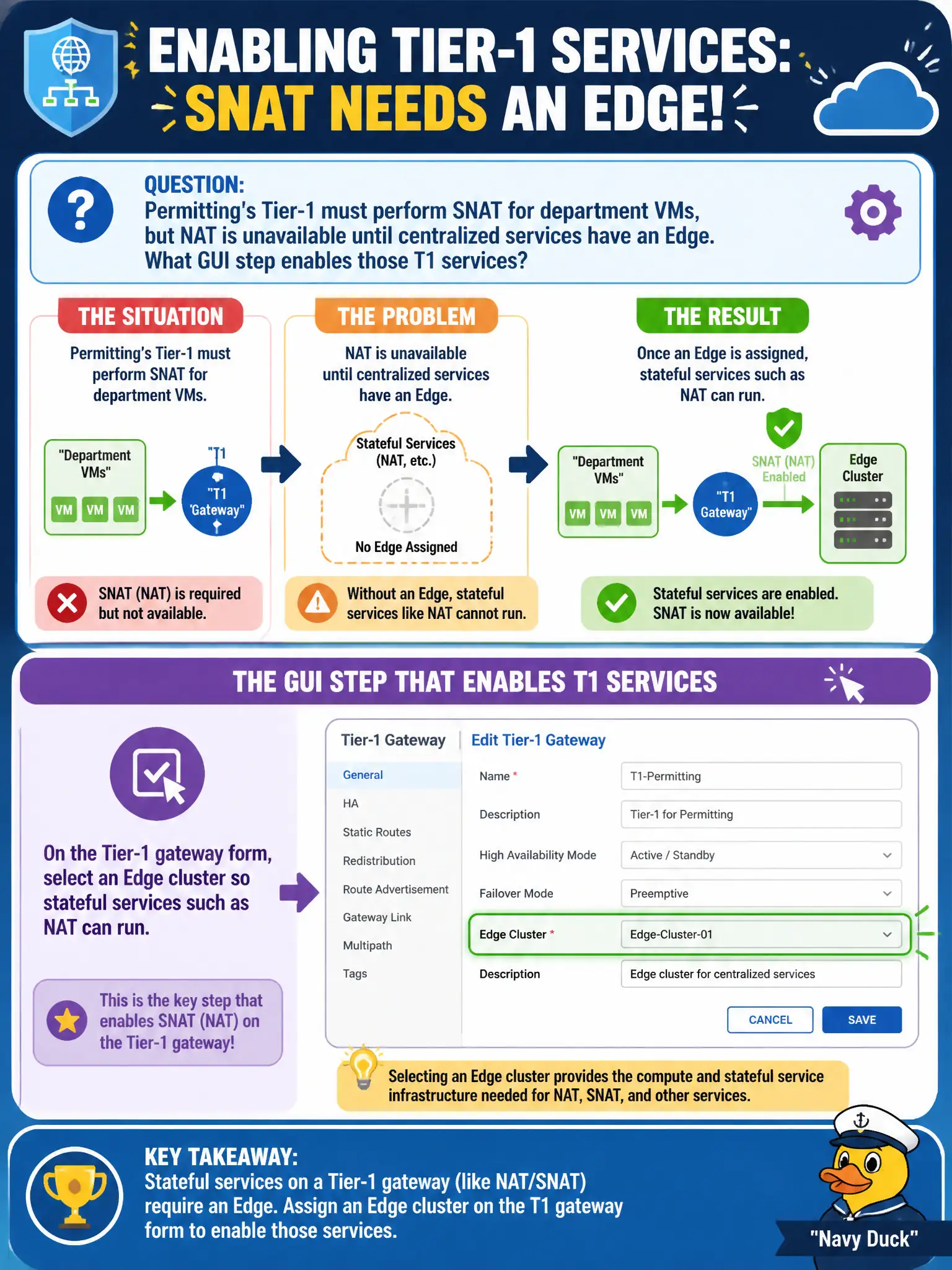
Permitting's Tier-1 must perform SNAT for department VMs, but NAT is unavailable until centralized services have an Edge. What GUI step enables those T1 services?
Select an answer to reveal the explanation.
Short Explanation
Distributed routing can happen on every host, but NAT is a stateful service that needs an Edge appliance—like a clerk who stamps passports. On the T1 form, pick an Edge cluster.
Full Explanation
Permitting’s Tier-1 needs an Edge cluster selected on the Tier-1 gateway form before stateful centralized services such as SNAT can run. Without that Edge association, NAT remains unavailable because stateful T1 services are realized on Edge nodes—the civic loading dock for SNAT—not solely in the distributed router. Tagging the Tier-1 “NAT” in Inventory does not start SNAT without Edges. Attaching a Tier-1 only to a vSphere Standard Switch port group is not how NSX enables T1 NAT services. Identity Firewall is AD-based DFW identity, not an Active Directory feature that replaces Edge-hosted NAT. Exam caveat: distributed routing on Tier-1 can exist without centralized services; SNAT/DNAT/load balancing require the Edge cluster field and successful Edge realization. Operational check: edit the permitting Tier-1, select the correct Edge cluster, publish, confirm service status, configure SNAT for department VMs, and test outbound translation; record Edge cluster name on the Tier-1 design worksheet. After Edge association, confirm the Tier-1 shows the centralized service status as successful before creating SNAT rules; failed Edge placement leaves permitting VMs without the expected public translation.