
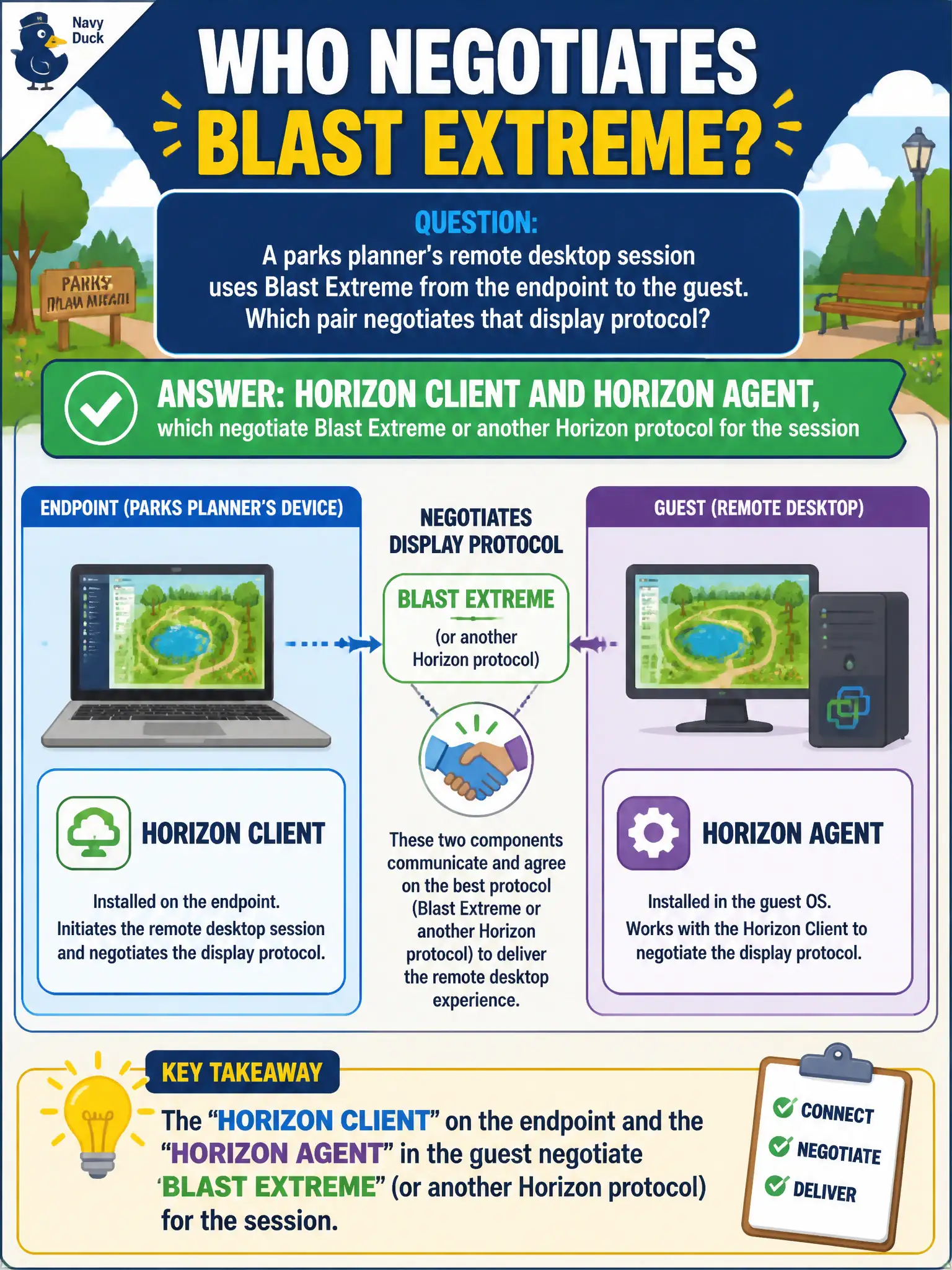
A parks planner's remote desktop session uses Blast Extreme from the endpoint to the guest. Which pair negotiates that display protocol?
Select an answer to reveal the explanation.
Short Explanation
Blast is a conversation between Horizon Client on the planner's endpoint and Horizon Agent in the desktop. Tunnel is a VPN straw, not a display protocol. Hub check-in and Boxer mail do not paint the screen.
Full Explanation
When a parks planner’s remote desktop session uses Blast Extreme from the endpoint to the guest, the pair that negotiates that display protocol is Horizon Client and Horizon Agent. Blast is a conversation between Horizon Client on the planner’s endpoint and Horizon Agent in the virtual desktop or RDSH host. Workspace ONE Tunnel and the UEM device profile fail by concept: Tunnel is a per-app VPN path for UEM-managed apps, not the VDI display protocol, and a UEM profile does not negotiate Blast. Intelligent Hub and AirWatch Cloud Connector fail because Hub handles digital-workspace enrollment/catalog experiences and ACC serves on-premises UEM connectivity—neither encapsulates Blast inside an MDM check-in as the session protocol. Workspace ONE Boxer and a Unified Access Gateway email notification service fail because Boxer is mail/calendar/contacts and email notifications are unrelated to display-protocol negotiation; UAG may carry Horizon traffic at the edge but does not replace Client-to-Agent protocol negotiation. Exam caveat: UAG can sit on the external path for Blast traffic, yet the protocol endpoints remain Client and Agent; confusing VPN, MDM check-in, or mail with Blast negotiation is a frequent trap. Operational check: start a parks planner session, confirm Horizon Client and Horizon Agent negotiate Blast Extreme (or the configured protocol), and verify Tunnel, Hub/ACC check-in, and Boxer are not the protocol pair.