
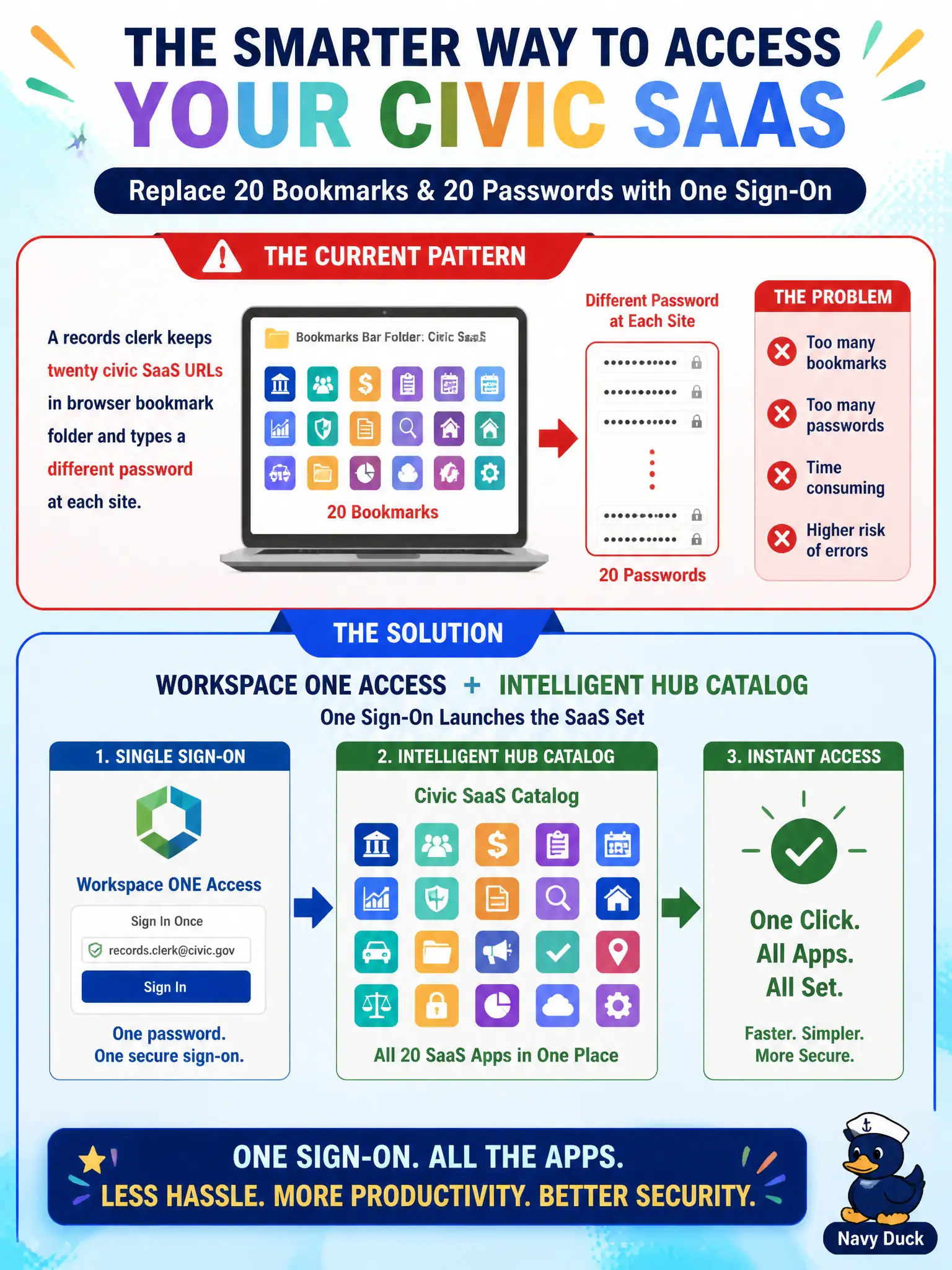
A records clerk keeps twenty civic SaaS URLs in a browser bookmark folder and types a different password at each site. Which product pair is meant to replace that pattern?
Select an answer to reveal the explanation.
Short Explanation
Twenty sticky-note passwords is the old clerk drawer. Access plus Hub is one badge and one catalog of those SaaS doors. GPU VDI, HA, and captured EXEs do not retire the bookmark folder.
Full Explanation
A records clerk who keeps twenty civic SaaS URLs in a browser bookmark folder and types a different password at each site should replace that pattern with Workspace ONE Access plus the Intelligent Hub catalog so one sign-on launches the SaaS set. The associate-level value of Access is identity federation and an SSO application catalog; Hub is the employee-facing launcher that presents those entitlements instead of sticky-note passwords. Twenty bookmarks is the old clerk drawer; Access plus Hub is one badge and one directory of SaaS doors. App Volumes plus a writable volume fails by concept: App Volumes captures and attaches Windows application packages—it does not turn SaaS URLs into EXE files or retire browser password sprawl for web SaaS. vSphere HA plus DRS fails because those features protect cluster compute and balance VMs; surviving a host failure does not give the clerk SSO or a managed catalog. Horizon Cloud on Azure plus a GPU-enabled pool fails because GPU VDI addresses graphics-heavy desktops, not the Access SSO problem of many SaaS passwords in bookmarks. Exam caveat: SSO quality still depends on federation or other integrations for each SaaS app in Access; merely installing Hub without entitling and integrating applications leaves the bookmark folder in place. Operational check: entitle the clerk’s SaaS set in Access, launch several from Intelligent Hub with one authentication, and confirm App Volumes, HA/DRS, and GPU pool settings are not what retired the per-site passwords.